Proofs of Tawhid
Thus Allah explains His mighty power in creating the heavens and the earth, and everything that is within them and between them. He says:
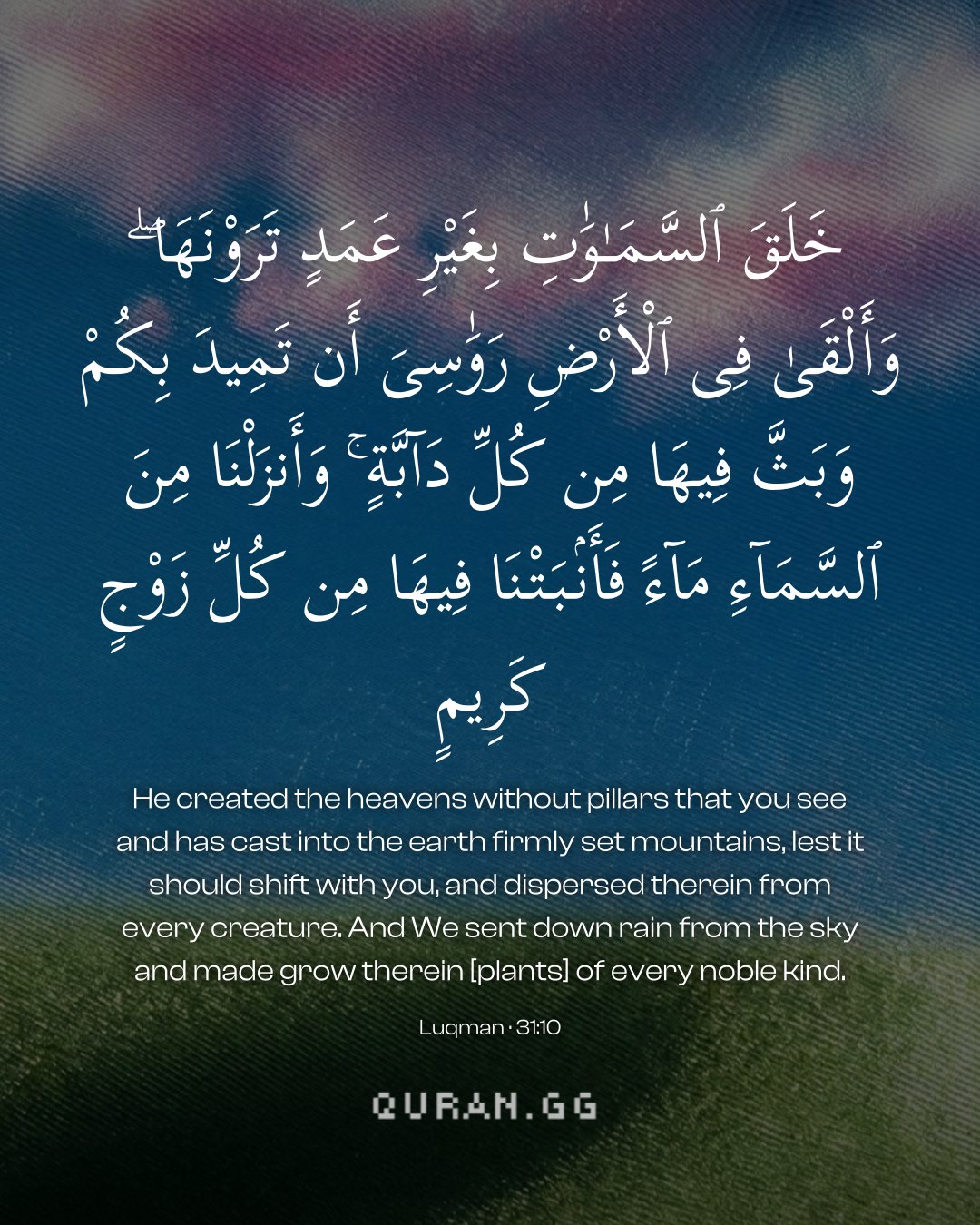
خَلَقَ السَّمَـوَتِ بِغَيْرِ عَمَدٍ
(He has created the heavens without any pillars) Al-Hasan and Qatadah said, "It does not have any pillars, visible or invisible."
وَأَلْقَى فِى الاٌّرْضِ رَوَاسِىَ
(and has set on the earth firm mountains) means, the mountains which stabilize and lend weight to the earth, lest it should shake with its water. Allah says:
أَن تَمِيدَ بِكُمْ
(lest it should shake with you.)
وَبَثَّ فِيهَا مِن كُلِّ دَآبَّةٍ
(And He has scattered therein moving creatures of all kinds) means, He has placed throughout it all kinds of animals, the total number of whose kinds and colors is known to no one except the One Who created them. When Allah tells us that He is the Creator, He also reminds us that He is the Provider, as He says:
وَأَنزَلْنَا مِنَ السَّمَآءِ مَآءً فَأَنْبَتْنَا فِيهَا مِن كُلِّ زَوْجٍ كَرِيمٍ
(And We send down water from the sky, and We cause (plants) of every goodly kind to grow therein in pairs,) meaning, every kind of good produce in pairs, i.e., they are beautiful to look at. Ash-Sha`bi said: "People are also produce of the earth, so whoever enters Paradise is goodly and whoever enters Hell is vile."
هَـذَا خَلْقُ اللَّهِ
(This is the creation of Allah.) means, all that Allah has mentioned here of the creation of the heavens and earth and everything in between stems from His power of creation and control alone, and He has no partner or associate in that, Allah says:
فَأَرُونِى مَاذَا خَلَقَ الَّذِينَ مِن دُونِهِ
(So, show Me that which those besides Him have created.) those idols and rivals whom you worship and call upon.
بَلِ الظَّـلِمُونَ
(Nay, the wrongdoers) means the idolators who associate others in worship with Allah
فِى ضَلَـلٍ
(in error) means, they are ignorant and blind.
مُّبِينٌ
(plain) means, it is clear and obvious, and not at all hidden.
Commentary
Verse 10 opens with the words: خَلَقَ السَّمَاوَاتِ بِغَيْرِ عَمَدٍ تَرَوْنَهَا (He has created the skies without the pillars that you may see). Another verse on the same subject: الَّذِي رَفَعَ السَّمَاوَاتِ بِغَيْرِ عَمَدٍ تَرَوْنَهَا (Allah is the One who raised the heavens without pillars. You see them. 13:2) has appeared earlier in Surah Ar-Ra` d ( with a different translation). Analyzed grammatically, the text admits two alternative meanings.
1. If we were to take تَرَوْنَهَا (tarawnah to be the attribute of عَمَدٍ ( ‘am-ad) and revert its pronoun to 'amad, it would mean that Allah Ta` a1a created the skies without pillars that you may see, that is, had the pillars been there, you would have seen them. When pillars are not seen, it is clear that this great roof of the sky has been erected without pillars. This explanation has been reported from Sayyidna Hasan and Qatadah. (Ibn Kathir)
2. And if we were to take the pronoun of: تَرَوْنَهَا (tarawnaha) as reverting to: السَّمَاوَاتِ (as-samawat: the skies) and this sentence as standing independently, then, it would mean that 'Allah Ta’ ala created the skies without pillars as you see.' Then, there is yet another option in the case of the first grammatical analysis whereby it could also be taken to mean that 'The skies stand on pillars that you cannot see - they are invisible.' This last explanation has been reported from Sayyidna Ibn ` Abbas, ` Ikrimah and Mujahid ؓ (IbnKathir).
No matter what the option, the verse does point out to the particular sign of the perfect power of Allah Ta’ ala that He has made this extensive, high and magnificent roof in a way that no column and pillar is seen there-under.
Utterances are of two types—one offering good advice and the other entertainment. The former make one realize one’s responsibilities and urge a man to do good rather than commit any impropriety. However, in every age those who have taken an interest in words of advice have indeed been very few. It has always been in the nature of man to prefer being entertained. Books which give good advice, are plentiful but he is always the more frequent purchaser of books which divert his mind and which do not demand any serious action on his part. The guilt of one who goes to the length of inducing others to indulge in purely entertaining (i.e.wasteful) pursuits is greater, because he has made himself the leader of dissipation, keeping people preoccupied with pointless activities and rendering them incapable of giving their attention to more serious affairs. Conceit is the worst trait in a man. If Truth presents itself before a conceited individual, he will not accept it, because he thinks too highly of himself. He will contemptuously overlook it and press on regardlessly. Just the opposite is true of the believers. Their advice-loving nature compels them to accept the truth and to surrender their life to it completely.
Uthmani text of the Madinah mushaf (King Fahd Complex). Translation: Saheeh International. Tafsir via Quran.com.