Luqman's Advice to His Son
Allah tells us how Luqman advised his son. His full name was Luqman bin `Anqa' bin Sadun, and his son's name was Tharan, according to a saying quoted by As-Suhayli. Allah describes him in the best terms, and states that he granted him wisdom. Luqman advised his son, the closest and most beloved of all people to him, who deserved to be given the best of his knowledge. So, Luqman started by advising him to worship Allah Alone, and not to associate anything with Him. Then he warned him:
إِنَّ الشِّرْكَ لَظُلْمٌ عَظِيمٌ
(Verily, joining others in worship with Allah is a great Zulm (wrong) indeed.) meaning, it is the greatest wrong. Al-Bukhari recorded that `Abdullah said: "When the Ayah
Continue reading the tafsir of ayahs 13–15Ma'arif al-Qur'an
Mufti Muhammad Shafi
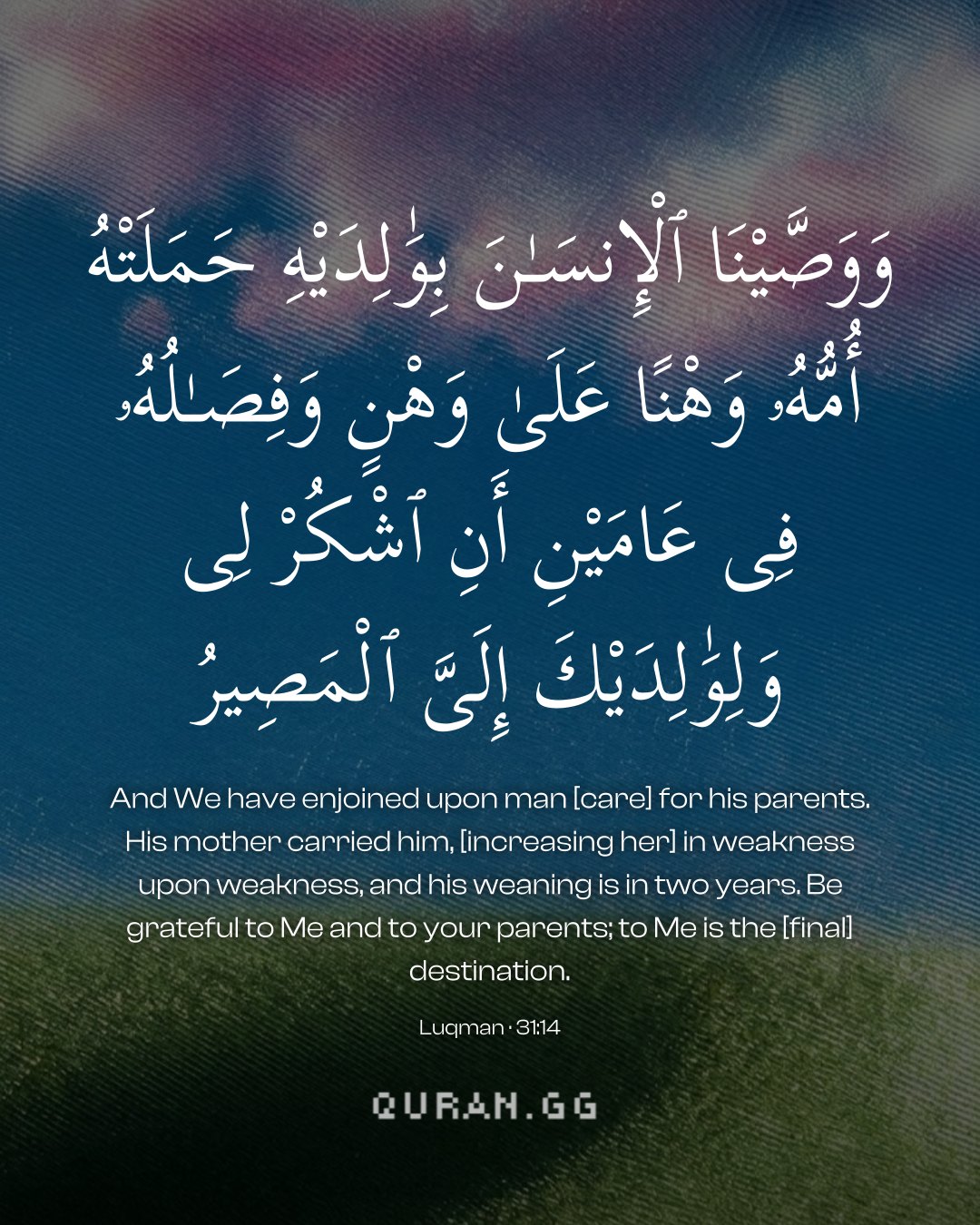
وَوَصَّيْنَا الْإِنسَانَ بِوَالِدَيْهِ حَمَلَتْهُ أُمُّهُ وَهْنًا عَلَىٰ وَهْنٍ وَفِصَالُهُ فِي عَامَيْنِ أَنِ اشْكُرْ لِي وَلِوَالِدَيْكَ إِلَيَّ الْمَصِيرُ ﴿14﴾ وَإِن جَاهَدَاكَ عَلَىٰ أَن تُشْرِكَ بِي مَا لَيْسَ لَكَ بِهِ عِلْمٌ فَلَا تُطِعْهُمَا ۖ وَصَاحِبْهُمَا فِي الدُّنْيَا مَعْرُوفًا ۖ وَاتَّبِعْ سَبِيلَ مَنْ أَنَابَ إِلَيَّ ۚ ثُمَّ إِلَيَّ مَرْجِعُكُمْ فَأُنَبِّئُكُم بِمَا كُنتُمْ تَعْمَلُونَ ﴿15﴾
And We commanded man (to be good) about his parents. His mother carried him facing weakness after weakness, and his weaning is in two years: "Be grateful to Me and to your parents. To Me is the ultimate return. [ 14] And if they force you to ascribe to Him partners about whom you have no knowledge, do not obey them. And be with them, in this world, with due fairness, and follow the way of the one who has turned himself towards Me. Then, towards Me is your return, so I shall tell you
about what you had been doing." [ 15]
Gratitude and Obedience to Parents is Obligatory - but, Obedience to anyone Counter to Divine Command is not Permissible
In effect, the command quoted above means: 'No doubt, We have asked children to be grateful and obedient to their parents. We have even commanded them to be grateful to Us, and along with it, to be grateful and obedient to their parents. But, Shirk (the ascribing of partners in the pristine divinity of Allah Ta’ ala) is so grave a transgression and so serious a sin that it does not become permissible for anyone, not even if one's parents command or force someone to commit it. If the parents of a person start forcing him or her to take someone as a partner of Allah Ta’ ala, even in that case, it is not permissible to obey their command.'
Now, at this place, where command has been given to be grateful to parents and fulfill their rights, also pointed out is its efficient cause. Is it not that one's mother has undergone great trial in the phenomena of his or her life and survival? She has kept the child in her body for nine months remaining vigilant and protective all the time. Because of this, day by day, her weakness and discomfort kept increasing. This she braved through. Then, even after the birth of the child, she handled the task of feeding the child, a task that demanded painstaking attention day and night and which also added to the already receding graph of her weakness. Since, it is the mother who faces most of the hardship in bringing up the child, therefore, the right of mother has been made to precede even the right of father in the Shari'ah of Islam. What has been said in: وَوَصَّيْنَا الْإِنسَانَ بِوَالِدَيْهِ حَمَلَتْهُ أُمُّهُ وَهْنًا عَلَىٰ وَهْنٍ وَفِصَالُهُ فِي عَامَيْنِ (And We commanded man [ to be good ] about his parents. His mother carried him facing weakness after weakness, and his weaning is in two years - 14) comes to mean exactly this. After that, in: وَإِن جَاهَدَاكَ (And if they force you - 15), it was pointed out that the matter of ascribing anyone other than Allah with Him is serious. In it, even the (otherwise essential) obedience to parents is haram (unlawful).
Islam's Peerless Law of Justice
Now in a situation under which the parents force a son or daughter to take to Shirk and Kufr while the command of Allah Ta’ ala tells them not to do what they say, things become difficult. One naturally fails to stay within limits. In this case, while implementing the Divine injunction, the probability did exist that the son or daughter would have used improper language or manners in their response to parents and thus insulted them. Islam is a law, just and equitable. Here, everything has a limit. Therefore, right along with the command of not obeying parents in matters of Shirk, also given there was the command:
Little has been recorded in history about Luqman, except that he was a wise and God-fearing man. The Quran says that Luqman was a grateful subject of God and who, as a father, advised his son to save himself from polytheism. Polytheism holds that beings other than God are man’s benefactors and that, man should direct his feelings of gratitude towards them. The belief in the oneness of God stems from the intense realisation that God is the sole benefactor of man and as such all his gratitude should be shown only to that One.
Uthmani text of the Madinah mushaf (King Fahd Complex). Translation: Saheeh International. Tafsir via Quran.com.