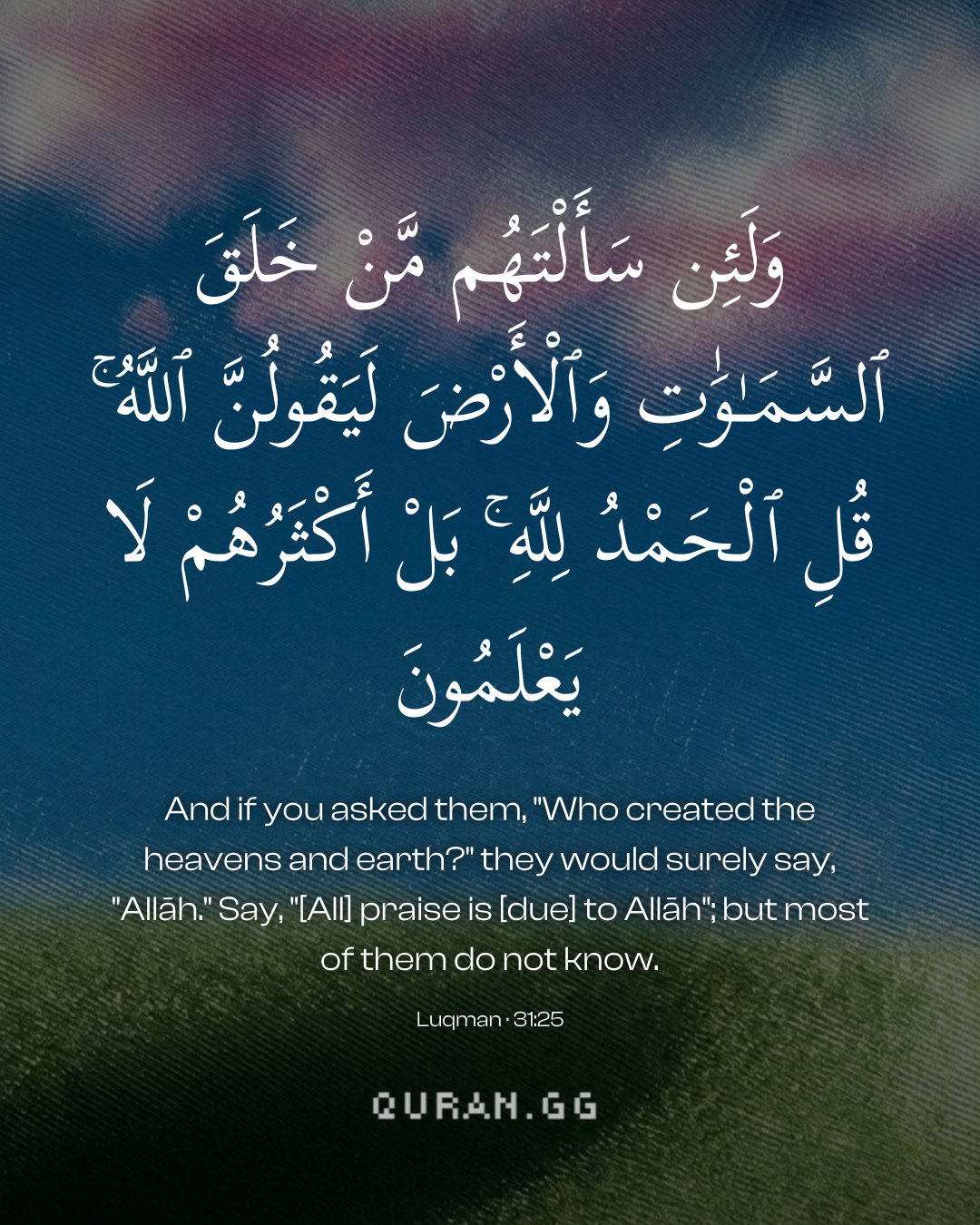
The Idolators admitted that Allah is the Creator
Allah tells us that these idolators who associated others with Him admitted that Allah Alone, with no partner or associate, is the Creator of heaven and earth yet they still worshipped others besides Him who they recognized were created by Him and subjugated to Him. Allah says:
وَلَئِن سَأَلْتَهُمْ مَّنْ خَلَقَ السَّمَـوَتِ وَالاٌّرْضَ لَيَقُولُنَّ اللَّهُ قُلِ الْحَمْدُ لِلَّهِ
(And if you ask them: "Who has created the heavens and the earth," they will certainly say: "Allah." Say: "All the praises and thanks be to Allah!") By their admitting that, proof is established against them,
بَلْ أَكْثَرُهُمْ لاَ يَعْلَمُونَ
(But most of them know not.) Then Allah says:
للَّهِ مَا فِى السَّمَـوَتِ وَالاٌّرْضِ
(To Allah belongs whatsoever is in the heavens and the earth.) meaning, He created it and has dominion over it.
إِنَّ اللَّهَ هُوَ الْغَنِىُّ الْحَمِيدُ
(Verily, Allah, He is Al-Ghani, Worthy of all praise.) means, He has no need of anyone or anything besides Himself, and everything else is in need of Him. He is Worthy of praise for all that He has created, so praise be to Him in the heavens and on earth for all that He has created and decreed, and He is worthy of praise in all affairs.
Commentary
At the beginning of the Surah, the Kafirs and the Mushriks were admonished for still persisting with their Kufr and Shirk despite that they had seen the manifestations of the all-encompassing knowledge and the most perfect power of Allah Ta’ ala. And in contrast to their condition, obedient believers were praised and mention was made of their good end. In between, the description of the bequests (wasaya of Luqman, peace on him, was in a way a complement of the same subject. In the verses cited above, the text reverts to the subjects of Allah Ta’ ala's all-encompassing knowledge and power, His bounties and favors showered on the creations with an exhortation to believe in the principle of His Oneness.
Continue reading the tafsir of ayahs 20–26 Every man’s nature has a direction in which he, along with his whole thought, action and his very existence, is inclined. The believer is one whose direction is entirely towards God. The life of a believer is a completely God-oriented life, and an unbeliever’s life is a non-God-oriented life. One who turns towards God is going in fact in the direction of the right goal, where he will find success. On the contrary, one who becomes neglectful of God and diverts his attention towards someone other than God becomes direction-less and goal-less. He may receive some temporary benefits for the time being but, in the permanent life of the Hereafter, there will be nothing for him except punishment.
Uthmani text of the Madinah mushaf (King Fahd Complex). Translation: Saheeh International. Tafsir via Quran.com.