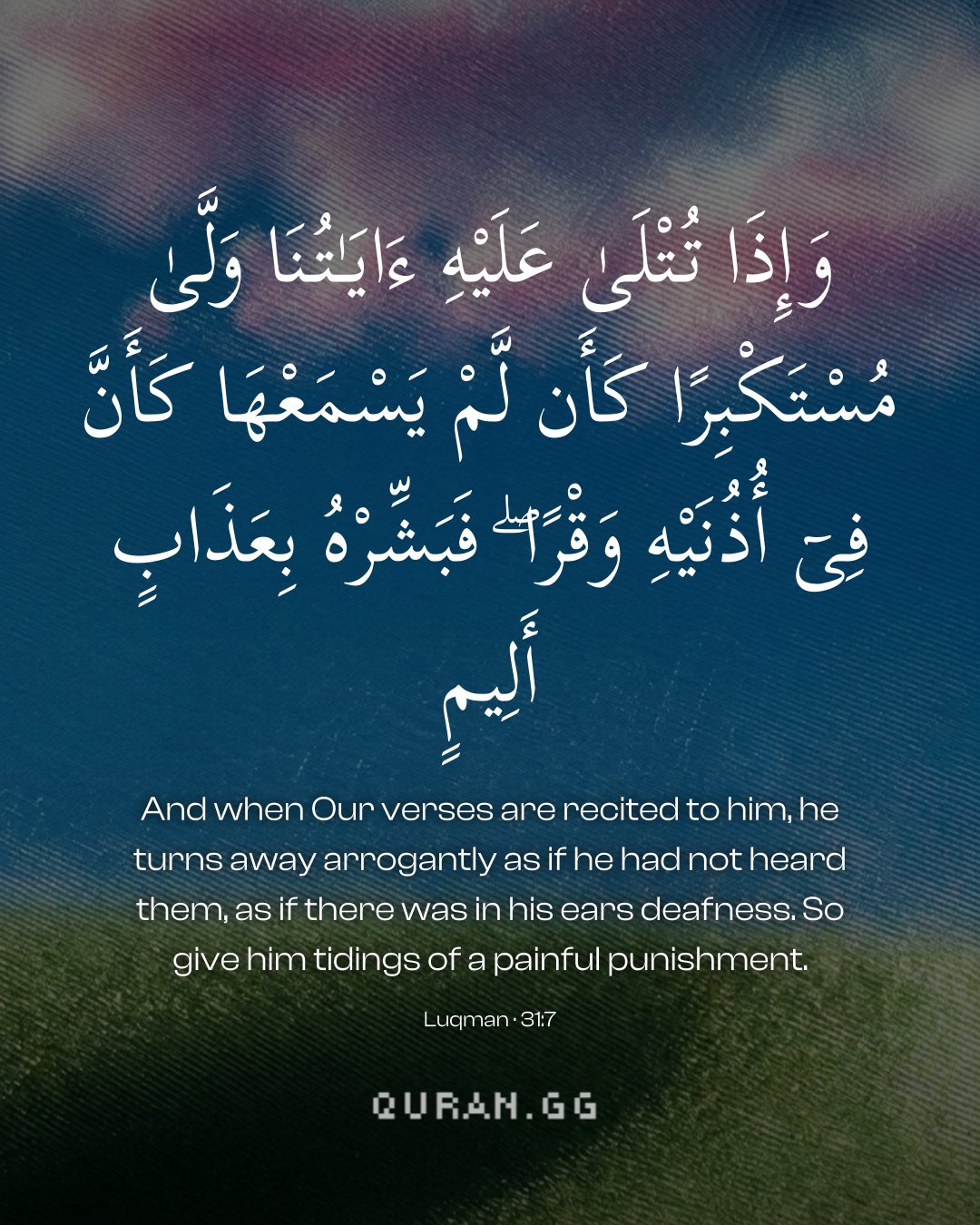
And when Our verses are recited to him, he turns away arrogantly as if he had not heard them, as if there was in his ears deafness. So give him tidings of a painful punishment.
(Allah has sent down the Best Statement, a Book, its parts resembling each other (and) oft-repeated. The skins of those who fear their Lord shiver from it. Then their skin and their heart soften to the remembrance of Allah) (39:23). He connect that with mention of the doomed, those who turn away from the Qur'an and do not benefit from hearing the Words of Allah. Instead, they turn to listening to flutes and singing accompanied by musical instruments. As Ibn Mas`ud commented about the Ayah:
The word: اشتراء (ishtira) in: وَمِنَ النَّاسِ مَن يَشْتَرِي لَهْوَ الْحَدِيثِ (And from among the people who buys the distracting amusement of things - 31:6) literally means 'to buy.' And on occasions, the same word is used in the sense of 'doing an act instead of another' - as in: أُولَـٰئِكَ الَّذِينَ اشْتَرَوُا الضَّلَالَةَ بِالْهُدَىٰ are the people who have bought error at the rice of guidance - 2:16, 2:175 and in some other verses.
The Cause of Revelation
This verse was revealed because of a particular event relating to Nadr Ibn Harith. He was one of the top businessmen from among the Mushriks of Makkah who used to travel to different countries in connection with his business. Once he bought and brought back a collection of historical stories featuring Cyrus and other Persian kings from Iran. Thus armed, he said to the Quraish of Makkah: "Muhammad tells you the stories of the people of ` Ad and Thamud and others. I shall tell you better stories, those of Rustam, Isfandyar and other kings of Persia. They started listening to his stories eagerly simply because they contained no lessons to learn and no work to do. It was nothing but some delicious stories. Because of these, many Mushriks who had some measure of interest in the Divine Word because of its miraculous nature, rather listened to it stealthily, found an excuse to draw away from the Qur'an. (ذکرہ فی الروح عن اسباب النزول للواحدی و مقاتل و ذکرنحوہ فی الدر المنثور بروایۃ البیھقی)
In this world, the criterion of the proper performance of a task (ihsan) is that it should be in accordance with the facts. From this point of view, one who carries out a task in this way is one who admits the reality (muhsin); his actions become a manifestation of his spirit of submission. Those who have it in their nature to mould themselves according to the factual position, are those who, when the Truth presents itself to them, accept it without suffering from any psychological complications. They immediately start fulfilling its practical requirements—they become regular offerers of prayers (salat), which is symbolic of fulfilling God’s will. They give prescribed alms (zakat), which amounts to honouring the rights of God’s subjects in the economic sphere. They shun the worship of worldly achievements and begin to think fondly of the Hereafter, because they know that the place where the question of success or failure shall finally be decided is nowhere other than the Hereafter.
Uthmani text of the Madinah mushaf (King Fahd Complex). Translation: Saheeh International. Tafsir via Quran.com.