The Conception and the Birth
Allah, the Exalted, informs about Maryam that when Jibril had spoken to her about what Allah said, she accepted the decree of Allah. Many scholars of the predecessors (Salaf) have mentioned that at this point the angel (who was Jibril) blew into the opening of the garment that she was wearing. Then the breath descended until it entered into her vagina and she conceived the child by the leave of Allah. Muhammad bin Ishaq said, "When she conceived him and filled her water jug (at a well), she returned (to her people). After this, her menstrual bleeding ceased and she experienced what the pregnant woman experiences of sickness, hunger, change of color and there was even a change in the manner of her speech. After this, no people came to visit any house like they did the house of Zakariyya. The word spread among the Children of Israel and the people were saying, `Verily, her partner (in fornication) was Yusuf, because there was no one else in the temple with her except him.' So she hid herself from the people and placed a veil between herself and them. No one saw her and she did not see anyone else." Allah said;
Continue reading the tafsir of ayahs 22–23Ma'arif al-Qur'an
Mufti Muhammad Shafi
Commentary
Injunction in respect of desire for death
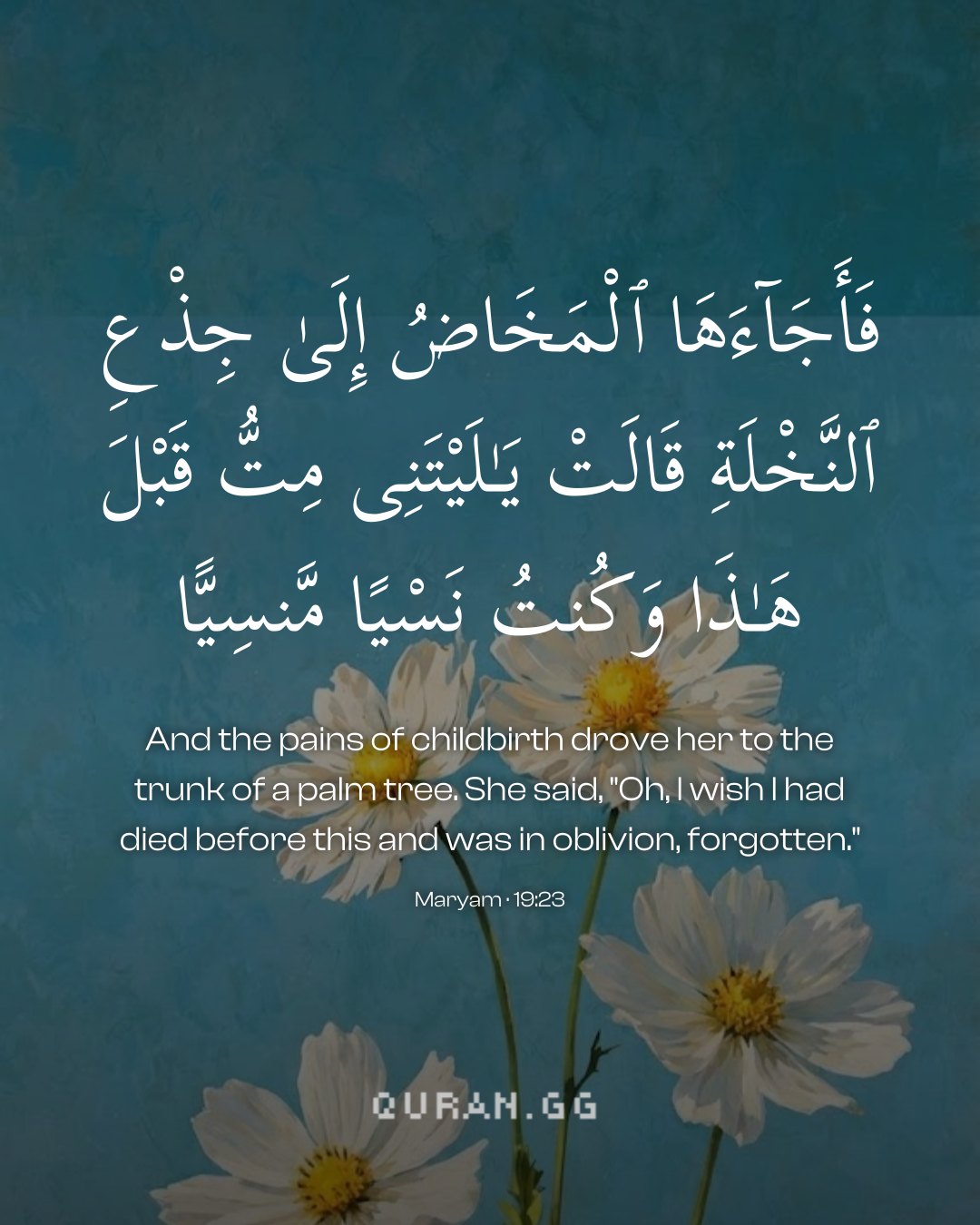
If her desire for death was due to worldly problems then she may be excused on the ground that she was overpowered by the surrounding circumstances and had reached a state of mind usually called by the mystics as غلبۃ الحال "Ghalabah-tul-Hal." But if the desire for death was due to religious consideration, it was justifiable in its own right, because she feared that people would talk ill of her and she would not be able to endure it with patience. This could be tantamount to committing a sin of showing impatience and only death could save her from such a predicament.
The vow of silence has been prohibited under the Islamic Law
Before the advent of Islam silence was also a form of worship, and those who observed this fast were not supposed to speak from dawn to dusk. Islam cancelled this fast and made it mandatory to refrain from idle talk, lying and back-biting. Refraining from normal conversation is not a form of worship in Islam anymore and, hence to take a vow of silence is also not permissible. Abu Dawud (رح) has reported the following Hadith from the Holy Prophet ﷺ .
لا یتم بعد احتلام ، ولا صمات یوم الی اللیل
It means that a child who has lost his father may not be regarded as an orphan after attaining puberty, and the rules pertaining to an orphan cease to apply on him. And that remaining silent from dawn to dusk is not a form of worship in Islam (This Hadith has been rated by As-Suyuti and Al-` Azizi as Hasan).
She has been directed to eat the dates because it has been established medically that the use of water and dates gives relief in labour pains.
Conceiving a child without copulation with a man is not totally impossible
That Sayyidah Maryam (علیہا السلام) conceived and gave birth to a child was a miracle. And miracles, however improbable they may be in appearance, are not beyond Allah's power, rather, the more improbable they are, the more pronounced their miraculous nature. However, it cannot be taken as totally impossible, because according to some books of medical science, the lubricants found inside the female genitals are not merely a passive agent for conceiving a child; they also have a capacity of being active and a potential to make fetus by themselves without an external semen joining them. Ibn Sina (Avicenna), the famous medical scientist, has mentioned in his book 'Al-Qanun' that in a special disease, named by him as 'Raja' an imperfect form of even the organs of a fetus is shaped in the uterus of a woman without the intermediation of a male semen. So long as this potential is there, it cannot be taken as totally impossible, because some abnormal factor may increase this potential.
In verse 25 Allah Ta` ala commanded Sayyidah Maryam (علیہا السلام) to shake the date tree, although it was within His power to drop the dates in her lap. But here the suggestion is that one should strive to earn one's living, and that the struggle for sustenance does not conflict with one's trust in Allah (Ruh ul-Ma’ ani).
Mary was an unmarried lady of a respectable and religious family. Being pregnant meant a calamitous trial for a lady like her; a trial of unparalleled severity. Ridden with anxiety, she quietly left the Haykal and went to far-off Bethlehem. When the time came and the labour pains began, she went out of town and sat under a date-palm tree. What a chaste, unmarried lady like her was going through at the time can be imagined from these words she uttered: ‘Alas! Why didn’t I die before this, so that my very existence would have been obliterated from people’s memories?’
Uthmani text of the Madinah mushaf (King Fahd Complex). Translation: Saheeh International. Tafsir via Quran.com.