Allah, the Exalted, tells His Prophet, Muhammad ﷺ,
وَاذْكُرْ فِى الْكِتَـبِ إِبْرَهِيمَ
(And mention in the Book, Ibrahim.) "Recite this to your people who are worshipping idols and mention to them what happened with Ibrahim, the intimate Friend (Khalil) of the Most Beneficent. These idol worshippers (Arabs) are his descendants and they claim to follow his religion. Inform them that he was a truthful Prophet. Tell them about what took place with his father and how he forbade him from worshipping idols." Ibrahim said,
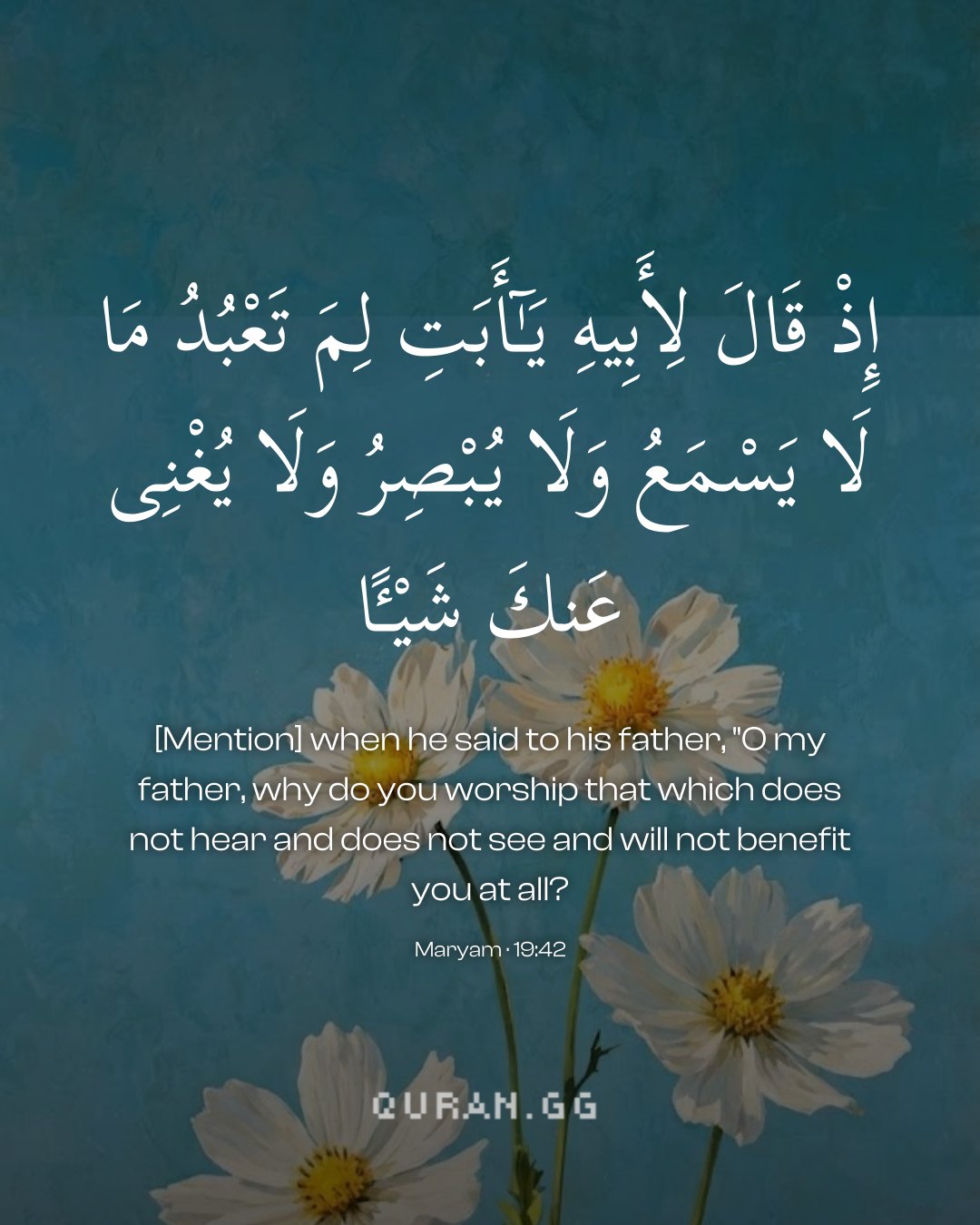
يَا أَبَتِ (My dear father - 19:42) In Arabic language this word conveys deep respect and intense love for one's father. Allah Ta` ala had combined in the person of Sayyidna Khalilullah (علیہ السلام) the noble qualities and attributes, and his address to his father is a perfect example of moderation and restraint on the one hand, and the balancing of the opposites on the other. He finds his father living a life of unbelief and polytheism, and also calling upon other people to follow him in a life of sin - the very things which he was sent to eradicate. At the same time there is the filial love and respect which he feels towards his father. Now, the thing to note is, how well he combines the two conflicting feelings together. In the first place he uses the word يَا أَبَتِ , which is the mark of love and respect for his father, in the beginning of each sentence of the address. Then there is not a single derogatory word in his address which could hurt the feelings of his father, and words such as infidel or sinner have been carefully avoided. Instead, guided by prophetic wisdom he merely invited his father's attention to the helplessness and insensitivity of his idols, so that he might himself realize the fallacy of his beliefs. In the second sentence he made a mention of the prophetic knowledge that was granted to him by Allah Ta’ ala. Then in the third and fourth sentences he warned him against the Divine wrath, which would surely fall on him as a punishment for infidelity and idolatry. Even to these respectful entreaties his father did not pay any heed and, instead of giving any thought to what was said to him and adopting a gentle attitude, he addressed him ina very harsh language. Whereas Sayyidna Ibrahim (علیہ السلام) had addressed him with the loving words of يَا أَبَتِ , which should have called for a soft and tender response, such as یَا بُنَیَّ (My dear son) he chose to call him by his name and said يَا إِبْرَاهِيمُ , and not only threatened to stone him to death but also asked him to leave his house. How Sayyidna Khalilullah' (علیہا السلام) responded to this threat is worthy of deep reflection.
Tazkirul Quran
Maulana Wahiduddin KhanOn ayahs 40–44
When a man meets with failure in this world, he has the opportunity to start his life afresh, and he feels himself fortunate to have friends and supporters who will offer him assistance. But, failure in the life hereafter allows of no chance of reversal. What keen regret a man feels when he learns that he had the opportunity to do what was right and proper, but did nothing until it was too late! The root cause of all evil is that man takes himself to be his own master, while the fact is that this life is only a transient period in his existence. God was the Lord of everything in the beginning and He will be the Lord of everything till the end. In truth, there is nobody but God who may hold the position of a master.
Uthmani text of the Madinah mushaf (King Fahd Complex). Translation: Saheeh International. Tafsir via Quran.com.