Surah Maryam Ayah 49 (19:49) — Meaning & Tafsir | Quran.GG

Surah Maryam, Ayah 49

19:49 · Meaning and tafsir

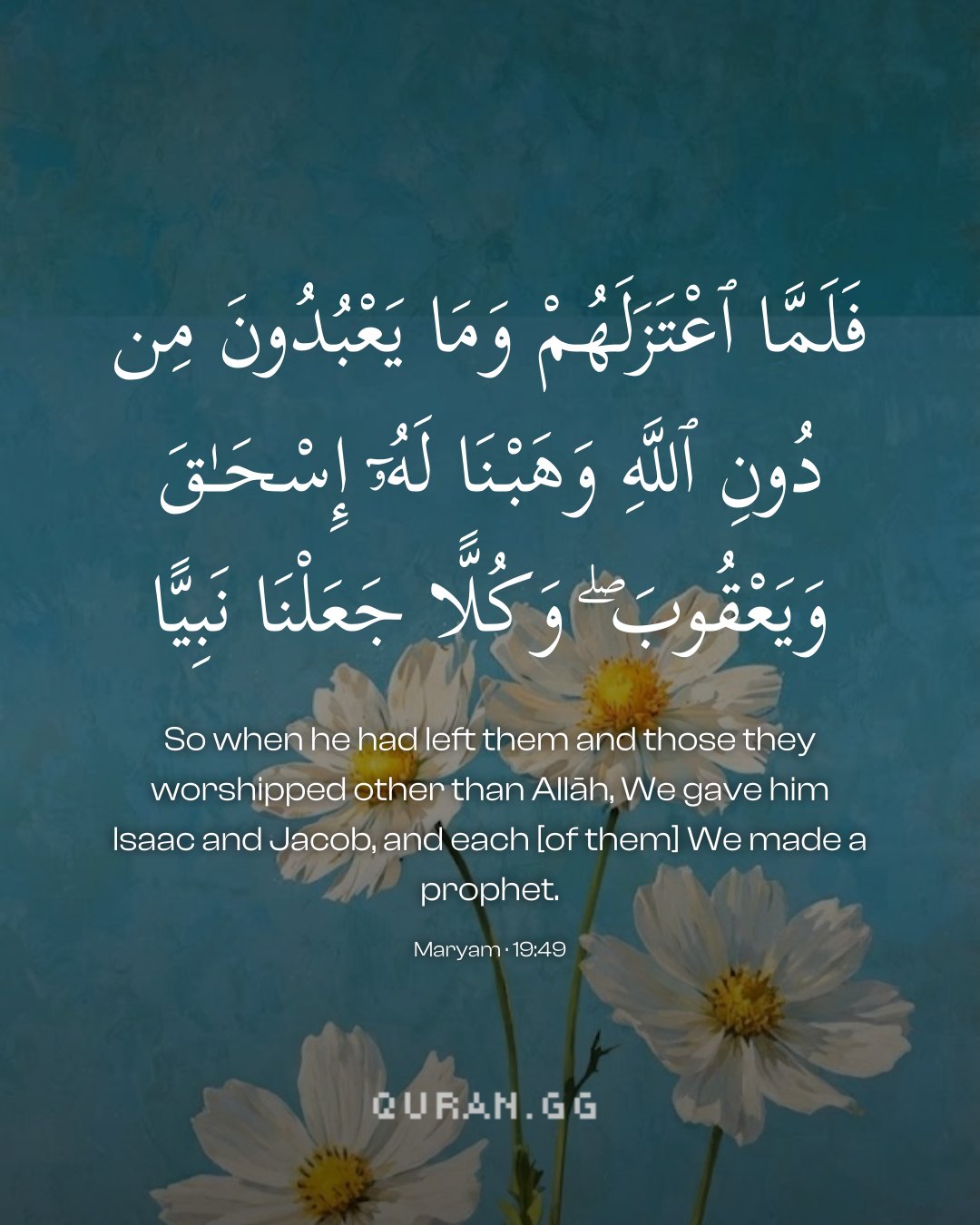
فَلَمَّا ٱعْتَزَلَهُمْ وَمَا يَعْبُدُونَ مِن دُونِ ٱللَّهِ وَهَبْنَا لَهُۥٓ إِسْحَـٰقَ وَيَعْقُوبَ ۖ وَكُلًّا جَعَلْنَا نَبِيًّا ٤٩

So when he had left them and those they worshipped other than Allāh, We gave him Isaac and Jacob, and each [of them] We made a prophet.

Surah Maryam 19:49 in Arabic with its translation: “So when he had left them and those they worshipped other than Allāh, We gave him Isaac and Jacob, and each…”

Make something with this ayah

Turn it into a video for Stories, Reels or TikTok, recited by the reciter you pick, or an image on a background you choose. Free, in your browser.

Download this image

Tafsir Ibn Kathir (abridged)

Allah gave Ibrahim Ishaq and Ya`qub

Allah, the Exalted, says that when the Friend of Allah (Ibrahim) withdrew from his father and his people for the sake of Allah, Allah gave him in exchange those who were better than them. He gave him Ishaq (Isaac) and Ya`qub (Jacob), meaning his son, Ishaq, and Ishaq's son, Ya`qub. This is as Allah said in another Ayah,

وَيَعْقُوبَ نَافِلَةً

(and Ya`qub, a grandson.) 21:72 Also, Allah says,

وَمِن وَرَآءِ إِسْحَـقَ يَعْقُوبَ

(and after Ishaq, of Ya`qub.) 11:71 There is no difference of opinion about Ishaq being the father of Ya`qub. This is what is recorded in the Qur'an in Surah Al-Baqarah.

أَمْ كُنتُمْ شُهَدَآءَ إِذْ حَضَرَ يَعْقُوبَ الْمَوْتُ إِذْ قَالَ لِبَنِيهِ مَا تَعْبُدُونَ مِن بَعْدِى قَالُواْ نَعْبُدُ إِلَـهَكَ وَإِلَـهَ آبَآئِكَ إِبْرَهِيمَ وَإِسْمَـعِيلَ وَإِسْحَـقَ

(Or were you witnesses when death approached Ya`qub When he said unto his sons, "What will you worship after me" They said, "We shall worship your God the God of your fathers, Ibrahim, Isma`il and Ishaq.")2:133 Allah only mentioned Ishaq and Ya`qub here to show that He made Prophets from among his descendants and successors in order to give him relief and happiness in his life. This is why Allah says,

وَكُلاًّ جَعَلْنَا نَبِيّاً

(and each one of them We made a Prophet.) 19:49 If Ya`qub had not become a Prophet in the lifetime of Ibrahim, then Allah would not have limited the promise of prophethood to him, but He would have mentioned his son Yusuf as well. For verily, Yusuf was also a Prophet, just as the Messenger of Allah ﷺ said in a Hadith whose authenticity is agreed upon, when he was asked who was the best of people. He said,

«يُوسُفُ نَبِيُّ اللهِ ابْنُ يَعْقُوبَ نَبِيِّ اللهِ ابْنِ إِسْحَاقَ نَبِيِّ اللهِ ابْنِ إِبْرَاهِيمَ خَلِيلِ الله»

(The Prophet of Allah, Yusuf, the son of the Prophet of Allah Ya`qub, the son of the Prophet of Allah Ishaq, the son of the Friend of Allah Ibrahim.) In another wording of this Hadith, he said,

«إِنَّ الْكَرِيمَ ابْنَ الْكَرِيمِ ابْنِ الْكَرِيمِ ابْنِ الْكَرِيمِ يُوسُفَ بْنَ يَعْقُوبَ بْنِ إِسْحَاقَ بْنِ إِبْرَاهِيم»

(Verily, the noble one is the son of the noble one, who is the son of the noble one, who is the son of the noble one. That is Yusuf, the son of Ya`qub, the son of Ishaq, the son of Ibrahim.) Concerning Allah's statement,

وَوَهَبْنَا لَهْمْ مِّن رَّحْمَتِنَا وَجَعَلْنَا لَهُمْ لِسَانَ صِدْقٍ عَلِيّاً

(And We gave them of Our mercy, and We granted Sidqin `Aliyyan on the tongues. ) `Ali bin Abi Talhah reported that Ibn `Abbas said, "Sidqin `Aliyyan means the good praise." As-Suddi and Malik bin Anas said the same thing. Ibn Jarir said, "Allah only said `Aliyyan (loftiness, exalted) because all of the religions commend them and mention them with praises, may Allah's peace and blessing be upon them all."

Ma'arif al-Qur'an

فَلَمَّا اعْتَزَلَهُمْ وَمَا يَعْبُدُونَ مِن دُونِ اللَّـهِ وَهَبْنَا لَهُ إِسْحَاقَ وَيَعْقُوبَ

"So, when he went away from them and what they worshipped besides Allah, We blessed him with Ishaq and Ya` qub." - 19:49.

In the sentence preceding this sentence Hadhrat Ibrahim (علیہ السلام) had expressed the hope that on account of his prayers and devotion Allah Ta` ala would not abandon him. This hope, in fact, was a prayer to Allah to protect him from the pain of loneliness after he left his house and family. The sentence reproduced above describes the manner in which his prayer was granted. When Ibrahim (علیہ السلام) left his home and family and their idols, Allah Ta` ala rewarded him with a son, Ishaq (علیہ السلام) to compensate him for his loss. It was further revealed to him that this son would have long life and also beget a son by the name of Ya` qub. Granting of a son is proof that he (Ibrahim) was married by then. In brief it means that he was granted a better family, which consisted of prophets and pious people after he had left his father's family.

Tazkirul Quran

The statues criticized by the Prophet Abraham were not simply ordinary pieces of stone. Rather, they represented those entities, whose supposed magical greatness, enshrined in the legends of the past, had charmed the people and left a lasting impression on their minds. Compared to them, ‘young Abraham’ appeared to be an ordinary person, while the statues of Iraq seemed to be mountains of greatness. That is why Abraham’s father contemptuously ignored his advice. If the call to the Truth, initiated at a particular place, reaches a stage when the addresee though fully understanding it, stoop to violence, the believers have to move away from that place. Such a move is called Hijrah or immigration. The call of Truth is a divine call. That is why, from the very outset, it is marked by God-oriented thinking. Even if those to whom the call is addressed deal contemptuously with the call-giver and oppress him, he still keeps a soft corner in his heart for them. Similarly, if he finds himself unsupported by his surroundings, he is not dejected, because his real support comes from God. He firmly believes that, as always, He is with him and will remain with him forever.

Uthmani text of the Madinah mushaf (King Fahd Complex). Translation: Saheeh International. Tafsir via Quran.com.