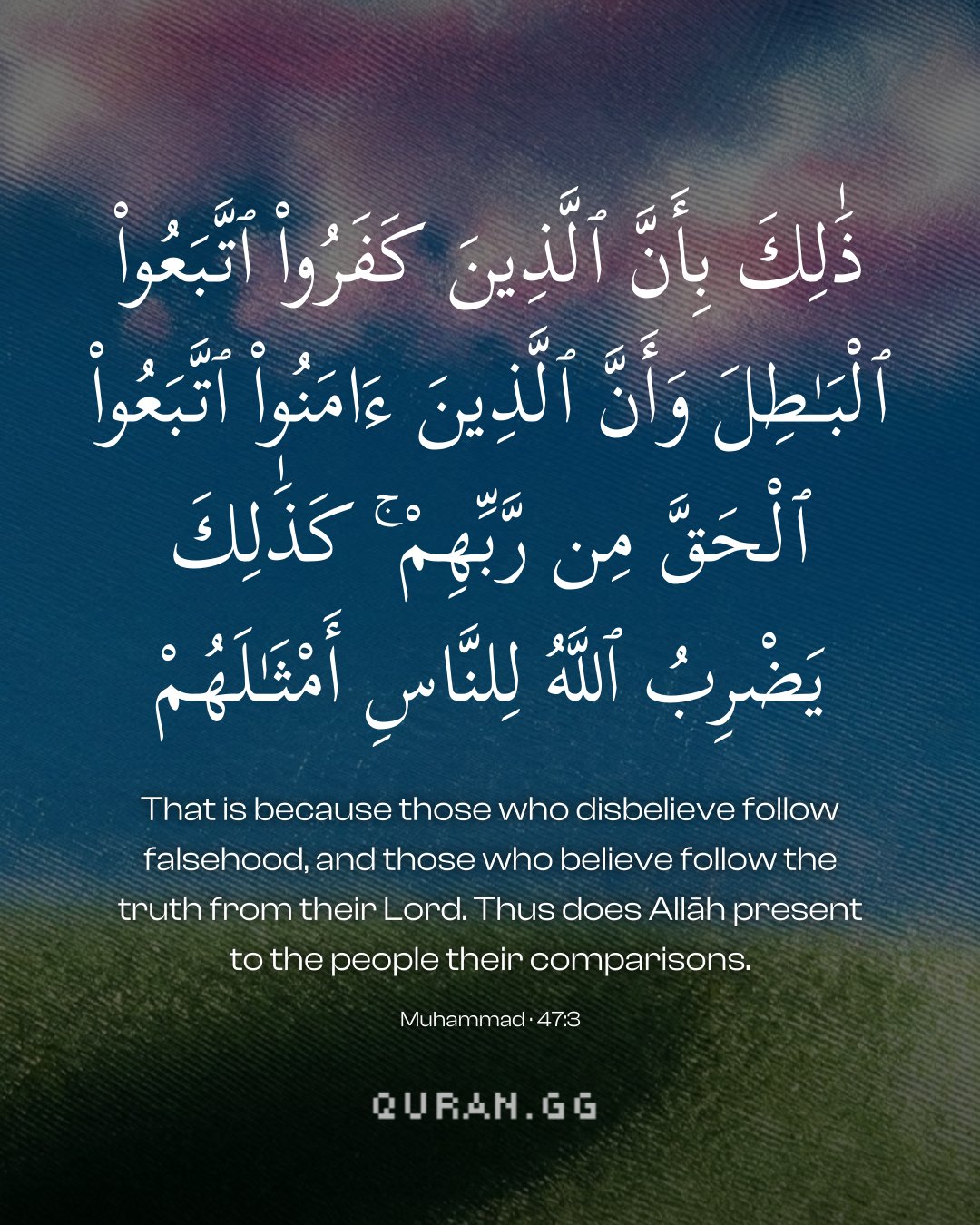
That is because those who disbelieve follow falsehood, and those who believe follow the truth from their Lord. Thus does Allāh present to the people their comparisons.
In the Name of Allah, the Most Gracious, the Most Merciful.
The Reward of the Disbelievers and the Believers Allah says,
الَّذِينَ كَفَرُواْ
(Those who disbelieve) meaning, in the Ayat of Allah.
وَصُدُّواْ
(and hinder (men)) Others.
عَن سَبِيلِ اللَّهِ أَضَلَّ أَعْمَـلَهُمْ
(from the path of Allah, He will render their deeds vain.) meaning, He renders their deeds vain and futile, and He denies them any rewards or blessings for them. This is similar to His saying,
…and believed in that which is revealed to Muhammad …(47:2)
Although the previous sentence has referred to faith and righteous deeds which includes faith in the messenger-ship of the Holy Prophet Muhammad ﷺ and the revelation that was sent down to him, this sentence specifies explicitly the fact that the actual basis of faith is to embrace all the teachings of the Last Holy Prophet ﷺ .
The word " بال (bal) in وَأَصْلَحَ بَالَهُمْ "…and will set aright their state of affairs..(47:2) " is sometimes used in the sense of state of affairs and condition, and at other times in the sense of heart. Here it could refer to both the senses. In the first sense, it means that Allah has set all their affairs aright, that is, He has set aright all their matters of this world and of the Hereafter. In the second sense, it would mean that Allah has improved their hearts. This also has the same implication, that is, corrected all their works, because correction of works is a logical result of improvement of heart, both being necessary to each other.
Tazkirul Quran
Maulana Wahiduddin KhanOn ayahs 3–5
In ancient Arabia, the deeds of those who denied the prophethood of the Prophet Muhammad and opposed him, counted for nothing. In other words, since they did not prove to be religious on the level of moral awareness, their achievements, performed as a matter of conventional and traditional religiosity, became valueless. The people of ancient Arabia used to consider themselves the community of Abraham and Ishmael. They also had the honour of being the custodians of the Kabah. The customs of prayer, fasting and Hajj in some form or the other were also prevalent among them. The serving of Hajj pilgrims, good treatment of relatives, and hospitality towards guests were also social requirements. Though the ancient Arabs acquitted themselves well on all these scores, their actions were not the outcome of their conscious religiousness. They performed all these deeds simply because it had been the custom to do so for centuries. In order to recognise the prophet of the time, it was necessary for them to have heightened their own awareness. At that time, the force of ancient traditions had not yet built up around the Prophet Muhammad. Therefore, only one who was capable of recognising reality through deep personal perception could have acknowledged him. In this context, when they rejected their contemporary prophet, it was clearly established that their religiousness was based purely on tradition and not on personal realization. And God requires religiousness in spirit not in form devoid of spirit. Those, however, who embraced the faith of the Prophet of their own times, proved that they were capable of being religious at a heightened level of consciousness.
Uthmani text of the Madinah mushaf (King Fahd Complex). Translation: Saheeh International. Tafsir via Quran.com.