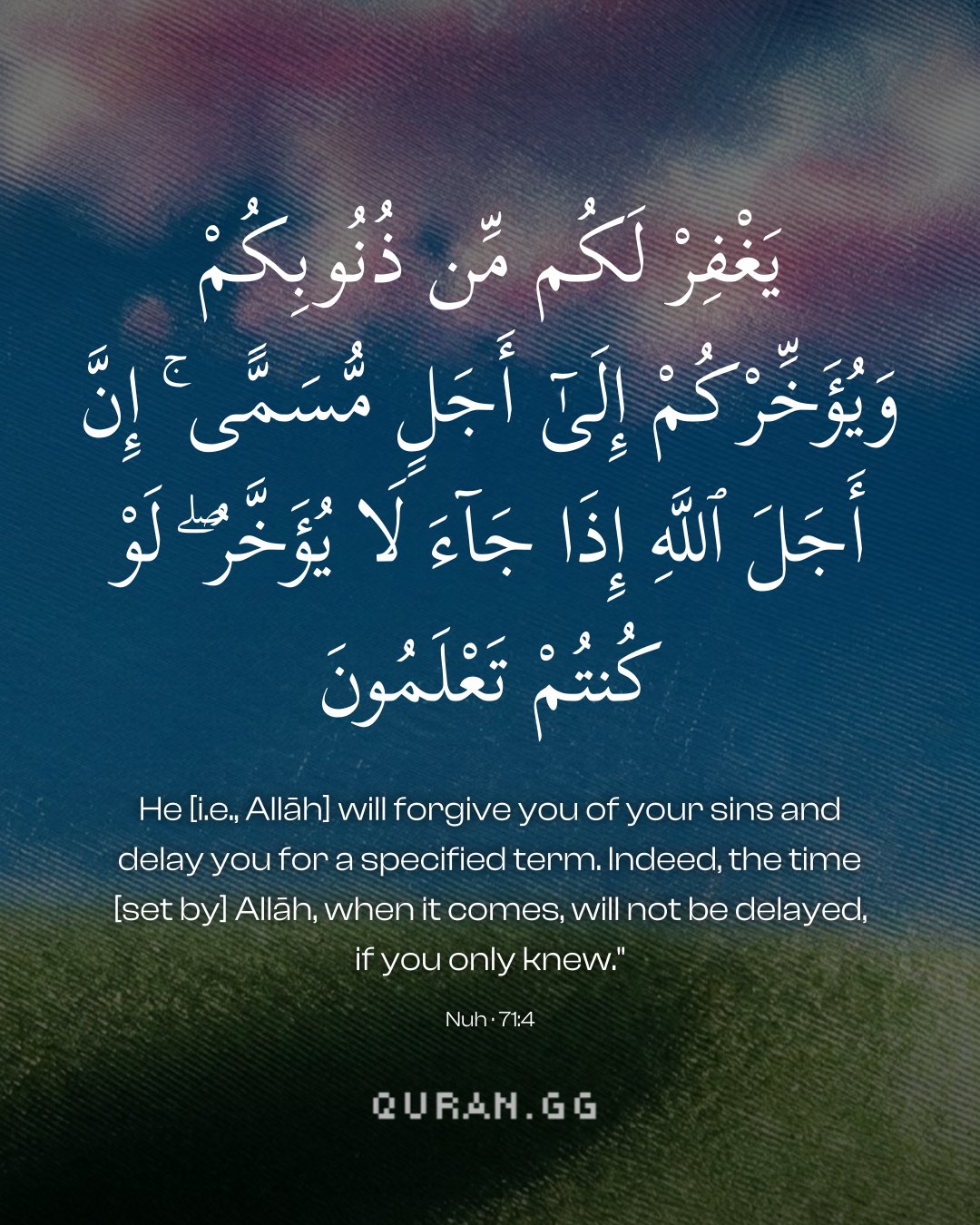
He [i.e., Allāh] will forgive you of your sins and delay you for a specified term. Indeed, the time [set by] Allāh, when it comes, will not be delayed, if you only knew."
(In the Name of Allah, the Most Gracious, the Most Merciful.
Nuh's Invitation to His People
Allah says concerning Nuh that He sent him to his people commanding him to warn them of the punishment of Allah before it befell them. He was to tell them that if they would repent and turn to Allah, then the punishment would be lifted from them. Due to this Allah says,
("Warn your people before there comes to them a painful torment." He said: "O my people! Verily, I am a plain warner to you.") meaning, clarity of the warning, making the matter apparent and clear.
يَغْفِرْ لَكُم مِّن ذُنُوبِكُمْ and Allah will forgive you your sins, 71:4). The particle min is often used to indicate division into parts, that is, to refer to only a part of an amount, group or number. If it is taken in that sense here, it would signify that by embracing the faith only those sins would be forgiven which pertains to the Divine rights because violation of human rights would be forgiven only when the believer fulfills the human rights which he has violated [ such as pecuniary obligations ] and if they cannot be fulfilled [ such as hurting somebody physically or verbally ], then the person who has been so hurt must first be requested to forgive. The hadith which reports that by embracing the faith all sins are forgiven must be understood in the light of the foregoing explanation. In other words, the hadith has the same conditions attached to it as the verse under comment, that is, violation of the rights of the human beings is not forgiven except upon fulfillment of those rights or seeking forgiveness from the victims of that violation. Other scholars of Tafsir interpret the particle min as za'idah, (having no meaning, and added only because of usage). In this way, it signifies that all their sins would be forgiven. However, on the basis of other texts, this general expression is subject to the conditions mentioned above.
Tazkirul Quran
Maulana Wahiduddin Khan
Noah is perhaps the first prophet after Adam. The message that he gave to the corrupted people of those days has been put here in three words—worship (‘ibadah), fear of God (taqwa) and obedience to the Prophet (ita‘ah), i.e. the worshipping of God and renouncing the worship of anything other than God, leading one’s life in the world with the fear of God in one’s heart and considering the prophet of God an example to be followed in all matters. This has been the real message of all prophets in every age and this is the true message of the Quran itself.
Uthmani text of the Madinah mushaf (King Fahd Complex). Translation: Saheeh International. Tafsir via Quran.com.