(In the Name of Allah, the Most Gracious, the Most Merciful.
This Surah has been separated from the one that preceded it in the primary Mushaf (the original copy
They (the Companions) wrote "In the Name of Allah, the Most Gracious, the Most Merciful" on the line (i.e., the space) between these two Surahs. They did this even though this Surah is directly related to the one which precedes it, as Muhammad bin Ishaq and `Abdur-Rahman bin Zayd bin Aslam have both clarified. This is because the meaning of both of them is, "We have prevented the Elephant from entering Makkah and We have destroyed its people in order to gather (Ilaf) the Quraysh, which means to unite them and bring them together safely in their city." It has also been said that the meaning of this (Ilaf) is what they would gather during their journey in the winter to Yemen and in the summer to Ash-Sham through trade and other than that. Then they would return to their city in safety during their journeys due to the respect that the people had for them because they were the residents of Allah's sanctuary. Therefore, whoever knew them would honor them. Even those who came to them and traveled with them, would be safe because of them. This was their situation during their journeys and travels during their winter and summer. In reference to their living in the city, then it is as Allah said,
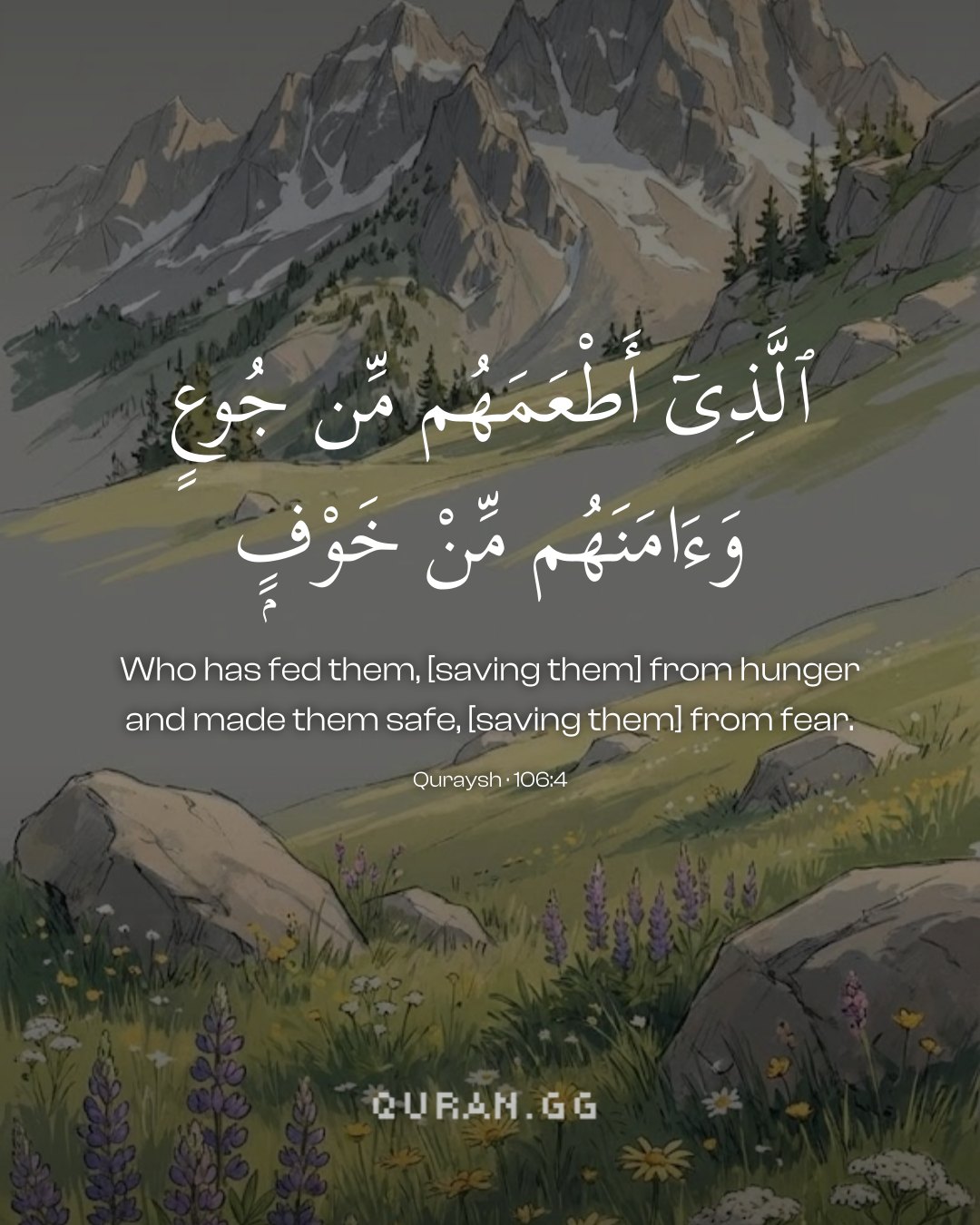
Verse [ 106:4] الَّذِي أَطْعَمَهُم مِّن جُوعٍ وَآمَنَهُم مِّنْ خَوْفٍ (Who gave them food against hunger, and gave them security against fear.) The verse comprehensively captures all that was needed for the Quraish to live happily and peacefully in the world. The first phrase أَطْعَمَهُم مِّن جُوعٍ (Who gave them food against hunger) implies that they were provided all year round with every kind of fruit and food. The security referred to in the second phrase آمَنَهُم مِّنْ خَوْفٍ (and gave them security against fear) includes security from enemies and robbers (who, out of their respect to them as guardians of Ka'bah, spared them from their attacks), and it also includes security from the punishment in the Hereafter (for those who fulfilled the necessary conditions of faith).
Special Note
Ibn Kathir says that whoever worships Allah according to the command given in this verse, Allah will give him safety, not only in this world, but also security from punishment in the Hereafter. And whoever deviates from this command, He will deprive him of both types of safety and security as exemplified in the following verse [ 16:112]:
(And Allah has given an example that there was a town, secure and satisfied, with its sustenance coming in plenty from every place. Then, it turned ungrateful to the bounties of Allah; so, Allah made it taste hunger and terror [ cast over it ] like a garment in return of what its people used to do. [ 16:112]
A Great Benefit
Abul Hasan Qazwini has stated that anyone who fears his enemy or an affliction, should recite Surah Al-Quraish. It will give him security from fear and calamity. This is cited by Imam Jazri and he says that this Surah has been tried and tested successfully for this purpose. Qadi Thana'ullah Panipati (رح) cites this in his Tafsir Mazhari and says that his Shaikh Mirza Mazhar Jan-i-Janan instructed him to recite this Surah at the time of fear and danger, and said its recitation has been tested and tried to avert all kinds of calamities and afflictions. Qadi Thana'ullah says that he has experienced it several times.
Al-Hamdulillah
The Commentary on
Surah Al-Quraish
Ends here
Tazkirul Quran
Maulana Wahiduddin Khan
This chapter was revealed at Makkah, where the Quraysh tribe was the custodian of the Kabah. Owing to this position they were held in high esteem throughout Arabia. This gave them a number of privileges. The Quraysh was a trading community. During the summer their traders’ caravans used to go to Syria and Palestine and in winter they would trade with Yemen. Their economy was dependent upon these trading activities. In ancient times, when the robbing of traders was common, the caravans of the Quraysh went unscathed. The reason for this was their connection with the Ka‘bah of which the Quraysh were the servants and trustees. Since respect for the Ka‘bah dominated the minds of the people, they used to respect its servants and trustees also, and on account of this they did not rob their caravans. Their tribe thus became prosperous. Here, in connection with the call for the acceptance of Truth, the Quraysh have been reminded of this blessing of God and called to Islam. They are told that it would be highly ungrateful to enjoy the worldly benefits of the House of God—the Ka‘bah (‘Baytullah’) while shirking the religious responsibility incumbent upon them. They are enjoined to worship only God who confered all material benefits upon them. This is to say, they are urged to give a positive response to the call of Truth brought to them by the Prophet Muhammad and surrender to their Creator and Sustainer. By extension, every believer is reminded here to be thankful to the Lord and worship Him.
Uthmani text of the Madinah mushaf (King Fahd Complex). Translation: Saheeh International. Tafsir via Quran.com.