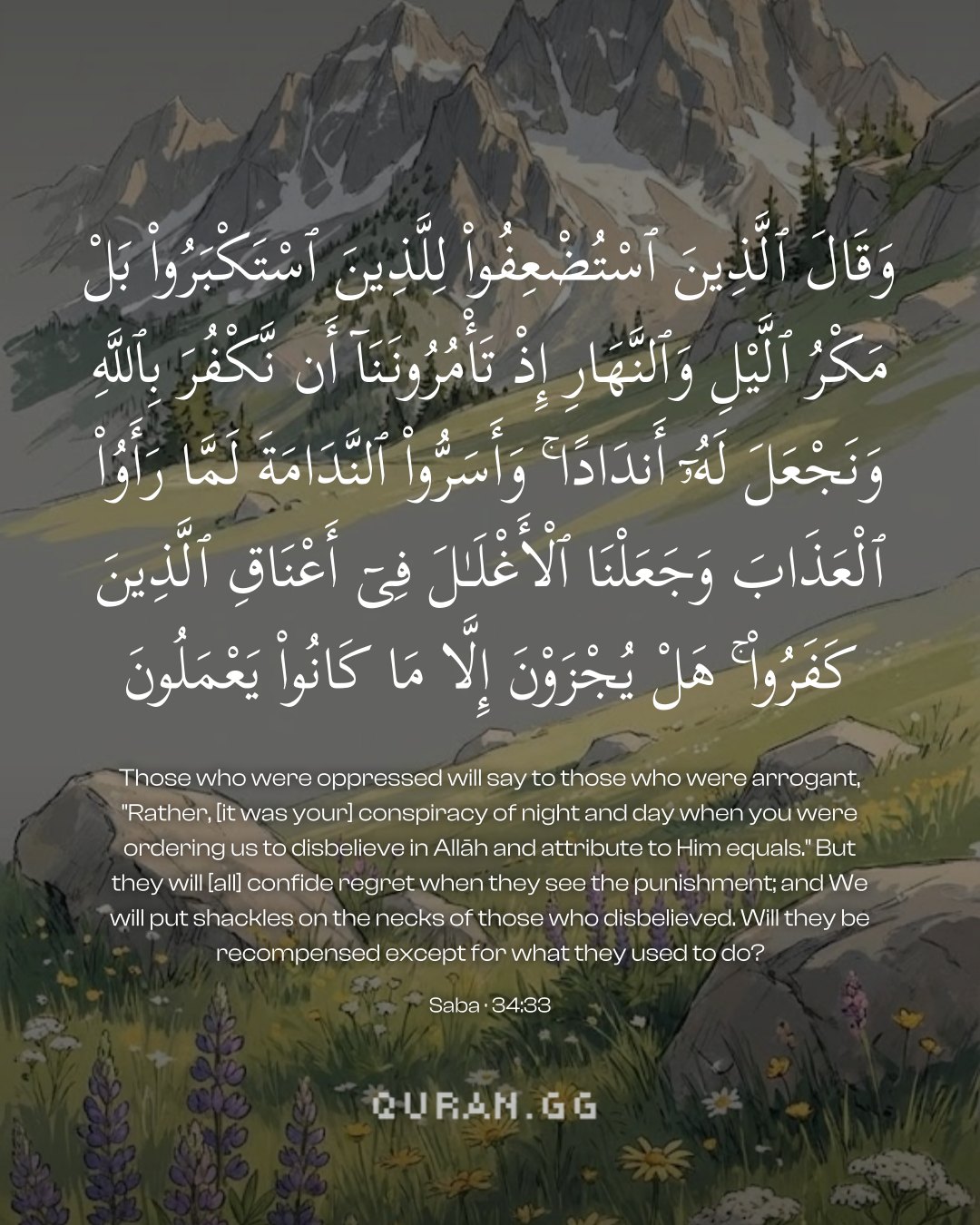
Those who were oppressed will say to those who were arrogant, "Rather, [it was your] conspiracy of night and day when you were ordering us to disbelieve in Allāh and attribute to Him equals." But they will [all] confide regret when they see the punishment; and We will put shackles on the necks of those who disbelieved. Will they be recompensed except for what they used to do?
How the Disbelievers have agreed in this World to deny the Truth,and how They will dispute with One Another on the Day ofResurrection
Allah tells us about the excessive wrongdoing and stubbornness of the disbelievers, and their insistence on not believing in the Holy Qur'an and what it tells them about the Resurrection. Allah says:
(And those who disbelieve say: "We believe not in this Qur'an nor in that which was before it.") Allah threatens them and warns them of the humiliating position they will be in before Him, arguing and disputing with one another:
That Allah is One and that His power is absolute was the subject in previous verses. In the present verse, it is being said that the Holy Prophet ﷺ “ was sent as the Messenger of Allah to all peoples of the world who are there now or will come in the future.
The word: كَافَّةً (Kaaffah) in: كَافَّةً لِلنَاس Kaaffatal-lin-naas: for all peoples) is used in the sense of making something universal and inclusive of all without the exclusion of anyone from it. The grammatical arrangement of the text required saying: لِلنَاس (lin-naasi kaaffatan: for the people as a whole) because the word: (kaaffah: all) is grammatically a hal (adverb) relatable to the word نَاس (naas: people). But, in order to put a clear accent on the universality of the mission of the Last Rasul of Allah, the word: كَافَّةً (Kaaffah: all) was set to come earlier.
Denial of Truth is the greatest crime. The result of this crime does not become apparent to an individual in this world. Therefore, he goes on fearlessly denying the Truth. But, in the Hereafter, when the adverse effect of denying the Truth impinges on the deniers, they will be caught in a state of turmoil. The common people, in this world, were proud of their leaders, but once in the Hereafter, they will curse them. In reply, their leaders will say, ‘Don’t blame us to cover up your ignominy. It was not we who misguided you but your own desires. You were with us simply because our words were in consonance with your own desires. You wanted a religion in which you could get credit for being righteous without taking much trouble and without changing yourself, and we provided you with it. You put our noose around your neck of your own accord; otherwise, we had no power to do so.’
Uthmani text of the Madinah mushaf (King Fahd Complex). Translation: Saheeh International. Tafsir via Quran.com.