How Those Who lived a Life of Luxury disbelieved in the Messengers and were misled by Their pursuit of Wealth and Children
Allah is consoling His Prophet and commanding him to follow the example of the Messengers that came before him. He tells him that no Prophet was ever sent to a township but those among its people who lived a life of luxury disbelieved in him, and the weaker people of the town followed him. The people of Nuh, peace be upon him, said to him:
أَنُؤْمِنُ لَكَ وَاتَّبَعَكَ الاٌّرْذَلُونَ
(Shall we believe in you, when the weakest (of the people) follow you) (26:110)
(nor do we see any follow you but the meanest among us and they (too) followed you without thinking) (11:27). The leaders among the people of Salih said:
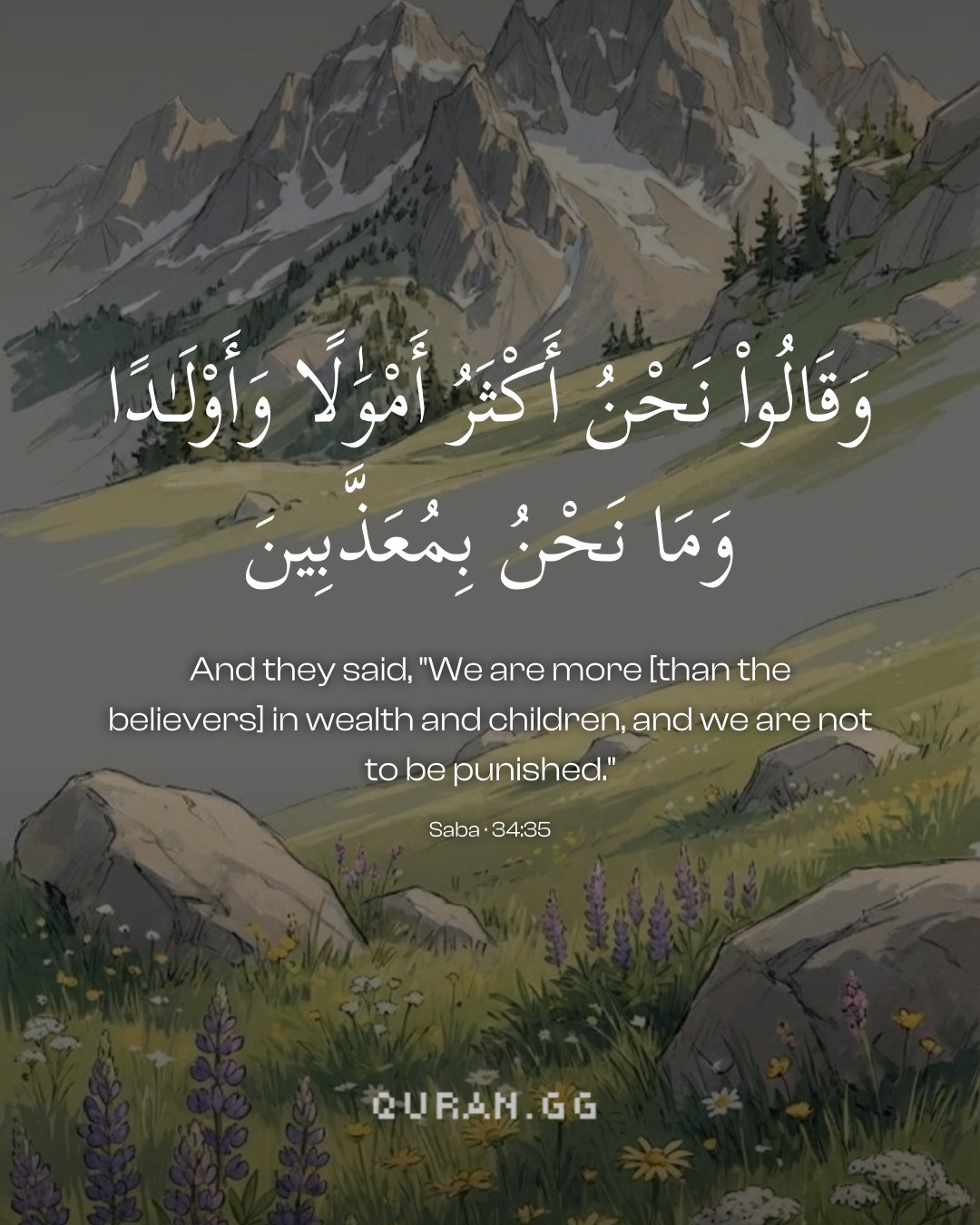
Quoted in the next verse (35) is their saying: نَحْنُ أَكْثَرُ أَمْوَالًا وَأَوْلَادًا وَمَا نَحْنُ بِمُعَذَّبِينَ which, in effect, means: "We are superior in riches and children, and we are not going to be punished - 35". (Obviously, by it, they meant: If we had been deserving of punishment in the sight of Allah Ta’ ala, why would He give us all this wealth and recognition)? The noble Qur'an gives an answer in the next two verses by saying:... نَحْنُ أَكْثَرُ أَمْوَالًا وَأَوْلَادًا وَمَا نَحْنُ بِمُعَذَّبِينَ ("I: fact, my Lord extends provision to whom He wills, and straitens (it for whom He wills), but most of the people do not know". 34:36] And neither your riches nor your children are the things that bring you near Us closely; however, the one who believes and acts righteously (is close to Us) وَمَا أَمْوَالُكُمْ وَلَا أَوْلَادُكُم 34:37). The gist of the answer is that having more wealth and recognition in this world, or not having any, is no proof of someone being acceptable or unacceptable in the sight of Allah. In fact, it is in view of creational considerations that Allah Ta’ ala would give, at least in this world, property and wealth in abundance to whomever He wills, and gives less to whomever He wills. He alone knows the creational consideration behind it. But, taking the abundance of wealth and children to be a proof of being acceptable in the sight of Allah is sheer ignorance because, with Him, the criterion of acceptability, approval, support and pleasure is no other but 'Iman (faith) and good deed. One who does not carry these two assets - no matter how much wealth and how many children one has - these cannot make him or her acceptable in the sight of Allah.
Tazkirul Quran
Maulana Wahiduddin KhanOn ayahs 33–38
Denial of Truth is the greatest crime. The result of this crime does not become apparent to an individual in this world. Therefore, he goes on fearlessly denying the Truth. But, in the Hereafter, when the adverse effect of denying the Truth impinges on the deniers, they will be caught in a state of turmoil. The common people, in this world, were proud of their leaders, but once in the Hereafter, they will curse them. In reply, their leaders will say, ‘Don’t blame us to cover up your ignominy. It was not we who misguided you but your own desires. You were with us simply because our words were in consonance with your own desires. You wanted a religion in which you could get credit for being righteous without taking much trouble and without changing yourself, and we provided you with it. You put our noose around your neck of your own accord; otherwise, we had no power to do so.’
Uthmani text of the Madinah mushaf (King Fahd Complex). Translation: Saheeh International. Tafsir via Quran.com.