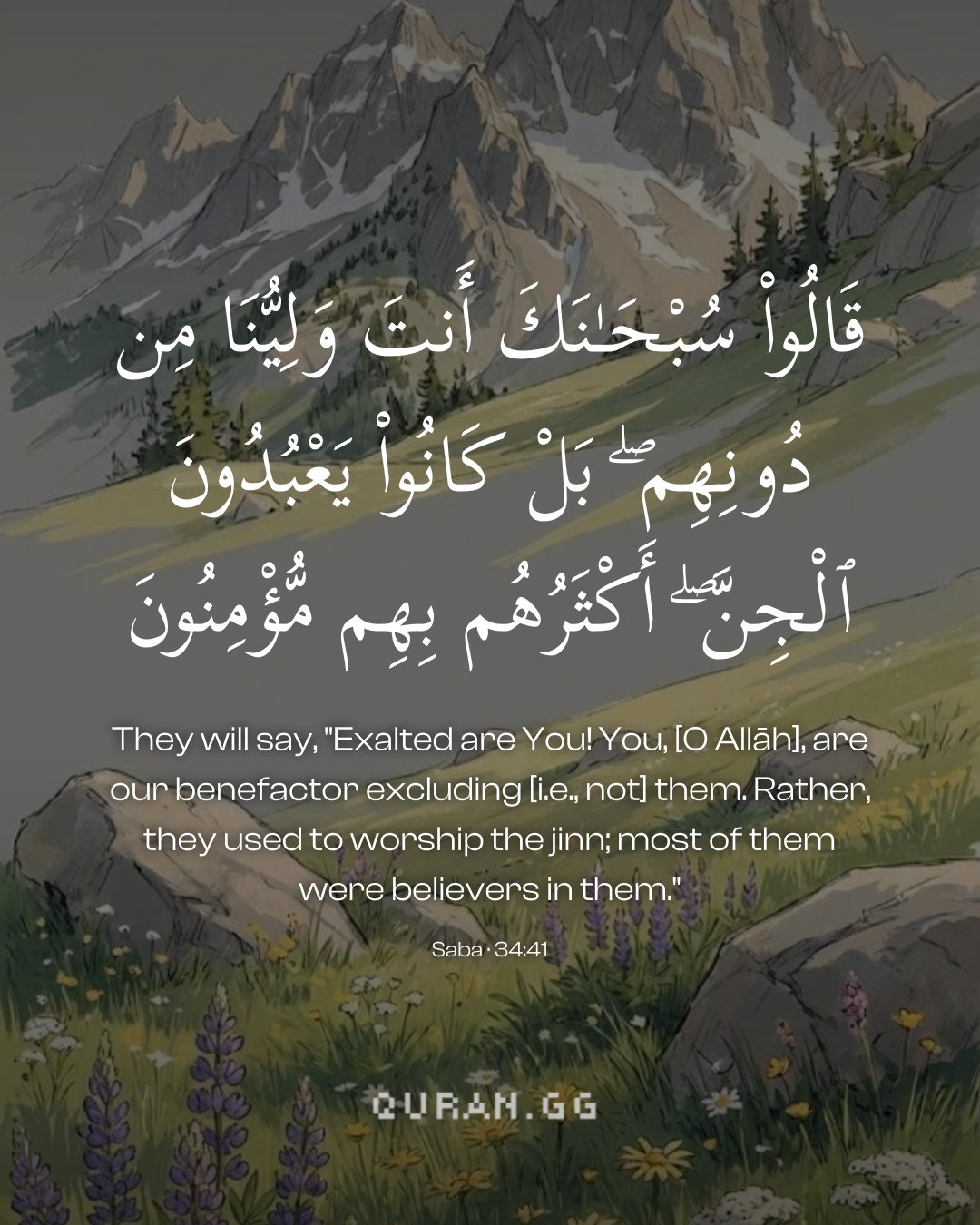
They will say, "Exalted are You! You, [O Allāh], are our benefactor excluding [i.e., not] them. Rather, they used to worship the jinn; most of them were believers in them."
The Angels will disown Their Worshippers on the Day of Resurrection
Allah tells us that on the Day of Resurrection, He will rebuke the idolators before all of creation. He will ask the angels whom the idolators used to worship, claiming that their idols were in the form of these angels and that they could bring them nearer to Allah. He will ask the angels:
أَهَـؤُلاَءِ إِيَّاكُمْ كَانُواْ يَعْبُدُونَ
(Was it you that these people used to worship) meaning, `did you command them to worship you' Allah says in Surat Al-Furqan:
This verse has appeared a little earlier (36) almost in the same words. As obvious, the same thing has been mentioned here, however, it has a difference. At this place, there is an addition of: مِنْ عِبَادِهِ (out of His servants) after: مَن يَشَاءُ whomsoever He wills) and: لَہ، (lahu: for him or whomever) after: یَقدِر (yaqdir: straitens). From the statement: مِنْ عِبَادِهِ (min 'ibadihi: from His servants), it is gathered that this rule of guidance has been put forth for His particular servants, that is, for the believers, and the purpose is to alert people of faith that they should not start loving wealth and comfort to the extent that their hearts choke when it comes to spending at occasions and on rights enjoined by Allah Ta’ ala. As for the earlier verse (36) that carries the same text, it was addressed to disbelievers and polytheists who prided on the worldly assets of wealth and children and declared these to be the proof of their success in the Hereafter. Thus, any discordance between the addressee and the purpose of address stands eliminated. Maulana Ashraf ` Ali Thanavi (رح) ، in his khulasah of Tafsir Bayn ul-Qur'an, has taken the same approach by first adding 'the believers' in parenthesis while explaining this verse.
Those who acquire wealth and power, rise to places of prominence in this world. This creates a sort of false confidence in them. Such people do not give due importance to the Hereafter, even when they are warned of it. They cannot believe that God, Who has given them honour in this world, will dishonour them in the Hereafter. This false confidence in every age has been the greatest cause of the rejection of the call for Truth by the influential members of a society; and when they look down upon something, men of lesser stature also hold it in contempt. In this way the common people as well as the elite are prevented from accepting the Truth. The wealth and other material things of this world are for the purpose of putting human beings to the test and are not meant as rewards. A surfeit of worldly effects is not a sign of nearness to God; nor does their shortage indicate being at a distance from Him. Only those who always remembered God and kept themselves within the limits laid down by Him, while availing of His divine bounty, are really close to God. These are the people who will be treated as deserving of God’s eternal blessings and rewards in the Hereafter.
Uthmani text of the Madinah mushaf (King Fahd Complex). Translation: Saheeh International. Tafsir via Quran.com.