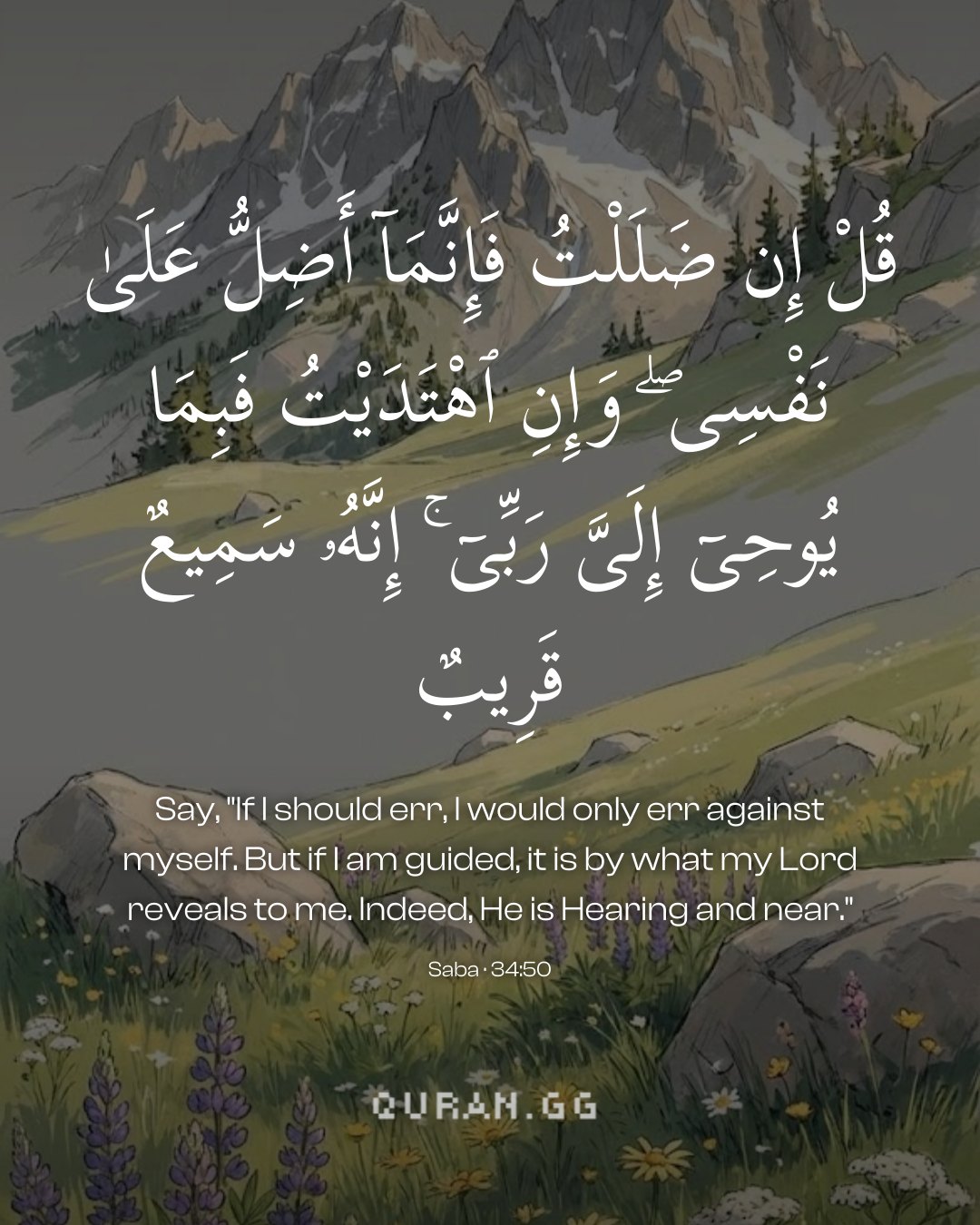
I do not ask for any Reward for conveying the Message
Allah commands His Messenger to say to the idolators:
مَا سَأَلْتُكُم مِّن أَجْرٍ فَهُوَ لَكُمْ
(Whatever wage I might have asked of you is yours.) meaning, `I do not want anything for conveying the Message of Allah to you, advising you and telling you to worship Allah.'
إِنْ أَجْرِىَ إِلاَّ عَلَى اللَّهِ
My wage is from Allah only, means, rather I will seek the reward for that with Allah.
وَهُوَ عَلَى كُلِّ شَىْءٍ شَهِيدٍ
and He is a Witness over all things. means, He knows all things, and He knows everything about me and the manner in which I am conveying the Message to you, and He knows all about you.
Verse 48: إِنَّ رَبِّي يَقْذِفُ بِالْحَقِّ عَلَّامُ الْغُيُوبِ (Say," My Lord sends forth the Truth. He is the Best-Knower of the Unseen." - 34:48) Say, "Truth has come, and falsehood (has vanished so as it) has no power to produce or reproduce (anything) ". It means that my Lord who is the Knower of the Unseen strikes out the false with a throw of the truth (as a result of which the false is destroyed, as it was said: فَإِذَا هُوَ زَاهِقٌ 'and there it is all gone'. Al-Anbiya', 21:18). Literally, the word: قَذَف (qadhf) means to hit by throwing. Here, the purpose is to highlight the truth as set against the false. Perhaps, there may be a wise consideration behind expressing this phenomenon through the word: یَقذِف (yaqdhifu: He throws), may be the purpose is to point out to the after effect of the truth prevailing over the false. It appears here in the form of a simile as the throwing of something heavy over something feeble that shatters into pieces. So it happens in the confrontation between truth and falsehood when the later lies shattered. Therefore, it was said next: وَمَا يُبْدِئُ الْبَاطِلُ وَمَا يُعِيدُ (and falsehood has vanished so as it has no power to produce or reproduce anything) that is, falsehood becomes so incapacitated in the face of truth that it can neither originate anything nor can it bring it back.
Tazkirul Quran
Maulana Wahiduddin KhanOn ayahs 50–53
The world has been created on the basis of Truth. Here, all emphasis is on Truth and all arguments support the Truth. Under these circumstances, Truth should prevail and untruth should carry no weight. But, it is not always so. In this world, sometimes Truth is unable to triumph over untruth. The reason for this is that this world is a testing ground, and the rules pertaining to the human trial are prevalent here. So, even untruth has the opportunity to flourish here. But this situation will last only till the end of the trial period. On the Day of Judgement, this unrealistic situation will end once and for all. At that time, all evidence will substantiate the Truth, and untruth will be completely valueless. This event will become a reality on the Day of Judgement. But if and when God wishes, He shows a glimpse of it in this world itself, so that people may learn a lesson from it. A demonstration of this was when Makkah fell and monotheism overcame polytheism, the Prophet of God recited this verse, ‘Truth has arrived and falsehood has perished, for falsehood is bound to perish.’
Uthmani text of the Madinah mushaf (King Fahd Complex). Translation: Saheeh International. Tafsir via Quran.com.