Sulayman the Son of Dawud
Allah tells us that he gave Sulayman to Dawud as a Prophet, as He says elsewhere:
وَوَرِثَ سُلَيْمَـنُ دَاوُودَ
(And Sulayman inherited Dawud) (27:1). meaning, he inherited prophethood from him. Dawud had other sons besides Sulayman, for he had one hundred free wives.
نِعْمَ الْعَبْدُ إِنَّهُ أَوَّابٌ
(How excellent a servant! Verily, he was ever oft-returning in repentance (to Us)!) This is praise for Sulayman, because he was very much obedient, worshipping Allah much and always turning to Allah in repentance.
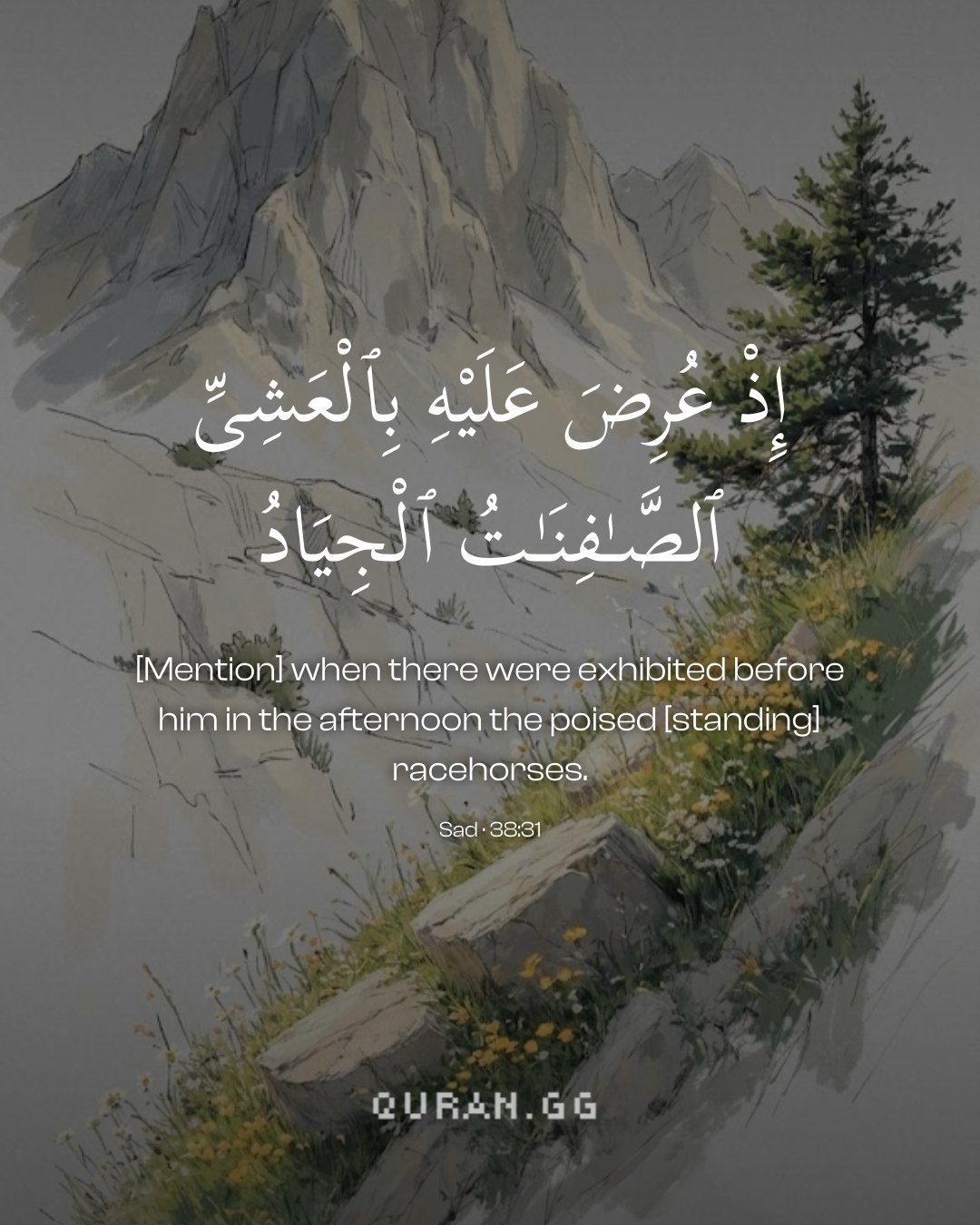
إِذْ عُرِضَ عَلَيْهِ بِالْعَشِىِّ الصَّـفِنَـتُ الْجِيَادُ
(When there were displayed before him, in the afternoon, well trained horses of the highest breed.) means, these well trained horses were shown to Sulayman, peace be upon him, in his capacity as king and ruler. Mujahid said, "They were the kind of horses which stand on three legs and raise the fourth, and they were swift horses." This was also the view of several others among the Salaf. Abu Dawud recorded that `A'ishah, may Allah be pleased with her, said, "The Messenger of Allah ﷺ came back from the campaign of Tabuk or Khaybar, and there was a curtain covering her room. The wind came and lifted the curtain, revealing some toys belonging to `A'ishah, may Allah be pleased with her. The Prophet said:
Continue reading the tafsir of ayahs 30–33 Commentary
In these verses, an event relating to Sayyidna Sulayman (علیہ السلام) has been mentioned. The gist of the well known Tafsir of this event is that Sayyidna Sulayman (علیہ السلام) was so engrossed in the inspection of the horses that he missed to perform the Salah of Al-` Asr at his usual time. Later, when he was alerted to this loss, he slaughtered all those horses as the unfortunate interference in the remembrance of Allah took place because of them.
This missed Salah could be a nafl salah. Given this situation, there should be no difficulty in understanding what Sulayman (علیہ السلام) did, for the noble prophets try to make amends for even this much of negligence. And it is also possible that the Salah concerned was obligatory (fard) and his engrossment in the inspection might have caused him to forget. Although if someone forgets to perform the fard (obligatory) Salah, it does not cause a sin to have been committed, but Sayyidna Sulayman (علیہ السلام) ، in view of his high station, expiated for that too.
Continue reading the tafsir of ayahs 30–31 The system governing the functioning of our world is bound by wise and firm principles, when a random and unreliable system could very well have existed in its place. Between these two possibilities, the choice of the better one—the one which is governed by firm laws—is indicative of the fact that the Creator of such a world created it for a purpose. It follows that a world whose beginning was purposeful cannot have an end which is purposeless. Similarly, every man in this world enjoys a certain amount of freedom. From amongst them, are those who submit to the truth and strive to lead their life on the principles of truth and justice whereas those who do not submit to the truth, indulge in unbridled talk and unrestrained actions. Such distinctly different persons cannot have the same fate.
Uthmani text of the Madinah mushaf (King Fahd Complex). Translation: Saheeh International. Tafsir via Quran.com.