Allah tells us that he gave Sulayman to Dawud as a Prophet, as He says elsewhere:
وَوَرِثَ سُلَيْمَـنُ دَاوُودَ
(And Sulayman inherited Dawud) (27:1). meaning, he inherited prophethood from him. Dawud had other sons besides Sulayman, for he had one hundred free wives.
نِعْمَ الْعَبْدُ إِنَّهُ أَوَّابٌ
(How excellent a servant! Verily, he was ever oft-returning in repentance (to Us)!) This is praise for Sulayman, because he was very much obedient, worshipping Allah much and always turning to Allah in repentance.
(When there were displayed before him, in the afternoon, well trained horses of the highest breed.) means, these well trained horses were shown to Sulayman, peace be upon him, in his capacity as king and ruler. Mujahid said, "They were the kind of horses which stand on three legs and raise the fourth, and they were swift horses." This was also the view of several others among the Salaf. Abu Dawud recorded that `A'ishah, may Allah be pleased with her, said, "The Messenger of Allah ﷺ came back from the campaign of Tabuk or Khaybar, and there was a curtain covering her room. The wind came and lifted the curtain, revealing some toys belonging to `A'ishah, may Allah be pleased with her. The Prophet said:
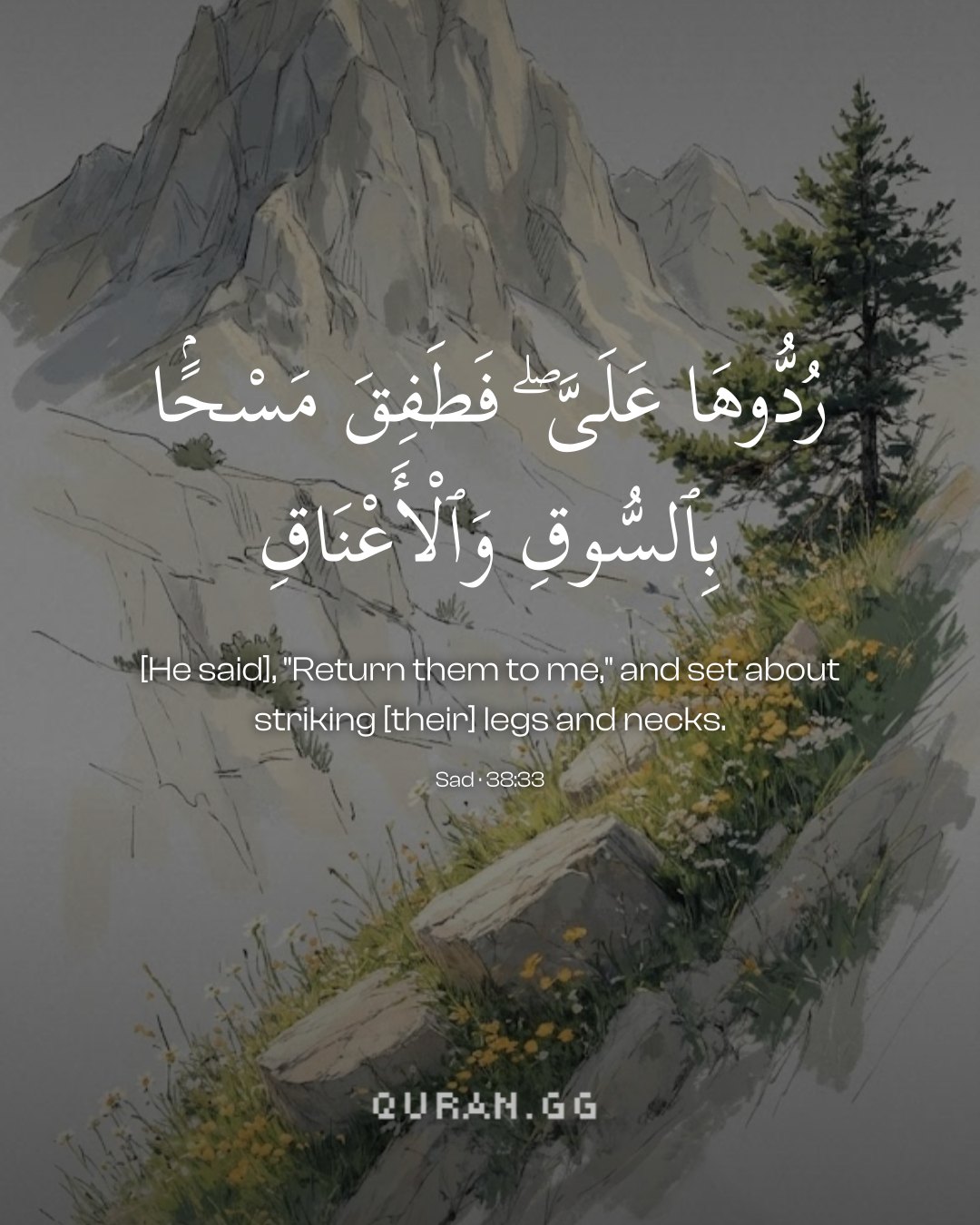
Some early interpreters have, while following the first Tafsir, also said that soon after having missed the Salah of al-` Asr, Sayyidna Sulayman (علیہ السلام) prayed to Allah Ta’ ala, or requested the angels, that the Sun should be made to return. Accordingly, the Sun was returned and he was enabled to perform his appointed Salah. After that, the Sun set once again. These people take the pronoun in: رُدُّوهَا (rudduha: Bring it back to me - 38:33) as reverting to the Sun.
But, investigative commentators, for instance, ` Allamah ` Alusi and others have rejected this fictional approach, and have said that the pronoun in: رُدُّوهَا (rudduha: Bring them back to me) is reverting to 'horses' and not to the Sun - not because, refuge with Allah, making the Sun to return is not within the power and control of Allah Ta’ ala, but because this story does not stand proved from the Qur'an and Hadith. (Ruh-ul-Ma’ ani)
Solomon, the son of David was the ruler of a great empire. Once the thoroughbred horses of his army were brought before him and a race was held. The galloping horses moved further and further away until they were out of sight. This was a magnificent moment upon witnessing which, an ordinary man would have become full of pride and vanity. But Solomon started remembering God. He said that he had not chosen these horses to flaunt his grandeur, but only for the sake of God. In the shape of the horses, he could discern the great workmanship of God, and by way of appreciating the greatness of God, he started to stroke the necks and legs of the horses. A believer, therefore, has the ability to observe the glory of God in everything, while a non-believer remains entrapped in the false notions of self-glory.
Uthmani text of the Madinah mushaf (King Fahd Complex). Translation: Saheeh International. Tafsir via Quran.com.