How Allah tested Sulayman then made Things easy for Him
Allah says,
وَلَقَدْ فَتَنَّا سُلَيْمَـنَ
(And indeed, We tried Sulayman) meaning, `We tested him.'
وَأَلْقَيْنَا عَلَى كُرْسِيِّهِ جَسَداً
(and We placed on his throne Jasad (a body)).
ثُمَّ أَنَابَ
(and he returned.) means, after this test, he turned back to Him and asked for forgiveness and to be given a kingdom such as shall not belong to any other after him.
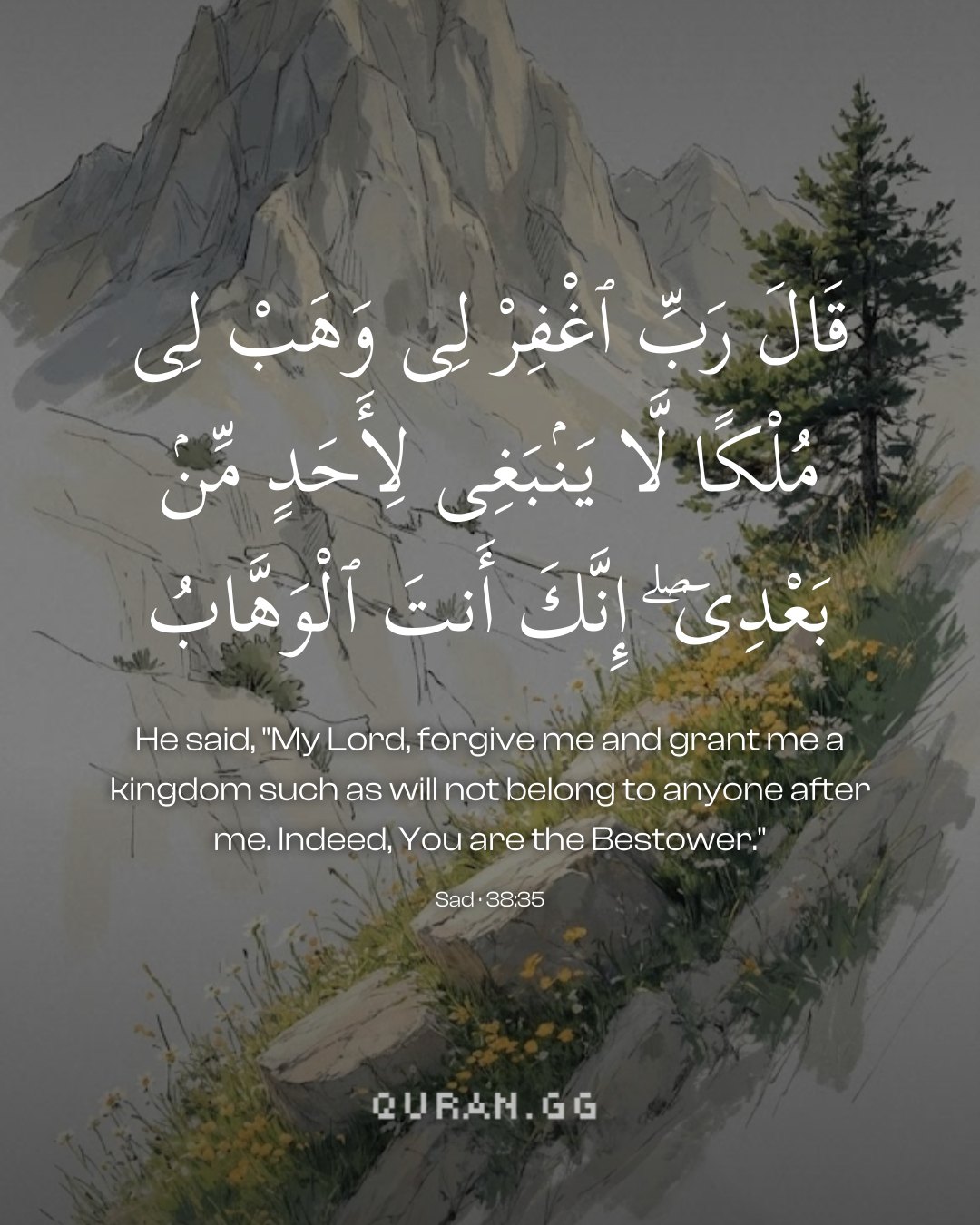
(He said: "My Lord! Forgive me, and bestow upon me a kingdom such as shall not belong to any other after me. Verily, You are the Bestower.") Some of them said, "No one after me will have the right to ask Allah for such a kingdom." This is the apparent meaning from the context of the Ayah, and several Hadiths with a similar meaning have been narrated from the Messenger of Allah ﷺ. In his Tafsir of this Ayah, Al-Bukhari recorded that Abu Hurayrah, may Allah be pleased with him, said that the Prophet said:
It was said in verse 35: هَبْ لِي مُلْكًا لَّا يَنبَغِي لِأَحَدٍ مِّن بَعْدِي (bless me with a kingdom that will not be available to anyone after me.). Some commentators explain the sense of this prayer as 'let not a great kingdom like mine belong to anyone else during my time.' In other words, they take "min ba` di": or 'after me' in the sense of 'other than me.' Maulana Ashraf Thanavi (رح) has done his translation accordingly. But, with most commentators, the sense of the prayer is: 'Even after me, let no one have a kingdom as great as this.' Accordingly, so it happened. The kingdom that Allah Ta ala gave to Sayyidna Sulayman (علیہ السلام) was a kingdom the like of which never became the lot of anyone else. The reason was simple. The subjugation of the wind and the command over the genre of the Jinn were exclusive traits of his kingdom, and no kingdom that followed him had these characteristics. There are some people who carry out mysterious exercises (amaliyyat) through which they are known to subjugate Jinns, a phenomenon that does not fall contrary to this, because it cannot be compared, in the least, to the subjugation of the jinn Allah had allowed for Sayyidna Sulayman (علیہ السلام) . Moreover, these experts in amaliyyat are able to make just about one or a few Jinns become obedient to them, but the kind of wide spread kingdom that Sayyidna Sulayman (علیہ السلام) had was not acquired by anyone.
Praying for office and power
At this place, it should be borne in mind that no prayer made by the noble prophets is made without the will and permission of Allah Ta’ ala. Sayyidna Sulayman (علیہ السلام) had made this prayer too by the will and permission of Allah Ta’ ala. And since some bland seeking of power was not his aim, rather the driving desire to implement Divine laws and the passion to make truth triumph was behind it - and Allah Ta’ ala knew that once Sayyidna Sulayman (علیہ السلام) had the power, he would work for these very high objectives, and would never entertain negative feelings of office, power and recognition - therefore, he was given the permission to make this prayer, and it was accepted as well. But, common people have been prohibited in Hadith from seeking power following their own initiative. The reason is that such an initiative usually gets to be tainted with the desire for power, influence, money and property. Accordingly, where one has the certitude of being free of such selfish desires and one really would love to see the banner of truth fly high without the least hunger for power hidden anywhere in the recesses of his heart - then, for such a person, praying for power and authority of government is permissible. (Ruh-ul-Ma’ ani etc.)
Tazkirul Quran
Maulana Wahiduddin KhanOn ayahs 35–42
Every human being is liable to err. But, for the pious and righteous subjects of God, a wrongful act leads to great virtue, because after the misdeed, they turn towards their Lord with much more devotion and thus become entitled to a much better reward. On one occasion, Solomon made an error in judgement which required an interpretation and making a decision. When the truth dawned on him, he turned towards God with the utmost devotion. Almighty God forgave him and in addition gave him the reward of a great empire; He also gave him such extraordinary powers as no other man had ever enjoyed.
Uthmani text of the Madinah mushaf (King Fahd Complex). Translation: Saheeh International. Tafsir via Quran.com.