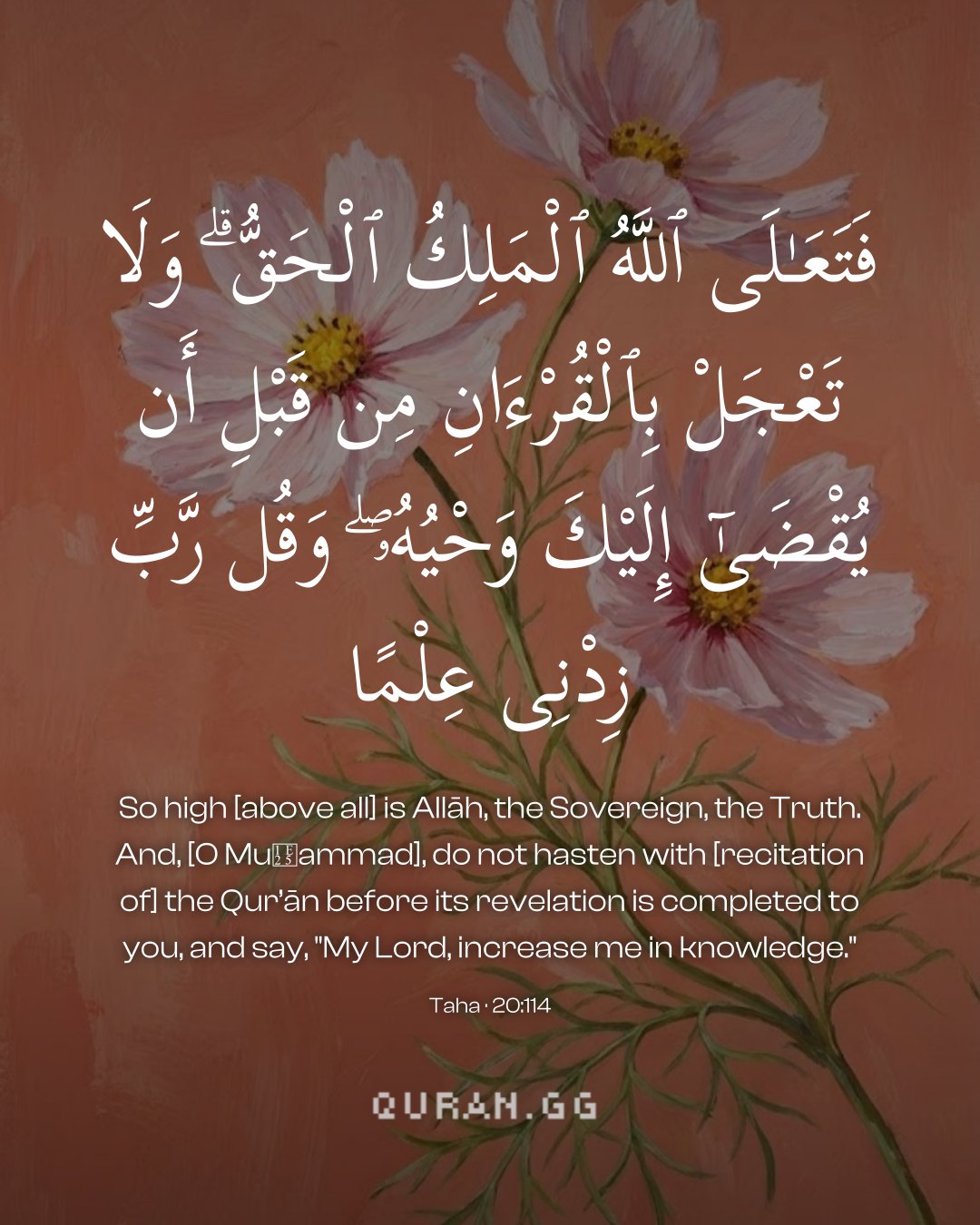
So high [above all] is Allāh, the Sovereign, the Truth. And, [O Muḥammad], do not hasten with [recitation of] the Qur’ān before its revelation is completed to you, and say, "My Lord, increase me in knowledge."
The Qur'an was revealed so that the People would have Taqwa and reflect
After Allah, the Exalted, mentions that on the Day of Judgement both the good and the evil will be recompensed and there is no avoiding it, He then explains that the Qur'an was revealed as a bringer of glad tidings and a warner in the clear and eloquent Arabic language. There is no confusion or deficiency in it.
(And thus We have sent it down as a Qur'an in Arabic, and have explained therein in detail the warnings, in order that they may have Taqwa of,) This means: so that they will leave off sins, forbidden things and lewd abominations.
وَلَا تَعْجَلْ بِالْقُرْآنِ مِن قَبْلِ أَن يُقْضَىٰ إِلَيْكَ وَحْيُهُ (And do not hasten with (reciting) the Qur'an before its revelation is concluded - 20: 114.) It has been stated in Sahih Hadith on the authority of Sayyidna Ibn ` Abbas ؓ that in the early days of revelation when angel Jibra'il (علیہ السلام) brought a Qur’ anic verse and recited it to the Holy Prophet ﷺ ، the latter would try to repeat it after him, lest it escapes from his memory. He had, thus, to make a double effort, i.e. to listen to and understand the meaning of the Qur'anic verses while they were being recited by Jibra'il (علیہ السلام) and also to repeat them in order to commit them to memory. In this verse as well as in the verse لَا تُحَرِّكْ بِهِ لِسَانَكَ occurring in Surah قِیَامۃ (75:16) Allah lightened this burden from the Holy Prophet ﷺ by assuring him that he need not worry himself about memorizing the Qur'anic verses which were revealed to him because He (Allah) would make it possible for him to remember them without any effort on his part. All that he was directed to do was that he should keep praying, رَّبِّ زِدْنِي عِلْمًا (My Lord, improve me in knowledge). This comprehensive prayer includes a plea for memorizing that portion of the Qur'an which had already been revealed to him and a desire for what remained of it and for the ability to understand its true meaning.
Tazkirul Quran
Maulana Wahiduddin KhanOn ayahs 114–116
A dayee should have two major aims: to bring about a psychological revolution in his addressees so that they may become God-fearing or at least he should be able to raise questions in his hearers about his call. During the Dawah campaign in Makkah, the addressees were raising all sorts of questions, creating problems for the Prophet. The Prophet naturally wanted that the intervals between the revelations could be reduced, so that he could receive God’s guidance more frequently. This would have enabled him to deal more promptly and effectively with the questions and problems which arose daily during his dawah work in Makkah. He was told that the process of revelation was in accordance with a divine, pre-ordained plan. It would continue as the occasion warranted, and would reach its completion in due course. He was asked not to desire the revelation of future parts of the Quran before their divinely appointed time. However, he was advised to pray to God to increase his understanding of the vast wisdom enshrined in the verses of the Quran. Instead of wishing for an early revelation of Quranic verses, he was expected to have the desire to understand the reason for their being revealed gradually, on a pre-planned scale of priority.
Uthmani text of the Madinah mushaf (King Fahd Complex). Translation: Saheeh International. Tafsir via Quran.com.