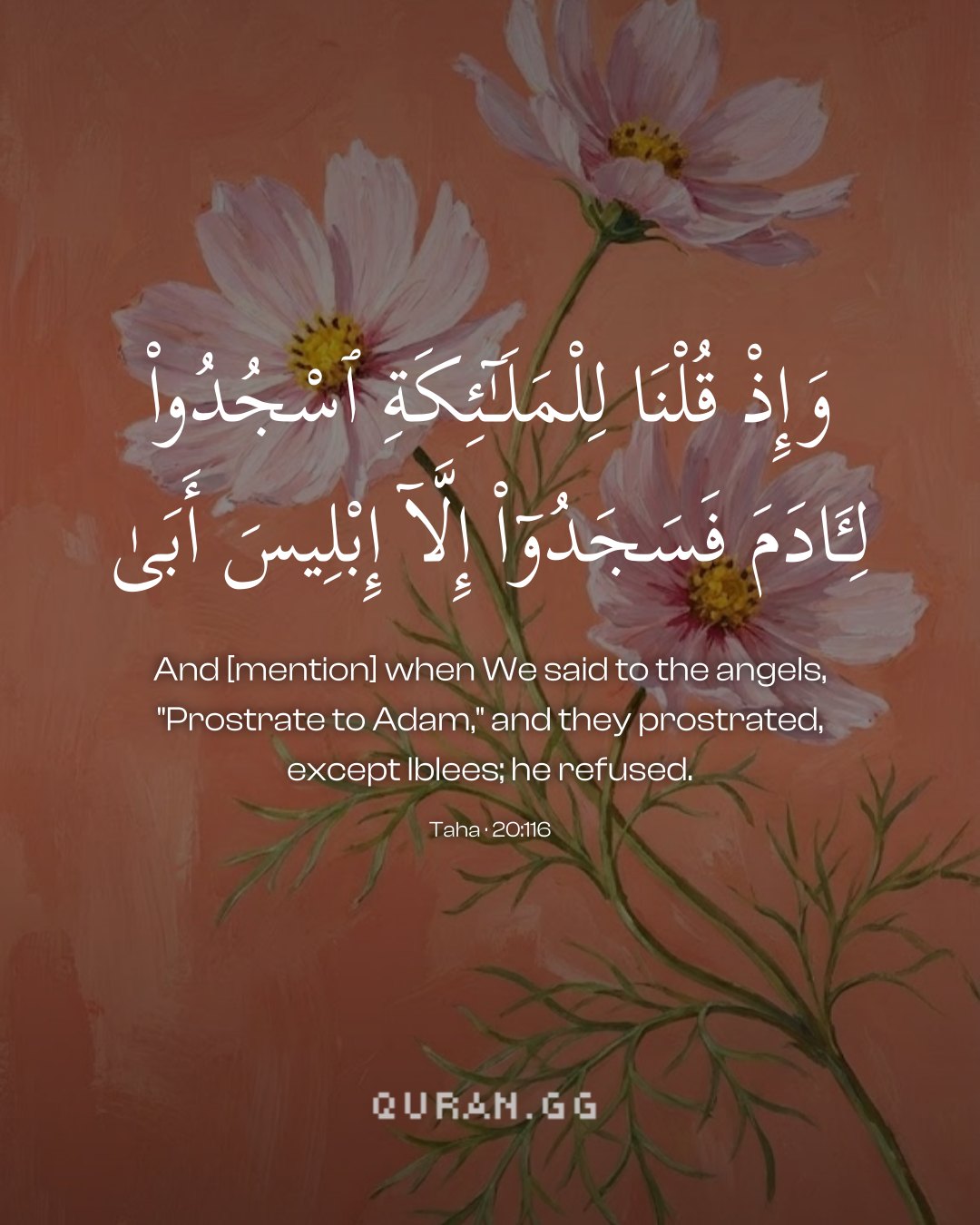
Ibn Abi Hatim recorded that Ibn `Abbas said, "Verily, man was named Insan only because he was given a covenant, but he forgot it (Nasiya)." `Ali bin Abi Talhah reported the same from Ibn `Abbas. Mujahid and Al-Hasan said that he forgot means, "He abandoned it." Concerning Allah's statement,
(And when We said to the angels: "Prostrate yourselves to Adam.") He, Allah mentions how Adam was honored and what respect was given to him. He mentions how He favored him over many of those whom He created. A discussion of this story has already preceded in Surat Al-Baqarah, Surat Al-A`raf, Surat Al-Hijr and Surat Al-Kahf. It will also be mentioned again at the end of Surah Sad. In this story, Allah mentions the creation of Adam and that He commanded the angels to prostrate to Adam as a sign of honor and respect. He also explains the enmity of Iblis for the Children of Adam and for their father, Adam, before them. Due to this Allah says,
وَإِذْ قُلْنَا لِلْمَلَائِكَةِ (And when We said to angels - 20:116)Here is a brief mention of the command which, after the creation of Sayyidna 'Adam (علیہ السلام) Allah gave to all the angels including Iblis (Shaitan) who at that time lived in the Paradise with them, to prostrate to him. All the angels obeyed but Shaitan refused. In his haughtiness he claimed that he was made of fire while Sayyidna 'Adam (علیہ السلام) was made of clay, and fire being superior to clay, he could not be expected to prostrate to the latter. As a punishment for his arrogance and defiance of the command of Allah he was accursed and driven from Paradise while all the gates of Paradise were opened wide for Sayyidna 'Adam (علیہ السلام) and Sayyidnh Hawwa' (علیہا السلام) to enjoy the fruits of its gardens and all the blessings of Allah at their will. However, there was one particular tree which they were told to shun in all circumstances and never to partake of any of its produce. This story has been related in Surah Al-Baqarah and Al-A'rif. Instead of repeating it here, Allah has mentioned his directives given to Sayyidna 'Adam (علیہ السلام) to comply with His commands to the fullest extent. Referring to the rebellious conduct of shaitan He reminds Sayyidna 'Adam (علیہ السلام) that the former is his enemy and that both he himself and his wife should at all times be on their guard against his deceptions. But if they succumbed to his tricks and became heedless of the commands of Allah then they would be expelled from Paradise and face distress
Tazkirul Quran
Maulana Wahiduddin KhanOn ayahs 114–116
A dayee should have two major aims: to bring about a psychological revolution in his addressees so that they may become God-fearing or at least he should be able to raise questions in his hearers about his call. During the Dawah campaign in Makkah, the addressees were raising all sorts of questions, creating problems for the Prophet. The Prophet naturally wanted that the intervals between the revelations could be reduced, so that he could receive God’s guidance more frequently. This would have enabled him to deal more promptly and effectively with the questions and problems which arose daily during his dawah work in Makkah. He was told that the process of revelation was in accordance with a divine, pre-ordained plan. It would continue as the occasion warranted, and would reach its completion in due course. He was asked not to desire the revelation of future parts of the Quran before their divinely appointed time. However, he was advised to pray to God to increase his understanding of the vast wisdom enshrined in the verses of the Quran. Instead of wishing for an early revelation of Quranic verses, he was expected to have the desire to understand the reason for their being revealed gradually, on a pre-planned scale of priority.
Uthmani text of the Madinah mushaf (King Fahd Complex). Translation: Saheeh International. Tafsir via Quran.com.