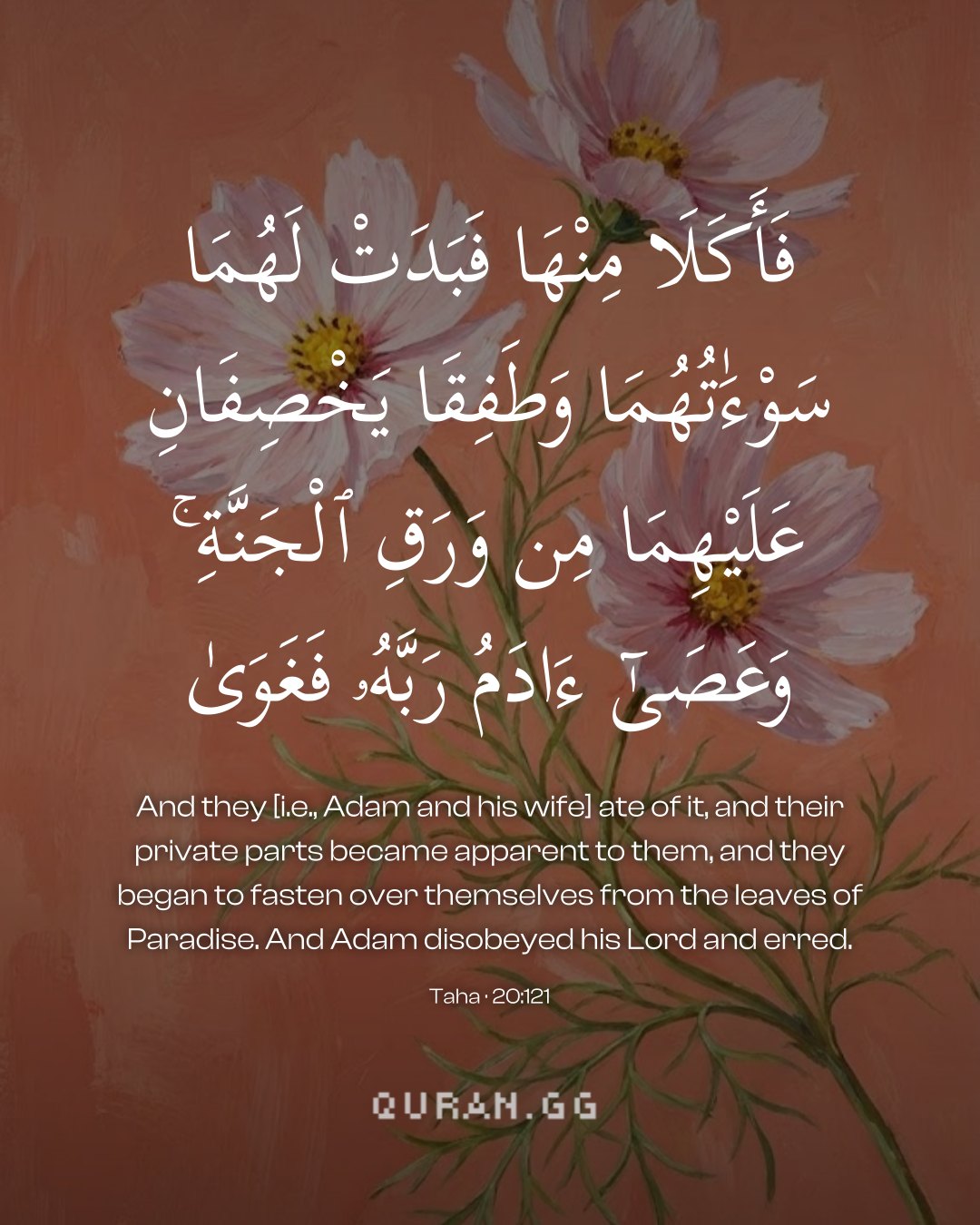
And they [i.e., Adam and his wife] ate of it, and their private parts became apparent to them, and they began to fasten over themselves from the leaves of Paradise. And Adam disobeyed his Lord and erred.
Ibn Abi Hatim recorded that Ibn `Abbas said, "Verily, man was named Insan only because he was given a covenant, but he forgot it (Nasiya)." `Ali bin Abi Talhah reported the same from Ibn `Abbas. Mujahid and Al-Hasan said that he forgot means, "He abandoned it." Concerning Allah's statement,
(And when We said to the angels: "Prostrate yourselves to Adam.") He, Allah mentions how Adam was honored and what respect was given to him. He mentions how He favored him over many of those whom He created. A discussion of this story has already preceded in Surat Al-Baqarah, Surat Al-A`raf, Surat Al-Hijr and Surat Al-Kahf. It will also be mentioned again at the end of Surah Sad. In this story, Allah mentions the creation of Adam and that He commanded the angels to prostrate to Adam as a sign of honor and respect. He also explains the enmity of Iblis for the Children of Adam and for their father, Adam, before them. Due to this Allah says,
فَوَسْوَسَ إِلَيْهِ الشَّيْطَانُ قَالَ يَا آدَمُ هَلْ أَدُلُّكَ عَلَىٰ شَجَرَةِ الْخُلْدِ وَمُلْكٍ لَّا يَبْلَىٰ ﴿120﴾ فَأَكَلَا مِنْهَا فَبَدَتْ لَهُمَا سَوْآتُهُمَا وَطَفِقَا يَخْصِفَانِ عَلَيْهِمَا مِن وَرَقِ الْجَنَّةِ ۚ وَعَصَىٰ آدَمُ رَبَّهُ فَغَوَىٰ (Then the Shaitan instigated him...And 'Adam disobeyed his Lord and erred- 120, 121.) Here it is pertinent to ask that when Allah had specifically told Sayyidna 'Adam and Sayyidah Hawwa' (علیہما السلام) to abstain from a particular tree or to eat any part of its yield, and had also warned them to beware of shaitan's machinations who was their sworn enemy who would do his best to seduce them and thus cause their expulsion from Paradise, why then, despite all the warnings and admonitions, did Sayyidna 'Adam (علیہ السلام) let himself fall into the trap laid out for him by the shaitan. His action clearly constituted disobedience of the commands of Allah and were, therefore, acts of sin. There is consensus among scholars that the prophets of Allah are immune from all sins - minor or major, and Sayyidna 'Adam (علیہ السلام) was a prophet of Allah! So how may one explain his action of eating the fruit of the forbidden tree when Allah had warned him in such clear terms? An answer to all these questions will be found in the commentary of Surah Al-Baqarah which also explains the use of the words عِصٰی (to disobey) and غَوٰی (to err) in reference to Sayyidna 'Adam (علیہ السلام) . According to the divine Islamic law the action of Sayyidna 'Adam (علیہ السلام) did not constitute a sin but because he was a prophet of Allah and in His high favour therefore this minor lapse on his part has been described as عِصیَان (disobedience) for which he was admonished by Allah. A further point here is that the word غَوٰی has two meanings: One is "to be deprived" and the other is "to err", or "to go astray". Al-Qushairi and Al-Qurtubi have adopted the first meaning of the word and have explained this verse by saying that as a punishment for his lapse Sayyidna 'Adam (علیہ السلام) was deprived of the comforts which were available to him in the Paradise and as a result his life became harsh and bitter.
To adhere steadfastly to God’s commandments, unwavering determination is essential. If a man is influenced by irrelevant factors, he will undoubtedly deviate from the path of God. In order to remain steadfastly on the path of God, it is not enough to know what His commandment is; it is also absolutely necessary to have the will to resist all that goes against His commandment, and not to let himself be influenced by it. When God ordered that all should kneel down before Adam, the angels immediately dropped to their knees. But Satan did not do so. The reason for this difference in behaviour was that the angels treated this matter as pertaining to God, whereas Satan, on the contrary, saw it as the affair of a mere mortal. When an issue concerns God, man has no option but to bow to His wishes. But when it is treated as relating to a human being, the person in question will appraise the human being before him. If the latter is comparatively stronger, he will kneel down; otherwise he will refuse to kneel down, even if such an action be the demand of truth and justice.
Uthmani text of the Madinah mushaf (King Fahd Complex). Translation: Saheeh International. Tafsir via Quran.com.