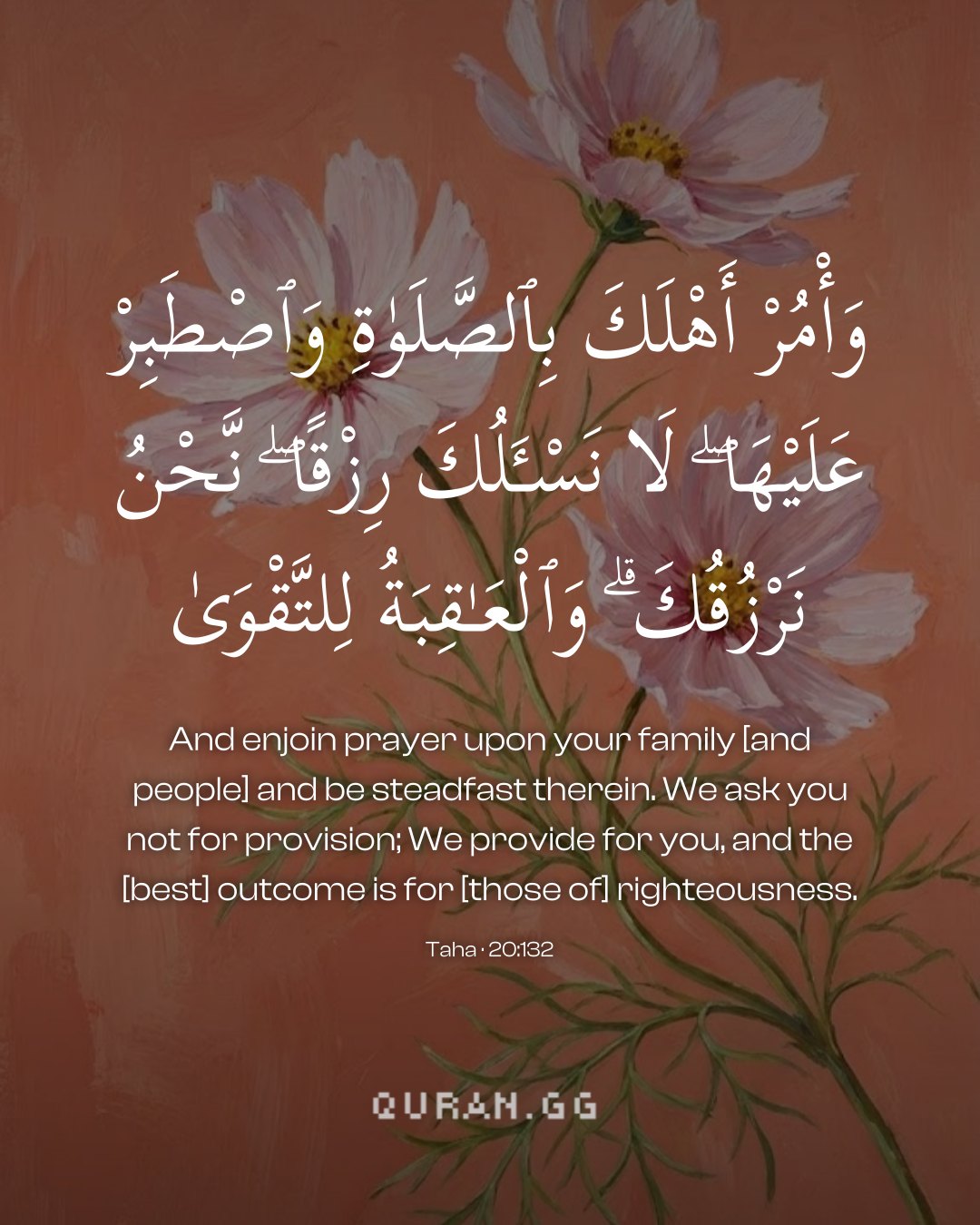
And enjoin prayer upon your family [and people] and be steadfast therein. We ask you not for provision; We provide for you, and the [best] outcome is for [those of] righteousness.
Do not look at the Enjoyment of the Wealthy, be patient in the worship of Allah
Allah, the Exalted, says to His Prophet Muhammad ﷺ, "Do not look at what these people of luxury and their likes and peers have of nice comforts. For verily, it is only short-lived splendor and a feeble bounty, which We are using to test them with. And very few of My servants are truly thankful." Mujahid said,
أَزْوَجاً مِّنْهُمْ
(various groups of them,) "This means the wealthy people." This means, "Verily, We have given you (O Muhammad) better than that which We have given them." This is just as Allah says in another Ayah,
Requiring one's relatives and associates to offer their prayers regularly and the philosophy behind it
وَأْمُرْ أَهْلَكَ بِالصَّلَاةِ وَاصْطَبِرْ عَلَيْهَا (And bid your family to perform salah and adhere to it yourself - 132) Here the Holy Prophet has been asked to direct the members of his family to say prayers and that he himself should be very particular about his prayers. These appear to be two separate commands, i.e. one for the family and the other for himself but the fact is that for a person to be steadfast in saying prayers it is essential that his family and friends should be equally mindful of their duty in this matter. The word اھل ahl used for the family is quite comprehensive and includes a person's wife, children and his associates because all of them influence the environment and are an integral part of society. After this verse was revealed to the Holy Prophet ﷺ he used to go to the house of Sayyidna Ali and Sayyidah Fatimah ؓ every morning at the time of morning prayers and call out الصَّلَاةِ الصَّلَاةِ (Come to salah, come to salah). (Qurtubi)
It is reported that whenever Sayyidna ` Urwah ibn Zubair ؓ saw a display of wealth, he would at once return home, call his family to prayer and recite to them this verse. Also when Sayyidna ` Umar ibn Khattab ؓ got up for his midnight (tahajjud) prayers, he would awake the other members of his family and recite to them this verse. (Qurtubi)
Allah provides easy sustenance to a person who devotes himself to prayers and to His worship
لَا نَسْأَلُكَ رِزْقًا (We ask no provision from you - 20:132) Allah does not demand of the people that they should provide sustenance to their families and dependants by their own power, because the responsibility for this is in His hands alone. Man is incapable of providing for himself, and the best that he can do is to plough the land and plant seeds in it, but he has no power to germinate it or to make a tree grow out of it. The role of man in all this is to protect the tree after it has grown to maturity and then to put its yield to his personal use. And for the person who spends all his time in prayer Allah makes even this labour bearable for him (Tirmidhi). Ibn Majah has quoted Sayyidna Abu Hurairah ؓ that the Holy Prophet ﷺ said,
یقول اللہ تعالیٰ : یا ابن آدم : تفرَّغ لعبادتی املأ صدرک غنی واسد فقرک، وان لم تفعل ملأت صدرک شغلا ولم اسد فقرک (ابن کثیر)
"Allah says: '0 son of 'Adam! You dedicate yourself to My worship and I will fill your chest with sufficiency and free you from want. But if you do not obey my commands, I will fill your chest with anxieties and worries and will not free you from want."' (Ibn Kathir)
The meaning of the words لم اسد فقرک (I will not free you from want) is that such a man will always remain poor because the more wealth he acquires the more his greed will increase. And Sayyidna ` Abdullah ibn Mas’ ud ؓ says that he heard the Holy Prophet ﷺ saying,
من جعل ھمومہ ھمّا واحدا ھمّ المعاد، کفاہ اللہ ھمّ دنیاہ، ومن تشعبت بہ الھموم فی احوال الدّنیا لم یبال اللہ وی ایّ اودیۃ ھلک [رواہ ابن ماجہ ] (ابن کثیر)
"A man who makes his concern for the Hereafter the focal point of all his efforts, Allah will take care of his concerns, but a person whose concerns are all about worldly affairs, Allah does not care in which valley he perishes."
Tazkirul Quran
Maulana Wahiduddin KhanOn ayahs 132–134
These verses are addressed not only to the Prophet, but to all of the faithful. In this world when a man dedicates himself to faith and dawah work, his life as a result becomes one of toil and struggle. In sharp contrast are those who, free from such responsibilities, spend their days in ease and comfort. Satan stresses this state of affairs and creates doubts and evil ideas in a man’s heart. He tries to shake the faith of both the believer and the missionary by making them feel that if the path chosen by them had been the true path of God, they would not have had to suffer so much. But, if the matter is examined in depth, it would appear that, beyond this temporary outward difference, there is another type of difference which is much more worthwhile. It is that whatever the world-loving people had received from God was only for the purposes of trial and purely of a temporary nature, leaving nothing in store for the eternal life of the Hereafter. On the other hand, what the believer and the missionary has received as a result of his devotion to God is much more valuable, i.e. God’s remembrance, concern for the Hereafter, a life of piety and prayer, anxiety to save God’s subjects from the reckoning of the Hereafter. This is also a form of sustenance (rizq). In fact, it is a higher type of sustenance, because this will be returned to the believer in the shape of boundless and inexhaustible blessings.
Uthmani text of the Madinah mushaf (King Fahd Complex). Translation: Saheeh International. Tafsir via Quran.com.