The Hand of Musa turning White without any Disease
This is the second sign of Musa. That is Allah has commanded him to place his hand into the opening of his garment, as is clearly stated in another Ayah. It mentioned here merely as a passing reference, saying:
وَاضْمُمْ يَدَكَ إِلَى جَنَاحِكَ
(And press your hand to your side:) Allah said in another Ayah,
(And draw your hand close to your side to be free from fear. These are two signs from your Lord to Fir`awn and his chiefs.) 28:32 Mujahid said,
وَاضْمُمْ يَدَكَ إِلَى جَنَاحِكَ
(And press your hand to your side:) "This means put your palm under your upper arm." When Musa put his hand into the opening of his garment and brought it out, it came out shining as if it were a half moon. Concerning His statement,
When Sayyidna Musa (علیہ السلام) received the high honour of conversing with Allah Ta` ala and was granted the mission of prophethood, then, instead of relying on his own self and on his own ability, he turned to Allah Ta` ala and sought His help in the discharge of his duties without which it would be impossible for him to endure and persevere in the face of the trials and tribulations inherent in the performance of his mission. He, therefore, prayed to Allah Ta` ala to grant him five favours.
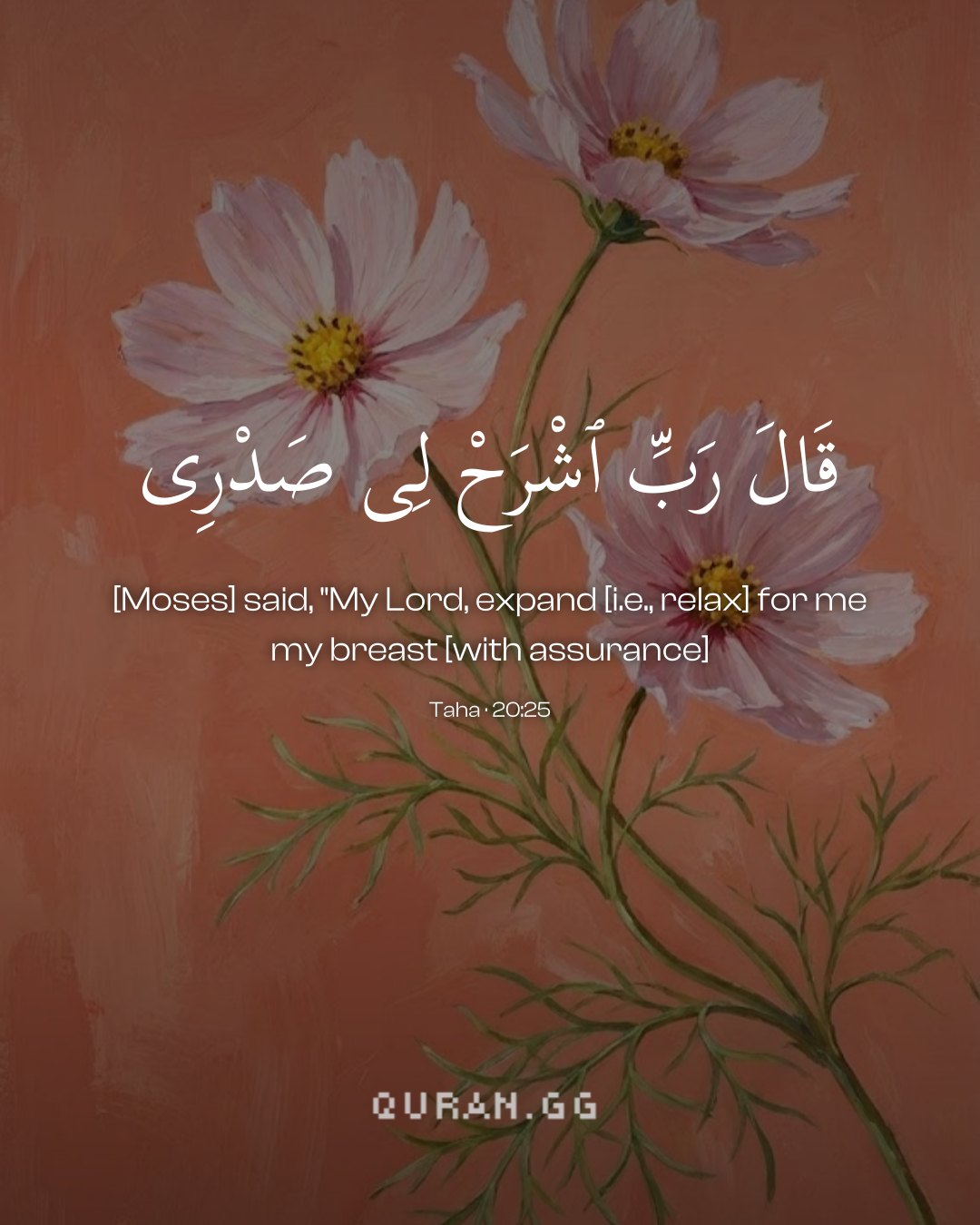
The first prayer was اشْرَحْ لِي صَدْرِي ! (Put my heart at peace for me - 20:25). Meaning to expand the ability of his heart to enable him to receive all the knowledge and wisdom of prophethood, and at the same time to bear with equanimity the slander of those people who will oppose him in his mission.
Tazkirul Quran
Maulana Wahiduddin KhanOn ayahs 24–35
Incidents in the lives of prophets of the past are mentioned in the Bible as well as in the Quran. But, at many places, there are meaningful differences in the versions respectively of the Quran and the Bible. For instance, in this case, the Bible says: Moses kept his hand on his chest and covered it, and when he brought it out and saw it, it was white like ice, due to leprosy (Exodus 4:7). The Bible attributes the whiteness of Moses’s hand to ‘leprosy’. In this context, the Quran’s describing of the miracle of the white hand and the adding of the words ‘without any blemish’ clearly indicate that the Qur’an is not derived from the Bible, but is directly from God, who is All-knowing. As such, it corrects the biblical version. Moses was given two special miracles. The miracle of the snake was the sign of power, and the miracle of the bright white hand was a symbol of his standing for a luminous Truth. Pharaoh transgressed all limits when, having attained power, he considered himself to be god. The literal meaning of ‘Pharaoh’ is the child of the sun. The ancient Egyptians used to regard the sun as the greatest god–the Mighty Lord. So Pharaoh had declared himself the representative of the sun god on earth. He had statues of himself made and installed in all the cities of Egypt and these statues were worshipped. Power is a blessing conferred by God; when a man receives this blessing, he should be overwhelmed with gratitude. But if he is vain and arrogant, he not only feels no gratitude, but he also sets himself up as God’s equal.
Uthmani text of the Madinah mushaf (King Fahd Complex). Translation: Saheeh International. Tafsir via Quran.com.