The Hand of Musa turning White without any Disease
This is the second sign of Musa. That is Allah has commanded him to place his hand into the opening of his garment, as is clearly stated in another Ayah. It mentioned here merely as a passing reference, saying:
وَاضْمُمْ يَدَكَ إِلَى جَنَاحِكَ
(And press your hand to your side:) Allah said in another Ayah,
(And draw your hand close to your side to be free from fear. These are two signs from your Lord to Fir`awn and his chiefs.) 28:32 Mujahid said,
وَاضْمُمْ يَدَكَ إِلَى جَنَاحِكَ
(And press your hand to your side:) "This means put your palm under your upper arm." When Musa put his hand into the opening of his garment and brought it out, it came out shining as if it were a half moon. Concerning His statement,
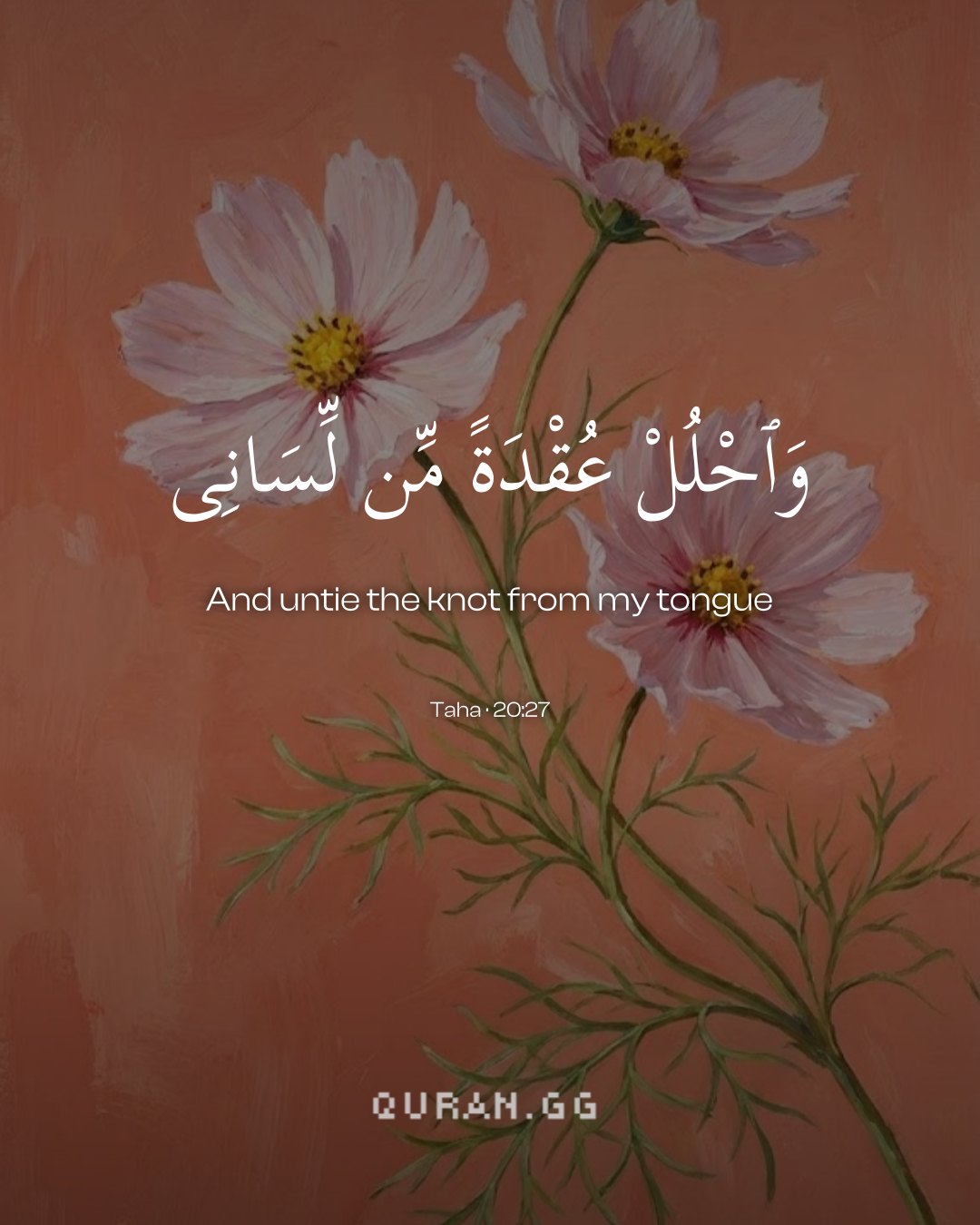
The third prayer وَاحْلُلْ عُقْدَةً مِّن لِّسَانِي يَفْقَهُوا قَوْلِي (And remove the knot from my tongue, that they may understand my speech - 20:27, 28). The story behind this "knot" is that as an infant Sayyidna Musa (علیہ السلام) lived with his own mother who used to suckle him and was paid for her services by the Pharaoh. When he was weaned, the Pharaoh and his wife 'Asiya ؓ adopted him, and took him away from his mother. One day Sayyidna Musa (علیہ السلام) caught hold of the Pharaoh's beard and slapped him on the face. Another version has it that he was playing with a stick and with it he struck the Pharaoh on his head. The Pharaoh was enraged and made up his mind to put him to death. His wife 'Asiya ؓ tried to pacify him and said, "0 King! Why do you take this matter so seriously? After all he is merely a child who does not understand things. You can test him if you like and you will find that he cannot distinguish between good things and bad things".
Thereupon, the Pharaoh ordered two trays to be brought. One was filled with live coal and the other with jewellery. It was expected that the child would be attracted by the brightness of the burning coal and reach for it because children are not normally drawn towards jewellery which is not as bright. This would have convinced the Pharaoh that what Sayyidna Musa (علیہ السلام) did was nothing more than the act of an innocent child. But Sayyidna Musa (علیہ السلام) was no ordinary child. Allah Ta'ala had chosen him to be a prophet whose instincts were unusual from the very moment of his birth. He put forth his hand to reach out for the jewellery instead of the coal, but Jibra'il (علیہ السلام) turned his hand away and placed it in the tray containing coal. He picked up a piece of burning coal and put it in his mouth and so burned his tongue. The Pharaoh was thus fully satisfied that the action of Sayyidna Musa (علیہ السلام) was not due to mischief but the result of a child's inability to distinguish between good and bad for himself. This incident caused an impediment in his speech which has been called عُقْدَةً (knot) in the Qur'an, and Sayyidna Musa (علیہ السلام) prayed to Allah Ta'ala to make loose this knot. (Mazharl and Qurtubi)
The first two prayers are of a general nature and sought Allah Ta` ala's help in all matters. The third prayer is for the removal of a disability because eloquence and fluency of expression are essential elements in the successful conduct of prophetic mission. In a subsequent verse Allah Ta'ala informed Sayyidna Musa (علیہ السلام) that all his prayers had been granted which would suggest that he was cured of his disability.
However, Sayyidna Musa علیہ السلام in his prayer to make Sayyidna Harun (علیہ السلام) his partner in the prophethood also said ھُوَاَفصَحُ مِنِّی لِساناً (He is more fluent in his tongue than me - 28:34) which would indicate that his speech's impediment was not fully cured and that the stammer persisted, though in a milder form. One of the defects which the Pharaoh found in Sayyidna Musa (علیہ السلام) was that وَلَا یَکَادُ یُبِینُ (he cannot express himself clearly - 43:52). Some people have argued that in his prayer Sayyidna Musa (علیہ السلام) had prayed to Allah Ta’ ala to loose the knot of his tongue only to the extent that others could understand his words. To that extent his stammer was cured but a trace of it still remained, which is not inconsistent with the grant of his prayer.
Tazkirul Quran
Maulana Wahiduddin KhanOn ayahs 24–35
Incidents in the lives of prophets of the past are mentioned in the Bible as well as in the Quran. But, at many places, there are meaningful differences in the versions respectively of the Quran and the Bible. For instance, in this case, the Bible says: Moses kept his hand on his chest and covered it, and when he brought it out and saw it, it was white like ice, due to leprosy (Exodus 4:7). The Bible attributes the whiteness of Moses’s hand to ‘leprosy’. In this context, the Quran’s describing of the miracle of the white hand and the adding of the words ‘without any blemish’ clearly indicate that the Qur’an is not derived from the Bible, but is directly from God, who is All-knowing. As such, it corrects the biblical version. Moses was given two special miracles. The miracle of the snake was the sign of power, and the miracle of the bright white hand was a symbol of his standing for a luminous Truth. Pharaoh transgressed all limits when, having attained power, he considered himself to be god. The literal meaning of ‘Pharaoh’ is the child of the sun. The ancient Egyptians used to regard the sun as the greatest god–the Mighty Lord. So Pharaoh had declared himself the representative of the sun god on earth. He had statues of himself made and installed in all the cities of Egypt and these statues were worshipped. Power is a blessing conferred by God; when a man receives this blessing, he should be overwhelmed with gratitude. But if he is vain and arrogant, he not only feels no gratitude, but he also sets himself up as God’s equal.
Uthmani text of the Madinah mushaf (King Fahd Complex). Translation: Saheeh International. Tafsir via Quran.com.