The Hand of Musa turning White without any Disease
This is the second sign of Musa. That is Allah has commanded him to place his hand into the opening of his garment, as is clearly stated in another Ayah. It mentioned here merely as a passing reference, saying:
وَاضْمُمْ يَدَكَ إِلَى جَنَاحِكَ
(And press your hand to your side:) Allah said in another Ayah,
(And draw your hand close to your side to be free from fear. These are two signs from your Lord to Fir`awn and his chiefs.) 28:32 Mujahid said,
وَاضْمُمْ يَدَكَ إِلَى جَنَاحِكَ
(And press your hand to your side:) "This means put your palm under your upper arm." When Musa put his hand into the opening of his garment and brought it out, it came out shining as if it were a half moon. Concerning His statement,
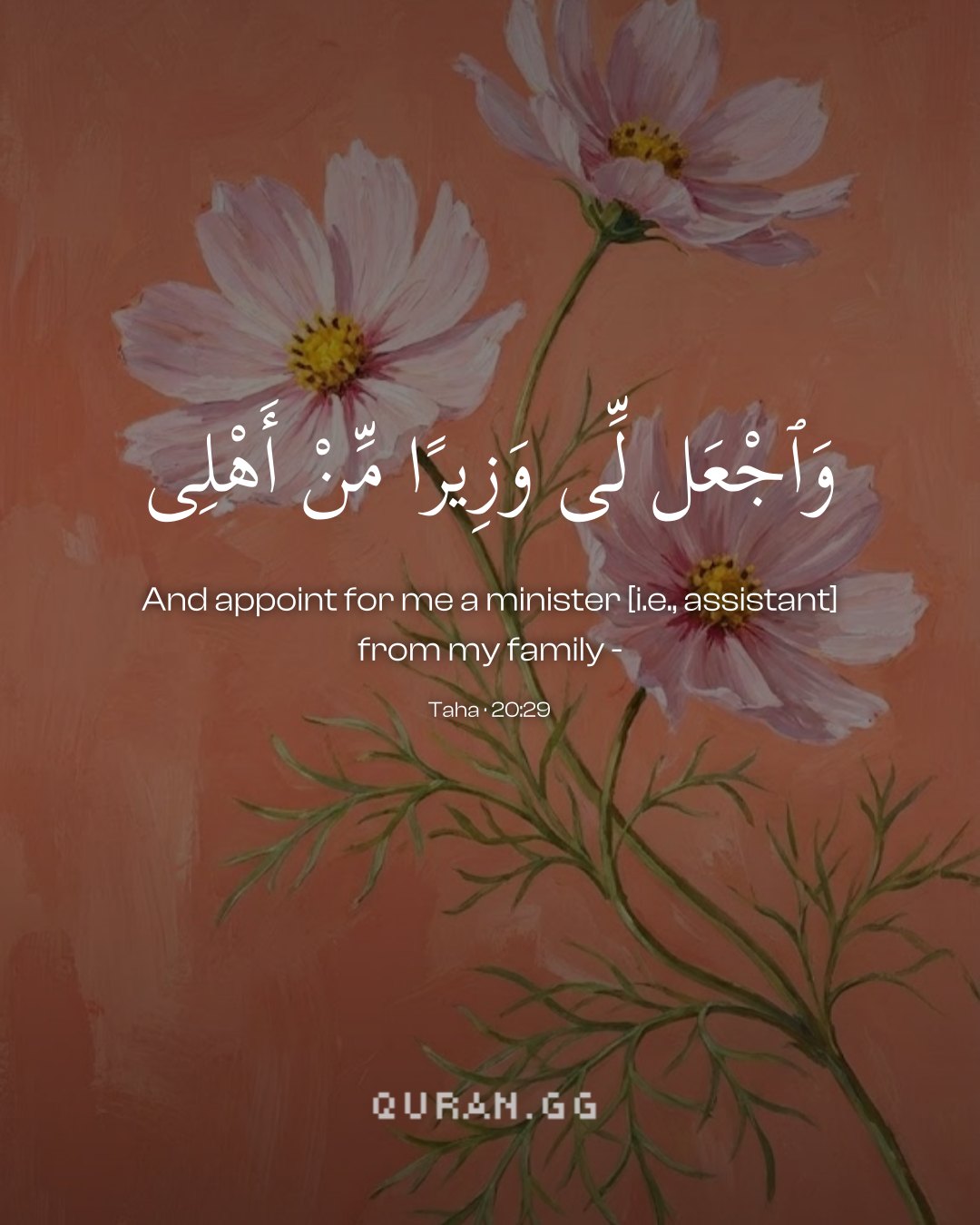
The fourth prayer was وَاجْعَل لِّي وَزِيرًا مِّنْ أَهْلِي (and make for me an assistant from my own family - 20:29). The first three prayers of Sayyidna Musa (علیہ السلام) concerned his own person. This fourth prayer relates to the assembling of means which would facilitate the successful completion of his mission, and the most important among these was the appointment of a deputy or a helper, who would assist him in this task. The literal meaning of the word j is "one who carries a burden", and since a minister of a state carries the burden of responsibilities entrusted to him by the ruler, he is called a minister. This shows the extreme foresight and prudence of Sayyidna Musa (علیہ السلام) because the success of any movement or enterprise depends on the selection of competent and dedicated supporters. With good and loyal workers it is easy to surmount all obstacles and hurdles, while with irresponsible and indifferent workers the best preparations and arrangements become futile. If one were to examine the causes of the decline of some of the modern states and the evils from which they suffer, they can all be attributed to the irresponsible conduct, mismanagement and incompetence of the ministers and advisers.
It is related from the Holy Prophet ﷺ that when Allah Ta` ala appoints someone to govern a country and wishes that the country should be well administered, He provides the ruler with a good Wazir to assist him in whatever he does, and if he forgets to attend to some important task, the Wazir is quick to remind him and to help him in what he intends to do. (Nisa'i, from Qasim Ibn Muhammad).
In this prayer Sayyidna Musa (علیہ السلام) has specified that the helper he wants should be from his own family, the reason being that the behavior and conduct of a member of the family is well-known. Besides, there is mutual affection and understanding between the members of the family which greatly helps towards the accomplishment of the mission. But it is essential that the person selected should be competent and in possession of the merit necessary for the performance of his duties so that his selection may not be attributed to nepotism and favouritism. Nowadays when there is a scarcity of people of integrity and dedication, the ruler who appoints his own close relatives to be his Wazir and deputies renders himself liable to public criticism. When, however, the standards of probity and integrity are high, such appointments are considered normal and are, in fact, conducive to the more efficient performance of sensitive assignments. Indeed all the four Khulafa' ar-Rashidin (guided Caliphs) who succeeded the Holy Prophet ﷺ were in some way related to him.
In his prayer Sayyidna Musa (علیہ السلام) first asked that the helper he required should be from his own family and then specifically asked for his brother Harun to be his Wazir so that with the latter's support and assistance he could better perform the duties of his prophetic mission.
Tazkirul Quran
Maulana Wahiduddin KhanOn ayahs 24–35
Incidents in the lives of prophets of the past are mentioned in the Bible as well as in the Quran. But, at many places, there are meaningful differences in the versions respectively of the Quran and the Bible. For instance, in this case, the Bible says: Moses kept his hand on his chest and covered it, and when he brought it out and saw it, it was white like ice, due to leprosy (Exodus 4:7). The Bible attributes the whiteness of Moses’s hand to ‘leprosy’. In this context, the Quran’s describing of the miracle of the white hand and the adding of the words ‘without any blemish’ clearly indicate that the Qur’an is not derived from the Bible, but is directly from God, who is All-knowing. As such, it corrects the biblical version. Moses was given two special miracles. The miracle of the snake was the sign of power, and the miracle of the bright white hand was a symbol of his standing for a luminous Truth. Pharaoh transgressed all limits when, having attained power, he considered himself to be god. The literal meaning of ‘Pharaoh’ is the child of the sun. The ancient Egyptians used to regard the sun as the greatest god–the Mighty Lord. So Pharaoh had declared himself the representative of the sun god on earth. He had statues of himself made and installed in all the cities of Egypt and these statues were worshipped. Power is a blessing conferred by God; when a man receives this blessing, he should be overwhelmed with gratitude. But if he is vain and arrogant, he not only feels no gratitude, but he also sets himself up as God’s equal.
Uthmani text of the Madinah mushaf (King Fahd Complex). Translation: Saheeh International. Tafsir via Quran.com.