Glad Tidings of the acceptance of Musa's Supplication and the Reminder of the Previous Blessings
This is a response from Allah to His Messenger, Musa, for what he requested from His Lord. It also contains a reminder of Allah's previous favors upon him. The first was inspiring his mother when she was breastfeeding him and she feared that Fir`awn and his chiefs would kill him. Musa was born during a year in which they (Fir`awn's people) were killing all of the male children. So she placed him in a case and cast him into the river. The river carried him away and she became grieved and distressed, as Allah mentioned about her when He said,
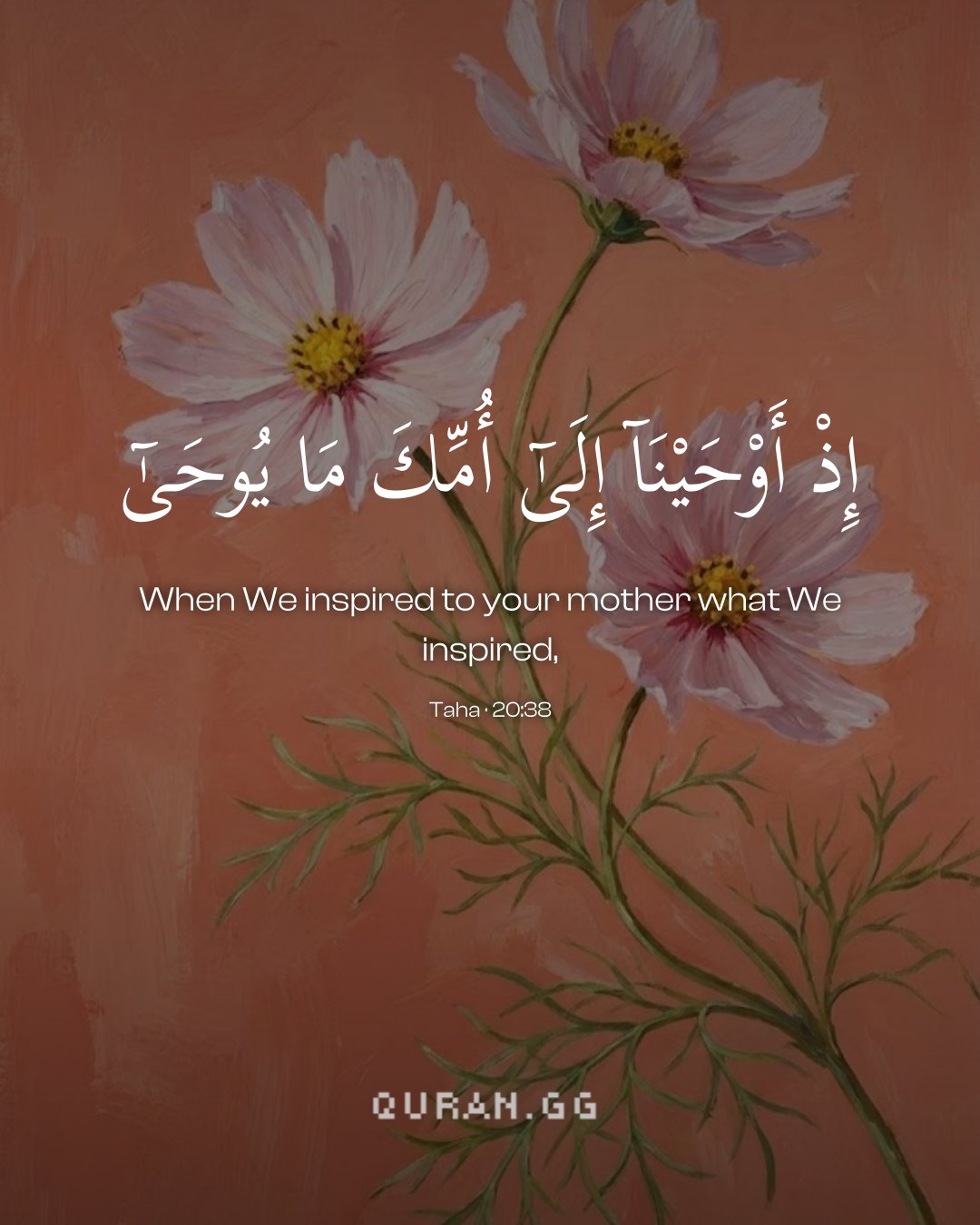
إِذْ أَوْحَيْنَا إِلَىٰ أُمِّكَ مَا يُوحَىٰ (When We revealed to your mother what was to be revealed - 20:38) It means that the information given to the mother of Sayyidna Musa (علیہ السلام) was about a matter which could be learnt only through Divine revelation. This was that the Pharaoh's soldiers had orders to put to death all the male children belonging to the tribe of Bani Isra'il. She was told by means of a revelation that in order to save the life of her son she should put him in a box and float it down the river. She was re-assured not to entertain any apprehensions about his safety because Allah Ta’ ala would protect him and also return him to her. These are things which cannot be learnt by conjecture or guess work. The promise of Allah Ta` ala, and the divine scheme to save his life are beyond human conception and can be made known through Divine revelation only.
Can a Revelation be sent to a person who is not a Prophet?
The truth of the matter is that the literal meaning of the word وَحِی (Wahy) is a secret message which can be understood only by the person to whom it is addressed and by no one else. According to this literal sense, the word وَحِی (Wahy) is not restricted to the prophets only and it can be used for people at large and even to animals. In the verse أَوْحَىٰ رَبُّكَ إِلَى النَّحْلِ (16:68) the word has been used in its literal and general sense, i.e. instructing the bees by means of ; Wahy. Similarly in this verse أَوْحَيْنَا إِلَىٰ أُمِّكَ (20:38) the word has been used in its general meaning and this does not necessarily mean that she was a prophet. Sayyidah Maryam (علیہا السلام) also received Divine messages though the scholars unanimously hold the view that she was not a prophet. The Wahy of this type is made by means of a Divine inspiration (Ilham اِلھَام). Allah Ta'ala puts an idea into someone's heart and then confirms him in the belief that it is from Allah Ta` ala. Saints and other devout people receive such inspirations. Abu Hayyan and some other scholars hold that sometimes such inspirations can be made through angels as happened to Sayyidnh Maryam (علیہا السلام) when Jibra'il (علیہ السلام) appeared before her in the form of a human being and conveyed to her the will of Allah Ta` a1a. These inspirations (Ilham: اِلھَام), however, are specific to the person to whom they are made and are not meant for public or to be used for the propagation of the True Faith, whereas the Wahy which is revealed to the prophets aims at appointing someone to reform people and enjoining upon him to invite people to the True Faith. It is the duty of such a person not only to have complete faith in His Wahy himself, but also to bind others to accept his prophethood and the Wahy and to pronounce as infidels those who deny him.
This is the difference between وَحِی اِلھَام (Wahy in the sense of Ilham) or literal وَحِی and وَحِی نبوّت (the wahy of a prophet) or technical Wahy. Literal Wahy has always been there and will be there forever, whereas the prophethood and (Wahy of a prophet) have ceased with the Holy Prophet ﷺ ، who was the last Prophet. Some respected scholars have given them the names of وَحِی تشریعی (legislative Wahy) and وَحِی غیر تشریعی (non-legislative Wahy). The false prophet of Qadiyan has used these definitions and certain writings of Sheikh Muhiyy-uddin Ibn ` Arabi in support of his claim to prophethood. His arguments, however, are contrary to what Ibn ` Arabi himself has written. A detailed discussion of this question will be found in my book خَتمِ نبوّت۔ (Khatme Nabuwwat).
The name of the mother of Sayyidna Musa (علیہ السلام)
In Ruh ul-Ma` ani her name is given as Yuhanadh (یُحَانذ) and in Itqan it is said that her name was Lihyana daughter of Yasmad Ibn Lawi (لحیانہ بنت یصمد بن لاوی). Others say her name was Barkha ( (بَارخَا and still others say that it was Bazakht (بَازخت). Some people who dispense charms and amulets attribute strange properties to her name but according to Ruh u1-Ma` ani there is no basis for such a belief and probably it is nothing more than a hoax to entice innocent and ignorant people.
Tazkirul Quran
Maulana Wahiduddin KhanOn ayahs 36–39
After attaining prophethood, Moses might well have developed a sense of pride. But, at that time, the nature of his request to God reveals that he did not take prophethood as a matter of pride but as a matter of responsibility. At that time, the words he uttered were those of one who is fully conscious of the delicate and exacting responsibility attached to the work of a mission. The opening of the heart for a man of the mission means that, according to the different occasions that may arise, appropriate guidance may enter it unhindered. The easing of the situation means that opponents should never succeed in impeding the work of the divine mission. Loosening the knot of the tongue means acquiring the capability to address large gatherings without hesitation in order to give the divine call. Almighty God granted all this to Moses to enable him to effectively discharge the responsibility of prophethood. Along with this, at his request, He made his (Moses’) brother, Aaron, a powerful assistant to him. This special assistance given to a prophet may also be given to a dayee, who is not a prophet, provided that he devotes himself fully to the work of the mission as the prophet had done. Remembrance of God is the real purpose of religion. But, remembrance does not mean the mere oral repetition of certain words. It indicates rather that state which is quite naturally engendered by the discovery of Truth. At that time, a man experiences the perfection of God’s attributes to the point of being quite swept away by them. He becomes so overwhelmed with godly feeling that he dedicates himself unstintingly to the divine cause.