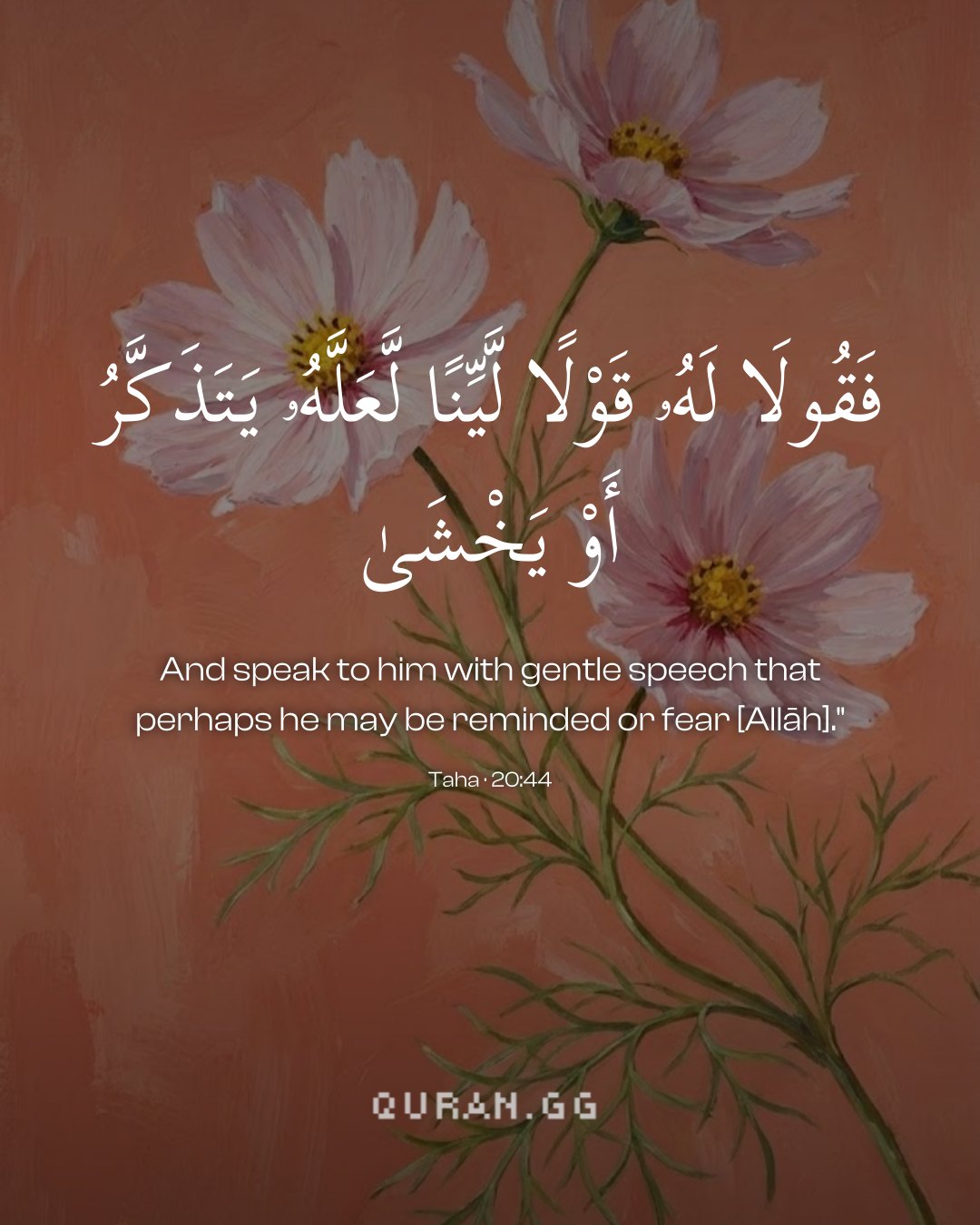
Choosing Musa to go to Fir`awn and to be Soft and Gentle in His Invitation
Allah, the Exalted, says in His address to Musa that he had lived among the people of Madyan, avoiding Fir`awn and his chiefs. He worked as a shepherd for his father-in-law until the appointed time for his work ended. Then he met the decree of Allah and His predetermined will, without him having any set appointment. This entire situation was under the control of Allah, Blessed be He, the Most High. He compels His servants and His creatures to whatever end He wills. This is why Allah says,
ثُمَّ جِئْتَ عَلَى قَدَرٍ يمُوسَى
(Then You came here according to the fixed term which I ordained (for you), O Musa!) Mujahid said, "For a set appointment." `Abdur-Razzaq recorded that Ma`mar reported from Qatadah that he said,
Our Lord is He who gave everything its shape, then guidance - 20:50.
The Pharaoh then asked them what they wanted. He charged Sayyidna Musa (علیہ السلام) with the murder of the Egyptian and at the same time reminded him how he had brought him up in his own palace and the great kindness he had shown towards him. The reply which Sayyidna Musa (علیہ السلام) gave on both these points is mentioned in the Qur'an. That is, the murder of the Egyptian was a mistake for which he had asked Allah's forgiveness. As for the second point, he accused the Pharaoh of having enslaved the Bani Isra'il and of subjecting them to oppression. These things could not be allowed to continue forever and in consequence an inevitable destiny so decreed that he should be brought up in the Pharaoh's palace. It was Allah's will and so it came to pass and he owed no gratitude to anyone. He then asked the Pharaoh to accept the True Faith and free the Bani Isra'il from the slavery. The Pharaoh refused, and asked Sayyidna Musa (علیہ السلام) to show some sign to prove his claim of prophethood. Musa (علیہ السلام) cast his staff (عصا) on the ground and it turned into a huge snake, which advanced towards the Pharaoh with a fearsome manner. In great fright the Pharaoh crawled under his throne and begged Sayyidna Musa (علیہ السلام) to save his life. Musa (علیہ السلام) picked up the snake and it became a staff again. He then showed the Pharaoh his second miracle. He pressed his hand under his armpit and when .he brought it out it was shinning brilliantly. Then he repeated the action and his hand became normal.
When, after a series of testing experiences, Moses reached the final stage of maturity, God assigned to him prophethood, so that he might communicate the divine message to man. Moses was given two pieces of advice—that he should never be remiss in the remembrance of God and that he should never be coercive in the performance of the mission of communicating the message of God to man. Remembrance of God means belief in God being so all-pervasive that the thought of God comes to mind, time and time again. Every observation a man makes and every incident in his life should, coupled with his God-consciousness, be the cause of awakening for him. While ordinary people live on material food, the preacher of Truth lives on the remembrance of God. Remembrance of God is an asset to the faithful (mu’min) and to the missionary alike. The second essential element is the adoption of a lenient approach in the communication of divine message to man. The very fact that Moses was so instructed when he had to approach such an arrogant person as Pharaoh shows that a tactful and considerate attitude in mission work is an absolute requirement in all cases. Even arrogance or harsh behaviour on the part of those who are the addressees, does not give the missionary any right to deviate from being kind and understanding in his approach.
Uthmani text of the Madinah mushaf (King Fahd Complex). Translation: Saheeh International. Tafsir via Quran.com.