Allah, the Exalted, informs about Fir`awn that he said to Musa, in his rejection of the existence of a Supreme Maker and Creator, Who is the God of everything and his own Lord and Owner:
فَمَن رَّبُّكُمَا يمُوسَى
(Who then, O Musa, is the Lord of you two) meaning "Who is the one who called you forth and sent you For verily, I do not know him and I have not given you any god other than myself."
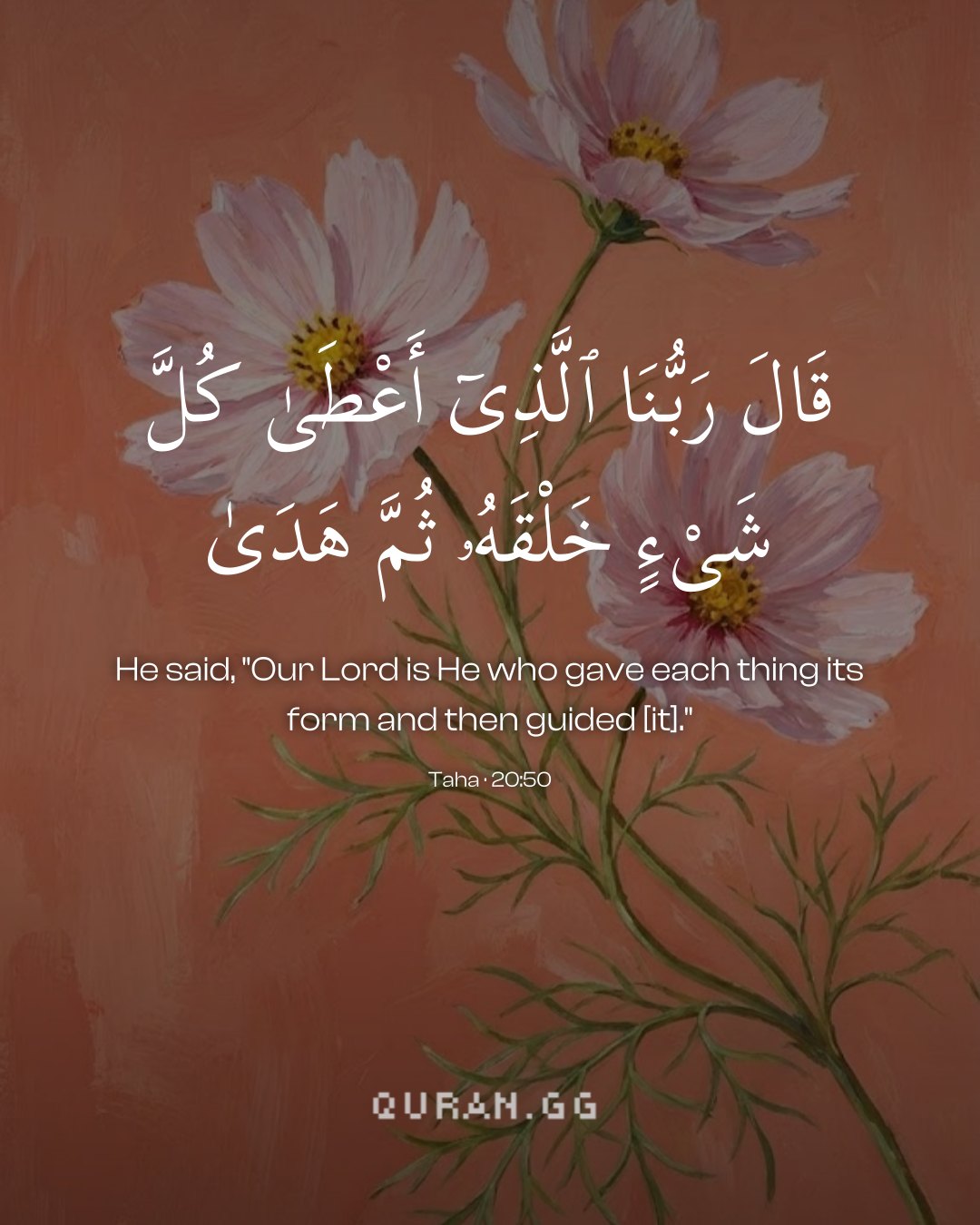
((Musa) said: "Our Lord is He Who gave to each thing its form and nature, then guided it aright.") `Ali bin Abi Talhah related that Ibn `Abbas said, "He is saying that He created a mate for everything." Ad-Dahhak said that Ibn `Abbas said, "He made the man a man, and the donkey a donkey and the sheep a sheep." Layth bin Abi Sulaym reported from Mujahid that he said, "He gave everything its form." Ibn Abi Najih said that Mujahid said, "He fashioned the creation of every moving creature." Sa`id bin Jubayr said concerning His statement,
أَعْطَىٰ كُلَّ شَيْءٍ خَلْقَهُ ثُمَّ هَدَىٰ (who gave everything its shape then guidance 20:50) refers to the guidance of Takwin (تکوینی ھدایت).
Sayyidna Musa (علیہ السلام) reminded the Pharaoh, at the first place, of those acts of Allah Ta` ala which are obviously done by Him alone and about which no one else could claim that he has performed them. The Pharaoh totally unable to refute this argument, and in his confusion asked Sayyidna Musa (علیہ السلام) a question which was designed to entangle him into giving a reply that would greatly offend the Egyptians. The question was: how did the people of bygone ages stand who all worshipped idols, and what was their fate? The Pharaoh's purpose was that if Sayyidna Musa (علیہ السلام) replied (as the Pharaoh surmised he would) that they were all misguided and deserving of Hell, then he could instigate his people against the latter. But the reply which Sayyidna Musa (علیہ السلام) gave was so wise and discreet that the Pharaoh's evil design was completely frustrated.
Tazkirul Quran
Maulana Wahiduddin KhanOn ayahs 48–51
Pharaoh was an extremely haughty and arrogant person. Having acquired power, he had started considering himself to be a god. So Moses feared that when the message of the real God was presented to him, he would flare up in anger. But God’s messengers are under His protection. So Moses was commanded to proceed and to be rest assured that Pharaoh, despite his great might and power, would not be able to do him any harm. The Israelites were monotheists like the Muslims. But, being in the midst of the polytheistic community of Egypt, they were badly affected by its polytheistic culture. Moreover, the rulers had subjected them to such privation and hard labour as to render them incapable of thinking about such higher realities as the oneness of God and the life hereafter. Therefore, Moses was instructed to remove the Israelites from this sphere and settle them elsewhere, so that they could be brought up and educated far away from this vitiating atmosphere of polytheism and ignorance.
Uthmani text of the Madinah mushaf (King Fahd Complex). Translation: Saheeh International. Tafsir via Quran.com.