Fir`awn describes Musa's Proofs as being Magic and Their Agreement to hold a Contest
Allah, the Exalted, informs of what Fir`awn said to Musa when he showed him the great proof. This great sign to Fir`awn was Musa casting down his stick which became a huge snake, and his pulling his hand out from under his arm while it was glowing white without any illness. At this, Fir`awn said, "This is magic that you have brought to us to bewitch us and conquer the people, so that they will follow you. Then you will outnumber us." Fir`awn then said, "Your plan will not work. We have magic just like yours, so do not let yourself be deceived by that what you are doing."
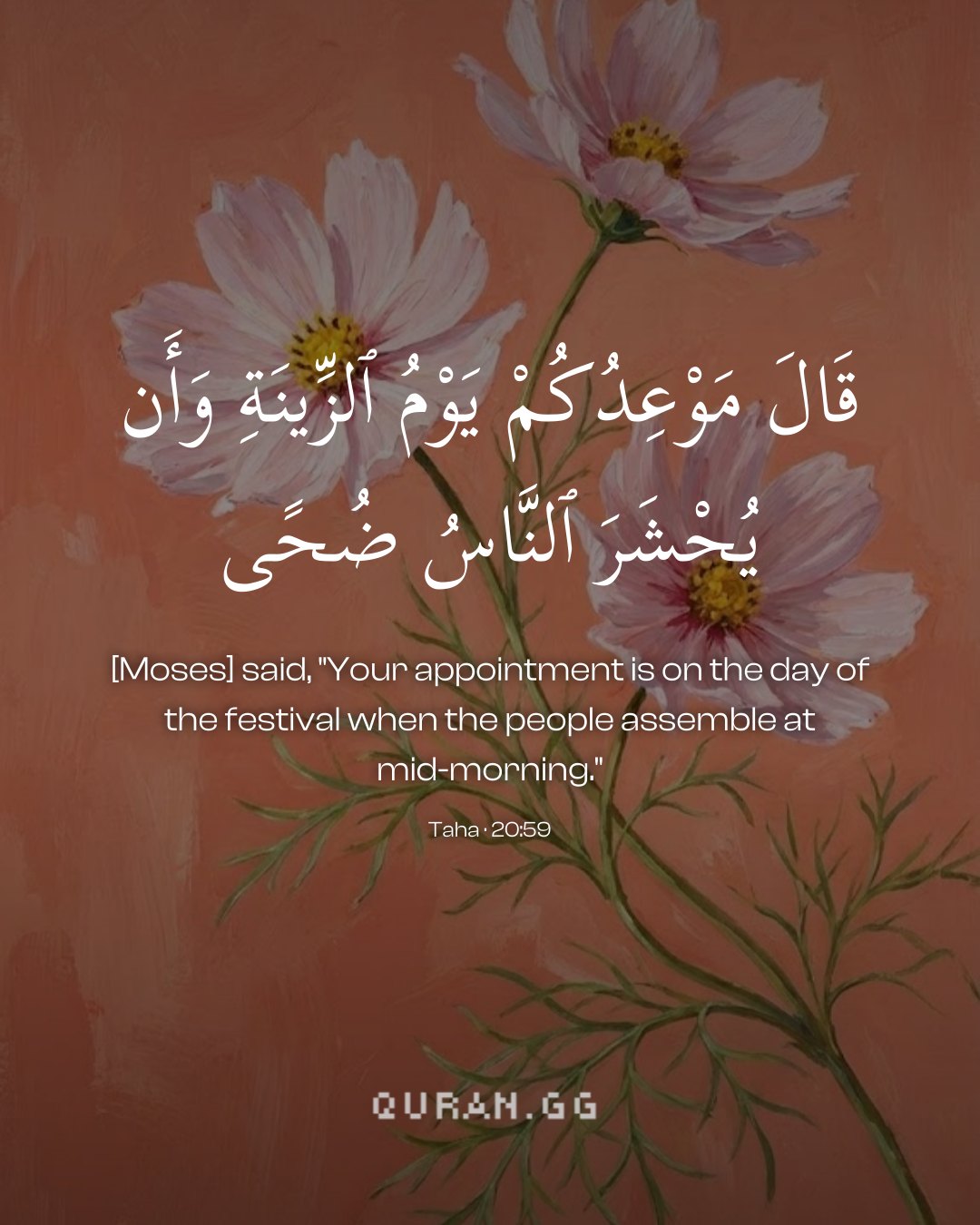
مَوْعِدُكُمْ يَوْمُ الزِّينَةِ وَأَن يُحْشَرَ النَّاسُ ضُحًى (Your appointment is the festival day and that the people are assembled at forenoon - 20:59). يَوْمُ الزِّينَةِ has been explained differently by different authorities. Some say it was a special festival when the Egyptians, attired in beautiful dresses, gathered outside the towns, while others say that it was a Saturday (' یوم السَّبت), and according to some others it was the tenth day of Muharram (عاشُورا).
The great advantage in fixing for the contest
It was a wise move on the part of Sayyidna Musa (علیہ السلام) to fix festival day as the day of contest when all Egyptians, high and low, were expected to assemble at an appointed place. There was also a point in fixing early forenoon as the time for the contest because this is the time when people, having finished their daily chores, are free to engage in other things. Also daylight and visibility are at their best in the early forenoon and people, while dispersing after witnessing a momentous event, spread the news far and wide. Thus when, with Allah's help, Sayyidna Musa (علیہ السلام) inflicted a crushing defeat on the Egyptian magicians, the story became known the same day to people living in far flung places.
Magic - its truth, forms and the rules governing it
For a detailed discussion on this subject reference may be made to the story of Harut and Marut in Surah Al-Baqarah at page 265 to 278 of Ma'ariful Qur'an vol. I.
Tazkirul Quran
Maulana Wahiduddin KhanOn ayahs 58–60
Moses continued to preach to Pharaoh over a long period of time, using rational arguments and also showing him miracles of a physical nature. But Pharaoh did not believe in Moses. In reality, admitting the truth of Moses’s preaching would have amounted to a negation of himself—something which his proud and egoistic mentality would never permit. Pharaoh tried to nullify Moses’s rational arguments by means of irrelevant pleas. On the subject of his miracles, Pharaoh alleged that they were simply magic, i.e., something which had no relevance to God, and insisted that anybody could acquire the necessary expertise to perform such feats. In order to keep up his boastful assertions, he said that he, through his magicians, could perform the same feats or miracles as Moses had demonstrated. After some discussion, it was finally decided that, at the forthcoming national fair, magicians of the country should gather, and there should be a competition between them and Moses before all the people.
Uthmani text of the Madinah mushaf (King Fahd Complex). Translation: Saheeh International. Tafsir via Quran.com.