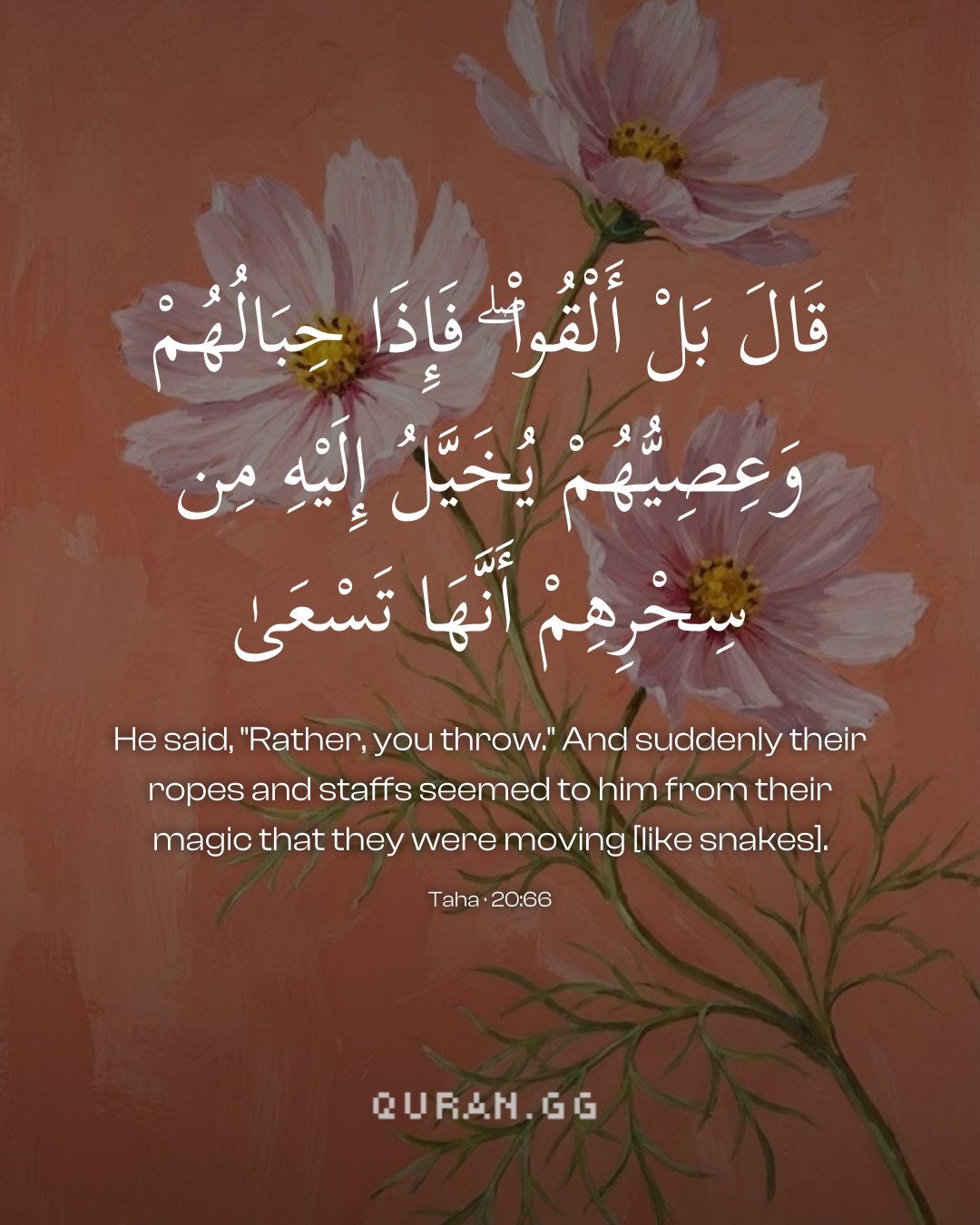
("...or we be the first to throw" (Musa) said: "Nay, throw you (first)!") This means, `you magicians should go first so that we can see what magic you are going to perform and so that the true state of their affair will become obvious to the people.'
The Egyptians were confident of their success and in a mood of complacency asked Sayyidna Musa (علیہ السلام) whether he would like to make the first move or whether they should initiate the contest. Sayyidna Musa (علیہ السلام) invited them to start the contest (Rather, you throw - 20:66) and there were several reasons for this. In the first place the Egyptians showed courage when they invited Sayyidna Musa (علیہ السلام) to open the battle and this offer called for an equally generous and chivalrous response. Secondly by making the offer the Egyptians showed their confidence in the outcome of the contest and implied as if they had already won it. On his side Sayyidna Musa (علیہ السلام) ، by his counter-offer, sought to convey to the Egyptians that he regarded the result of the game as a foregone conclusion in his own favour. And finally he wished to see the tricks of the Egyptians before he planned his own strategy. So, with these preliminaries over, the Egyptians cast their staffs and ropes on the ground and it appeared to the onlookers as if they had turned into snakes and were running about.
يُخَيَّلُ إِلَيْهِ مِن سِحْرِهِمْ أَنَّهَا تَسْعَىٰ (Their ropes and sticks seemed to him, due to their magic, as if they were running - 20:66). The verse shows that the Egyptian magicians had cast a hypnotic spell on the onlookers to whom it appeared that the staffs and the ropes had turned into snakes and were running about on the ground, whereas in fact no such transformation had taken place.
Tazkirul Quran
Maulana Wahiduddin KhanOn ayahs 64–69
Moses’ initial speech caused a difference of opinion among the magicians. One group said that this was the statement not of a magician but of a prophet. Others were opposed to it and held that Moses was a magician no different from themselves. (Tafsir ibn Kathir). These magicians were certainly capable of recognising their co-professionals. The more experienced among them realised that what they were about to encounter were miracles, not magic. So now they felt afraid to enter the competition. However, at the instance of Pharaoh and his enthusiastic companions, they agreed to compete. At that time, the entire structure of Egyptian life was based on polytheistic beliefs. The worship of Pharaoh as the personification of their super god (the sun) was the foundation of their political and social systems. Pharaoh provoked and exploited public sentiment by saying that the extant system based on the best traditions was their national system, and that if the upholders of God’s unity succeeded in their mission, their entire national system would be overthrown.
Uthmani text of the Madinah mushaf (King Fahd Complex). Translation: Saheeh International. Tafsir via Quran.com.