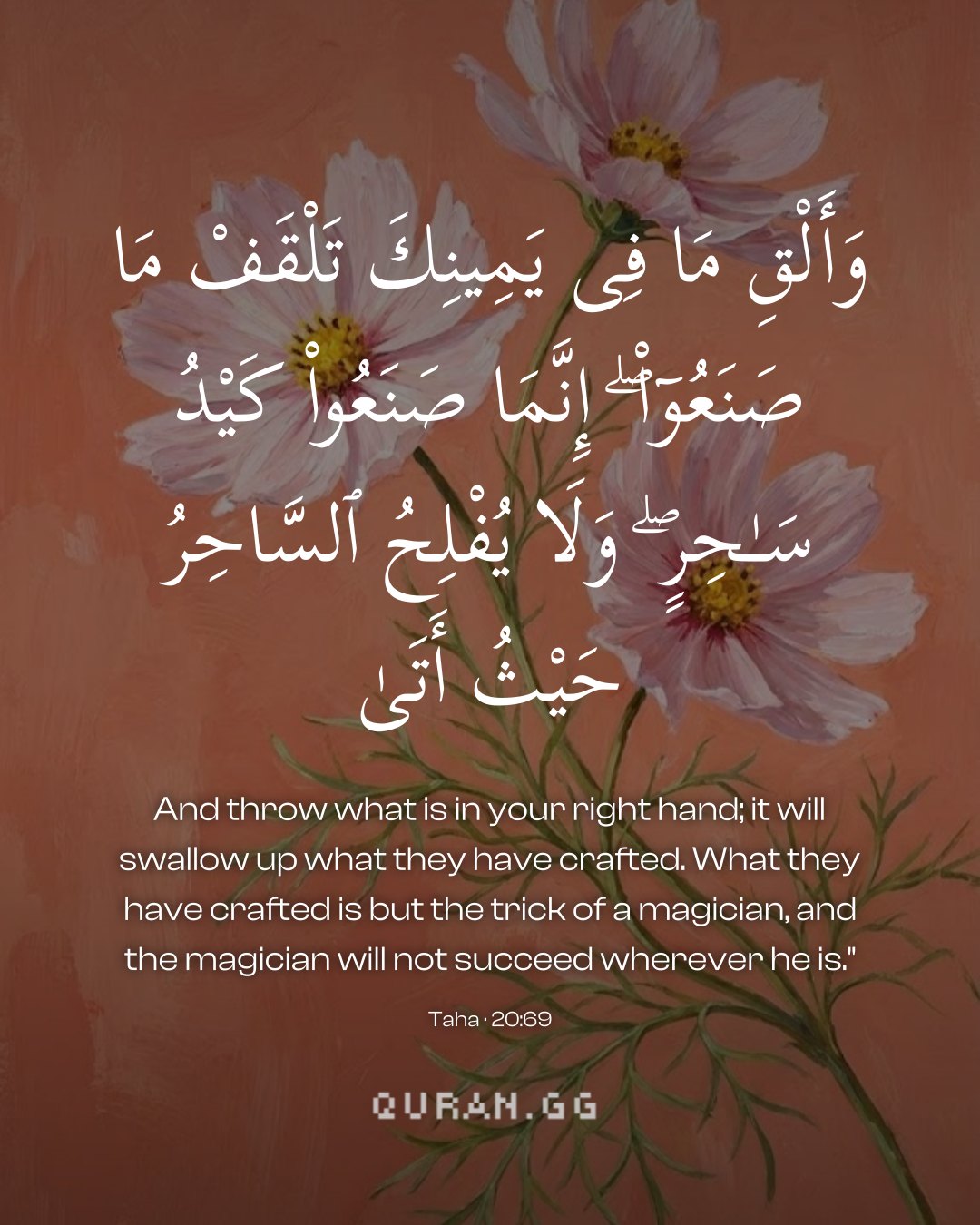
And throw what is in your right hand; it will swallow up what they have crafted. What they have crafted is but the trick of a magician, and the magician will not succeed wherever he is."
("...or we be the first to throw" (Musa) said: "Nay, throw you (first)!") This means, `you magicians should go first so that we can see what magic you are going to perform and so that the true state of their affair will become obvious to the people.'
وَأَلْقِ مَا فِي يَمِينِكَ (And throw what is in your right hand - 20:69). Allah commanded Sayyidna Musa (علیہ السلام) by means of a revelation (وحی) to cast down what he held in his right hand, and when he threw down his staff it turned into a huge snake and ate up all the imaginary snakes which the Egyptian magicians had produced by their magic.
Conversion to Islam and bowing in prostration by the Pharaoh's magicians
The Egyptian magicians who were masters of their art realized at once that what they had just witnessed was not magic but a miracle brought about by a Supreme Power. Consequently they fell in prostration and declared openly their faith in Allah - the God of Sayyidna Musa (علیہ السلام) and Sayyidna Harun (علیہ السلام) . According to some traditions these magicians did not raise their heads until they had seen a glimpse of heaven and hell. (رواہ عبد بن حمید و ابن ابی حاتم وابن ال؛منذر عن عکرمہ - روح)
Tazkirul Quran
Maulana Wahiduddin KhanOn ayahs 64–69
Moses’ initial speech caused a difference of opinion among the magicians. One group said that this was the statement not of a magician but of a prophet. Others were opposed to it and held that Moses was a magician no different from themselves. (Tafsir ibn Kathir). These magicians were certainly capable of recognising their co-professionals. The more experienced among them realised that what they were about to encounter were miracles, not magic. So now they felt afraid to enter the competition. However, at the instance of Pharaoh and his enthusiastic companions, they agreed to compete. At that time, the entire structure of Egyptian life was based on polytheistic beliefs. The worship of Pharaoh as the personification of their super god (the sun) was the foundation of their political and social systems. Pharaoh provoked and exploited public sentiment by saying that the extant system based on the best traditions was their national system, and that if the upholders of God’s unity succeeded in their mission, their entire national system would be overthrown.
Uthmani text of the Madinah mushaf (King Fahd Complex). Translation: Saheeh International. Tafsir via Quran.com.