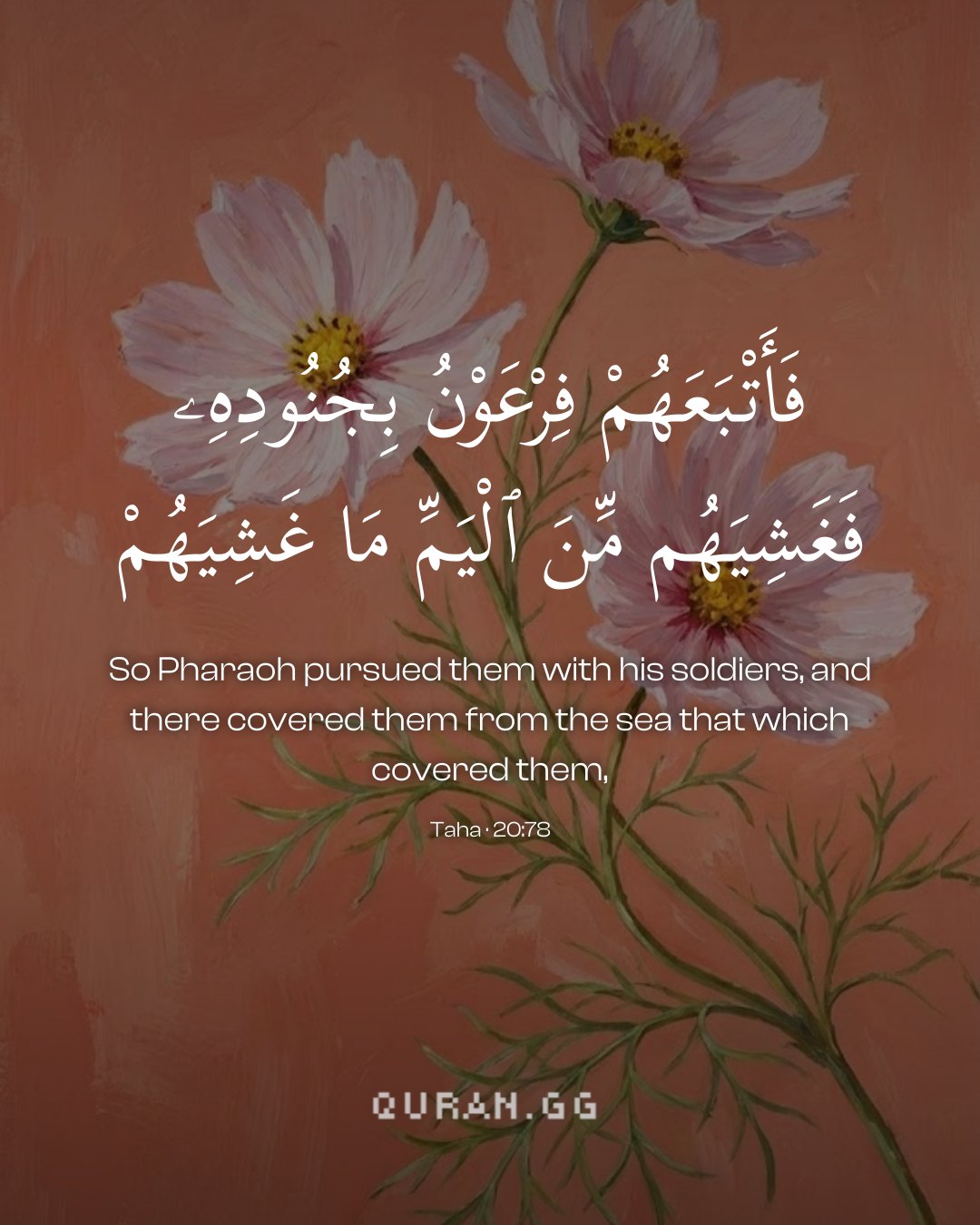
Allah, the Exalted, informs that He commanded Musa to journey at night with the Children of Israel, when Fir`awn refused to release them and send them with Musa. He was to take them away from Fir`awn's captivity. Allah expounds upon this in Surahs other than this noble Surah. Musa left with the Children of Israel, and when the people of Egypt awoke in the morning they found that not a single one of them remained in Egypt. Fir`awn became extremely furious. He sent callers into all of the cities to gather together his army from all of his lands and provinces. He said to them,
The decisive defeat which he suffered in the contest between the right and wrong and between miracle and magic broke the power of the Pharaoh, and the Bani Isra'ile stood united under the leadership of Sayyidni Musa (علیہ السلام) . Allah now commanded Sayyidna Musa (علیہ السلام) to take his men out of Egypt. But this move was full of danger. First there was the risk of pursuit by the Pharaoh, and second the river, which they had no means of crossing, barred their flight. Allah dispelled both these fears from Sayyidna Musa (علیہ السلام) mind and told him to strike his staff on the surface of the water, and dry passageways would appear in the bed of the river over which they could all escape, thus frustrating Pharaoh's pursuit. This story has been narrated earlier under Hadith ul-Futun in this very Surah.
What is meant by ‘becoming a criminal or a delinquent’? Delinquency is that state to which a man descends when he has a sign from God shining brightly before his eyes, but fails to learn a lesson from it. Truth is revealed to him in the language of reason, but he ignores it. He is not capable of pulling himself out of the grip of worldly forces and material considerations to the point of admitting the Truth. In the life hereafter there is the sternest punishment for such people. The troubles of this world, howsoever great, are necessarily limited in their severity by the very fact of being bound to come to an end—sooner or later—with death. But the hereafter is a place from which man, beset by unspeakable afflictions, will find it impossible to run away, for there, he will not even have death ahead of him to put an end to his torment. Paradise is for one who purifies himself and purification consists of giving up a life of carelessness and neglect, and adopting a prudent way of living. The aspirant to Paradise abstains from all things that come in the way of Truth. He rids himself of the hindrance of any worldly considerations obstructing his path. He crushes the base desires of his self when they arise. If feelings of false pride and the urge to transgress raise their heads within him, he stifles them and buries them in his innermost self. Such are men of true faith. In this world their faith takes the shape of a garden of pious deeds. In the life hereafter, it will be returned to them in the shape of heaven’s eternally flourishing garden.
Uthmani text of the Madinah mushaf (King Fahd Complex). Translation: Saheeh International. Tafsir via Quran.com.