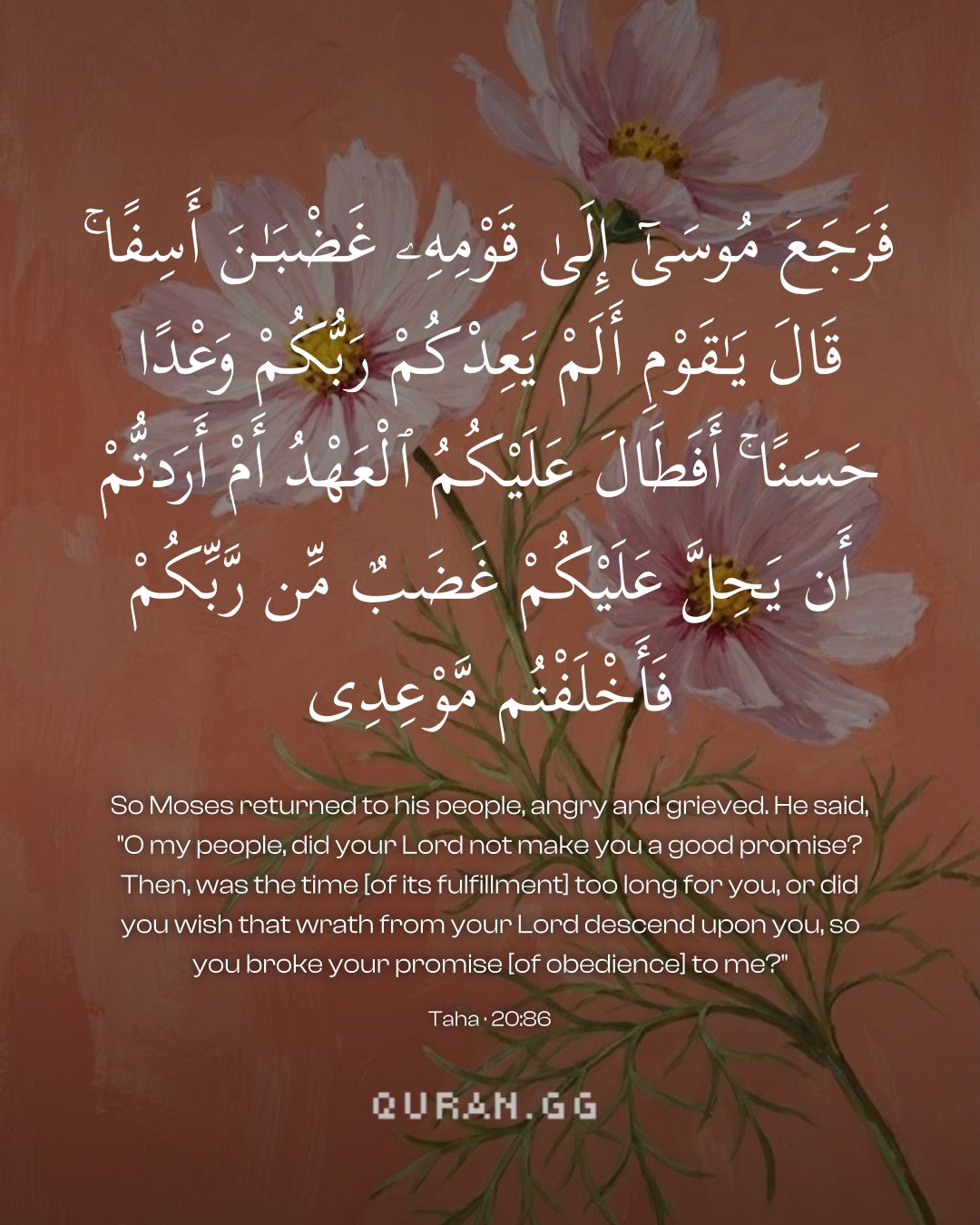
So Moses returned to his people, angry and grieved. He said, "O my people, did your Lord not make you a good promise? Then, was the time [of its fulfillment] too long for you, or did you wish that wrath from your Lord descend upon you, so you broke your promise [of obedience] to me?"
(And they came upon a people devoted to some of idols. They said: "O Musa! Make for us god as they have gods." He said: "Verily, you are a people who know not. Verily, these people will be destroyed for that which they are engaged in. And all that they are doing is in vain.") 7:138-139 Then, Allah made a covenant with Musa of thirty nights after which He added to them ten more nights. Thus, they were forty nights in all. The covenant was that he was to fast these number of days, during both the day and night. Thus, Musa made haste to go to the Mountain and he left his brother, Harun, in charge over the Children of Israel. This is why Allah says,
أَلَمْ يَعِدْكُمْ رَبُّكُمْ وَعْدًا حَسَنًا (Did your Lord not promise you a good promise? - 20:86) Sayyidna Musa (علیہ السلام) returned to his people full of sorrow and anger. First of all he reminded them of the promise which Allah had made to them that He would give them a Book for their guidance by adhering to which they could achieve all their worldly and religious objectives. He said that it was for the purpose of receiving the Book that he had started out with them for the mount of Tur.
أَفَطَالَ عَلَيْكُمُ الْعَهْدُ (Did then the time become too long for you? - 20:86) Not much time had elapsed on Allah's promise and it is inconceivable that the Bani Isra'il could have forgotten it, or if they remembered it, there was no reason for them to despair of its fulfillment on account of delay, thus providing for themselves justification for the worship of the calf.
أَمْ أَرَدتُّمْ أَن يَحِلَّ عَلَيْكُمْ غَضَبٌ مِّن رَّبِّكُمْ (Or did you wish that wrath from your Lord befalls you? - 20:86) But since neither of the two eventualities mentioned above could be contemplated, the only conclusion was that they knowingly and of their own choice invited the wrath of Allah.
Tazkirul Quran
Maulana Wahiduddin KhanOn ayahs 86–88
When Almighty God informed Moses that his community had gone astray, he returned to his community very emotionally upset. He reminded his people that God had only recently showered His blessings on them and had revealed His many signs to them. So, how was it that they had forgotten everything so quickly and gone astray? Moses had gone to receive revelations from God for the Israelites and in the meantime the Israelites had started indulging in the worship of false deities at the instigation of certain misguided persons. This shows how deeply the polytheistic atmosphere of Egypt had influenced the Israelites and why it had become necessary to take them away from Egypt in order to restore them to the worship of the one God. Whatever Moses did with regard to Pharaoh was in connection with his dawah mission, and whatever he did with regard to the Israelites was in the context of safeguarding true religion. He performed both these tasks simultaneously. This shows the importance of both these tasks. If the Muslims had gone astray, dawah activity could not be stopped on that account and, similarly, if dawah work had to be done, it was not to be at the cost of internal reform.
Uthmani text of the Madinah mushaf (King Fahd Complex). Translation: Saheeh International. Tafsir via Quran.com.