(And they came upon a people devoted to some of idols. They said: "O Musa! Make for us god as they have gods." He said: "Verily, you are a people who know not. Verily, these people will be destroyed for that which they are engaged in. And all that they are doing is in vain.") 7:138-139 Then, Allah made a covenant with Musa of thirty nights after which He added to them ten more nights. Thus, they were forty nights in all. The covenant was that he was to fast these number of days, during both the day and night. Thus, Musa made haste to go to the Mountain and he left his brother, Harun, in charge over the Children of Israel. This is why Allah says,
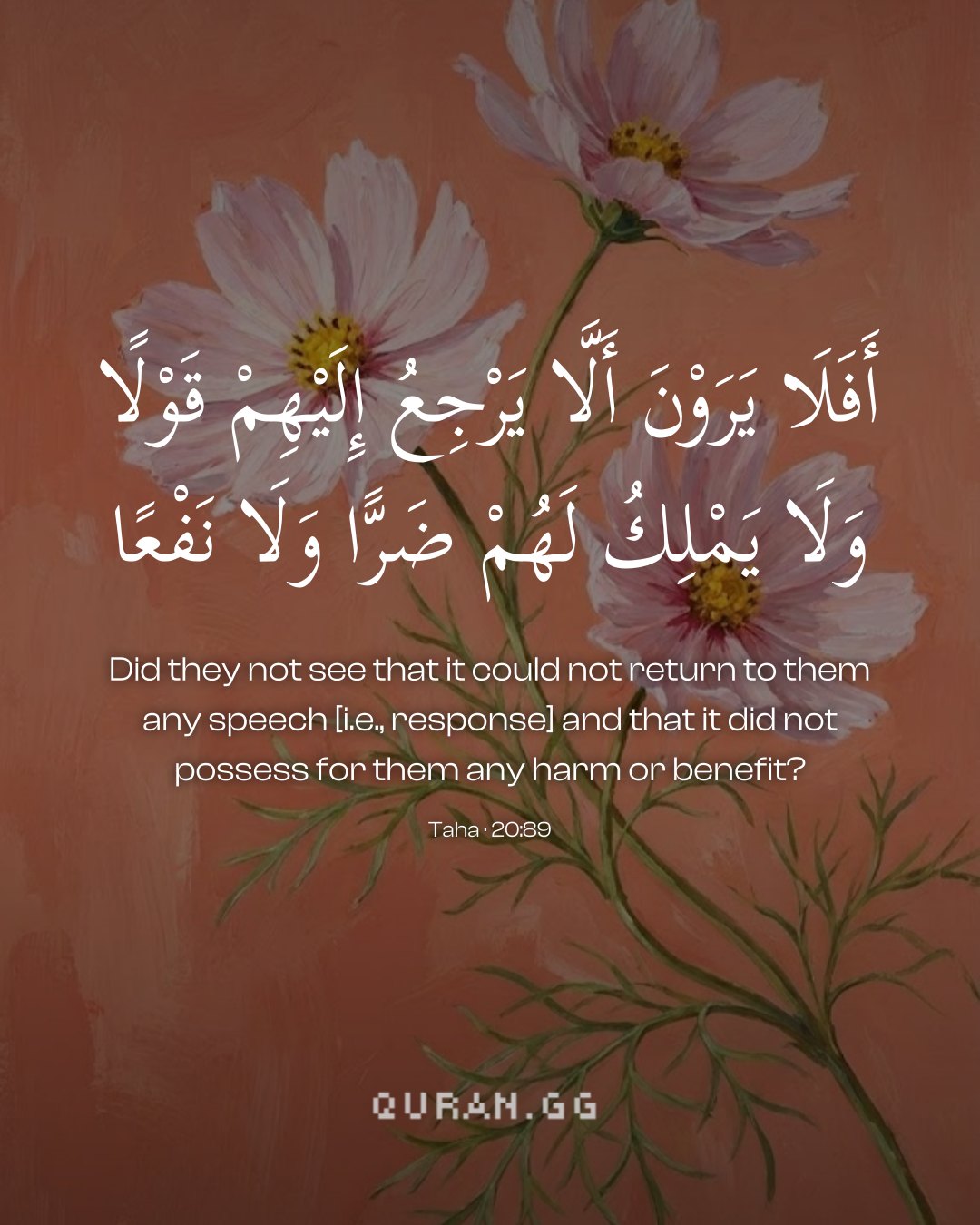
أَفَلَا يَرَوْنَ أَلَّا يَرْجِعُ إِلَيْهِمْ قَوْلًا وَلَا يَمْلِكُ لَهُمْ ضَرًّا وَلَا نَفْعًا (Do they not then see that it does not respond to them with a word, nor does it have power to harm or benefit them? - 20:89) The excuses put forward by the Bani Isra'il before Sayyidna Musa (علیہ السلام) for the evil deeds end with the previous verse. In this verse Allah reminds them of their folly by pointing out to them that even if the calf had life and made bovine noises would that be sufficient reason to adopt it as the object of their worship? They were well aware that it could not answer their prayers nor had it the power to harm them or to benefit them.
Tazkirul Quran
Maulana Wahiduddin KhanOn ayahs 89–90
According to ancient custom, the Israelite women were probably laden with heavy jewelry. During the journey when the community halted to set up camp, the women removed their jewels and put them all together in one place. Among the Israelites, there was one al-Samiri (the Samaritan) who was experienced in the old Egyptian art of making likenesses of deities. He melted these jewels down and made from them a calf-shaped statue. This calf was hollow from inside and shaped so skillfully that when the breeze passed through it, it gave out a sound like the lowing of a bull. Then al-Samiri said to the ignorant Israelite community, ‘See, here is your real God, and Moses has gone in search of God, to which mountains nobody knows.’ The ‘Samiris’ of every age fool the people in exactly the same way. They make a fetish of some tangible thing, then try to prove that it is the greatest reality. Being duped by their glib talk, large crowds of gullible people gather around them. Worship of material objects has been the greatest weakness of man from time immemorial till the present day.
Uthmani text of the Madinah mushaf (King Fahd Complex). Translation: Saheeh International. Tafsir via Quran.com.