(a similitude; the Dwellers of the Town, when there came Messengers to them.) In the reports that he transmitted from Ibn `Abbas, Ka`b Al-Ahbar and Wahb bin Munabbih - Ibn Ishaq reported that it was the city of Antioch, in which there was a king called Antiochus the son of Antiochus the son of Antiochus, who used to worship idols. Allah sent to him three Messengers, whose names were Sadiq, Saduq and Shalum, and he disbelieved in them. It was also narrated from Buraydah bin Al-Husayb, `Ikrimah, Qatadah and Az-Zuhri that it was Antioch. Some of the Imams were not sure that it was Antioch, as we shall see below after telling the rest of the story, if Allah wills.
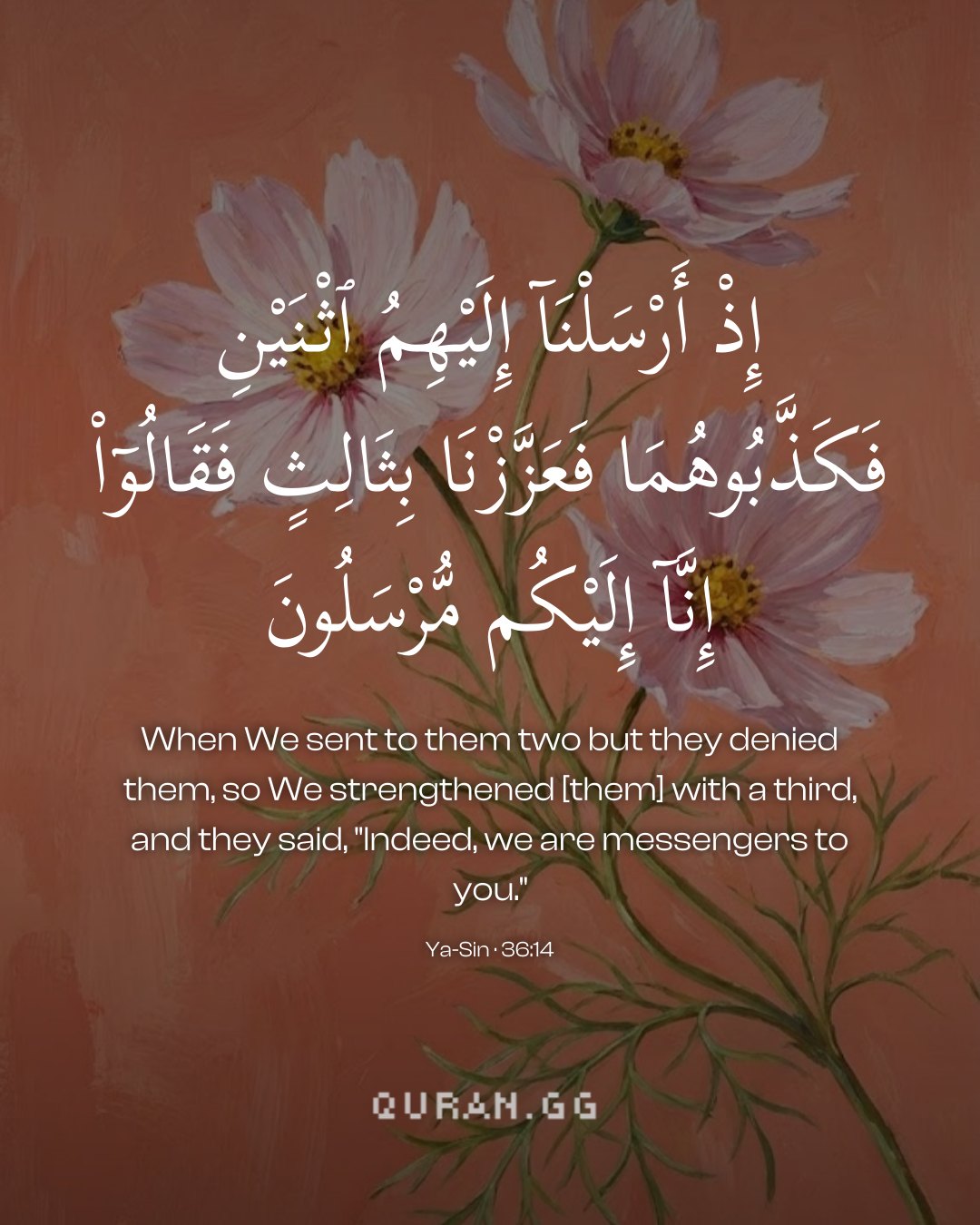
In the next sentence of verse 13: إِذْ أَرْسَلْنَا إِلَيْهِمُ اثْنَيْنِ فَكَذَّبُوهُمَا فَعَزَّزْنَا بِثَالِثٍ فَقَالُوا إِنَّا إِلَيْكُم مُّرْسَلُونَ (when the messengers came to it... - 13). The text has briefly mentioned the coming of messengers to the town. The number of the messengers sent has been identified in verse 14:إِذْ جَاءَهَا إِنَّا إِلَيْكُم مُّرْسَلُونَ (when We sent to them two (apostles), and they rejected them both, so We supported them with a third one. So they said, "We are sent to you" ) This shows that three messengers were sent to the said town. First came two, the people of the town rejected them and refused to listen to them. Then Allah Ta’ ala strengthened them by sending the third messenger. After that, all three addressed the people of the town, telling them that they had been sent to guide them to the straight path.
What does 'messenger' mean? Who were these people?
In the Qur'an, the word: رسول (rasul: messenger) and: مُرسل (mursal: sent) is generally used for a prophet or apostle of Allah. In this verse, Allah Ta’ ala has attributed their sending to Himself. This too indicates that they are prophets who have been sent to accomplish some mission. This is what Ibn Ishaq reports from Sayyidna Ibn ` Abbas ؓ Ka'b Ahbar ؓ and Wahb Ibn Munabbih. According to the reports, these three elders mentioned as the ones sent to this town were the prophets of Allah. Their names as given in this narration are Sadiq, Saduq and Shalum, while in another narration, the name of the third appears as Sham` un. (Ibn Kathir)
And it has been reported from Sayyidna Qatadah ؓ that the word: مُّرْسَلُونَ (mursalun: sent ones) has not been used here in its technical sense, instead, it appears in the sense of a bearer of message, and the three elders who were sent to this town were no prophets themselves, rather, were from among the disciples of Sayyidna ` Isa (علیہ السلام) and were sent for the guidance of this town under his order (Ibn Kathir). And since their sender, Sayyidna ` Isa (علیہ السلام) was a messenger of Allah, therefore, in a way, his sending was indirectly the sending of Allah Ta’ ala. Hence, his sending has been attributed to Allah Ta’ ala. Out of the commentators, Ibn Kathir has opted for the first saying while al-Qurtubi and others have gone by the second. From the apparent sense of the text of the Qur'an too, it is generally gathered that these blessed souls were prophets of Allah. Allah knows best.
Tazkirul Quran
Maulana Wahiduddin KhanOn ayahs 12–18
Modern research has established that whatever a man utters remains preserved in the atmosphere in the form of vibrations or waves. Similarly, the image of the actions which a man performs remains preserved in the form of light waves. In other words, every individual in this world is being constantly video-recorded. It should be borne in mind that in this world, without a man’s knowledge and quite independent of his will, his utterances and actions, being completely recorded and preserved, could be replayed any time later.
Uthmani text of the Madinah mushaf (King Fahd Complex). Translation: Saheeh International. Tafsir via Quran.com.