(And a sign for them is the night. We withdraw therefrom the day,) meaning, `We take it away from it, so it goes away and the night comes.' Allah says:
فَإِذَا هُم مُّظْلِمُونَ
(and behold, they are in darkness.) As it says in the Hadith:
(When the night comes from here, and the day departs from here, and the sun has set, then the fasting person should break his fast.) This is the apparent meaning of the Ayah. Allah's saying:
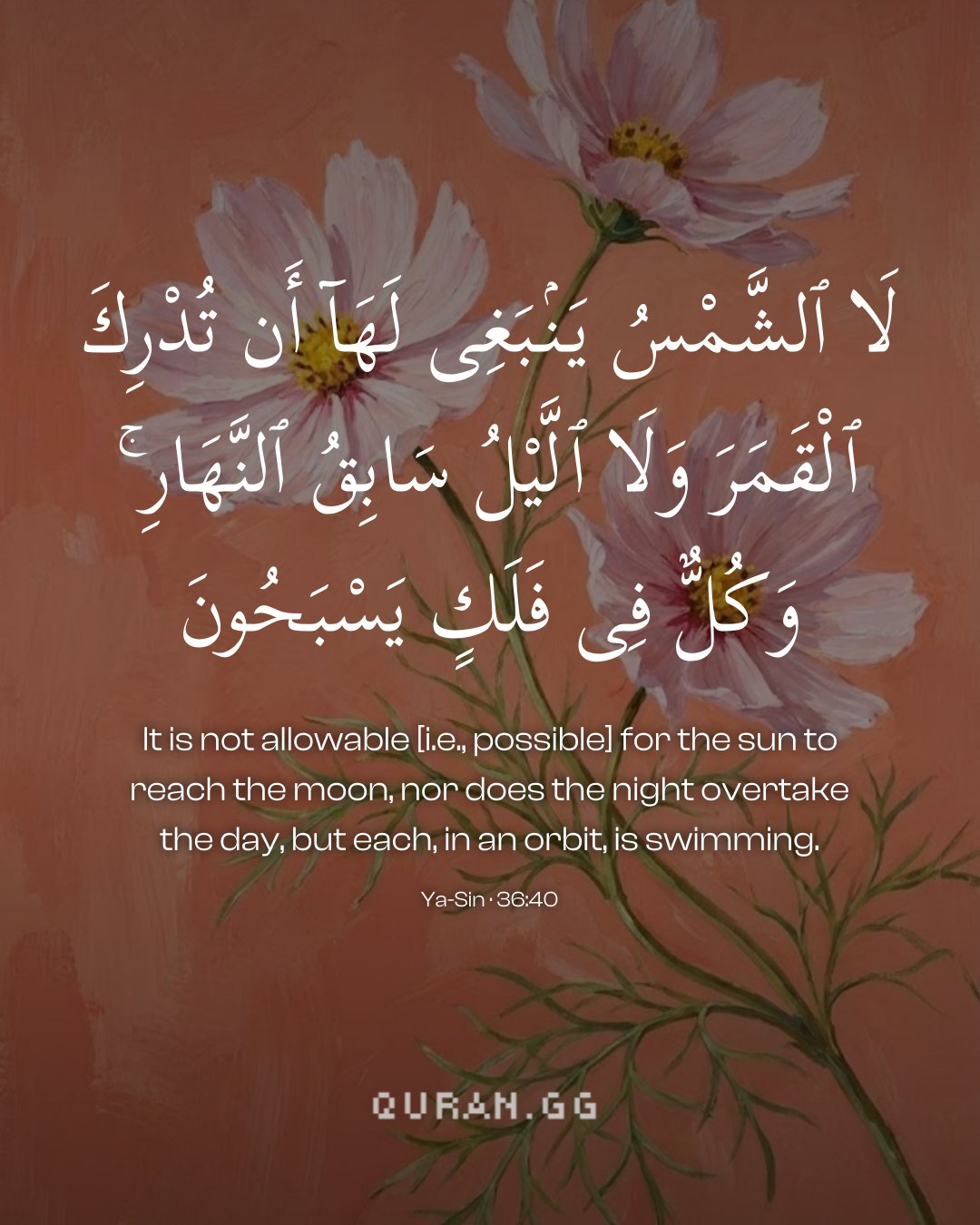
In verse 40, it was said: وَكُلٌّ فِي فَلَكٍ يَسْبَحُونَ (And each one is floating in an orbit - 40). Literally, the word: فَلَک (falak) does not mean the sky. Instead, it means the orbit in which some star moves. This verse has also appeared earlier in Surah Al-Anbiya' (21:33). It tells us that the moon is not contained within some sky as presumed by the astronomical theory of Ptolemy. Instead, it moves in a particular orbit in the space lower than it. Then, there are recent investigations as well as the human access to the moon that have made it certain.
Tazkirul Quran
Maulana Wahiduddin KhanOn ayahs 40–43
The earth, the moon and the sun have their fixed orbits, in which they move with the utmost precision, and due to which different celestial phenomena take place: for instance, the occurrence of day and night on the earth and the waxing and waning of the moon, serve as a heavenly calendar. This system has been in existence for millions of years now, and there is still no deviation of any kind in it. This observation is purely an introduction to the fathomless and unlimited powers of God. If man learns lessons from these phenomena, the majesty of the One God will prevail over his mind to such an extent that all other impressions of greatness will be automatically erased from it.
Uthmani text of the Madinah mushaf (King Fahd Complex). Translation: Saheeh International. Tafsir via Quran.com.