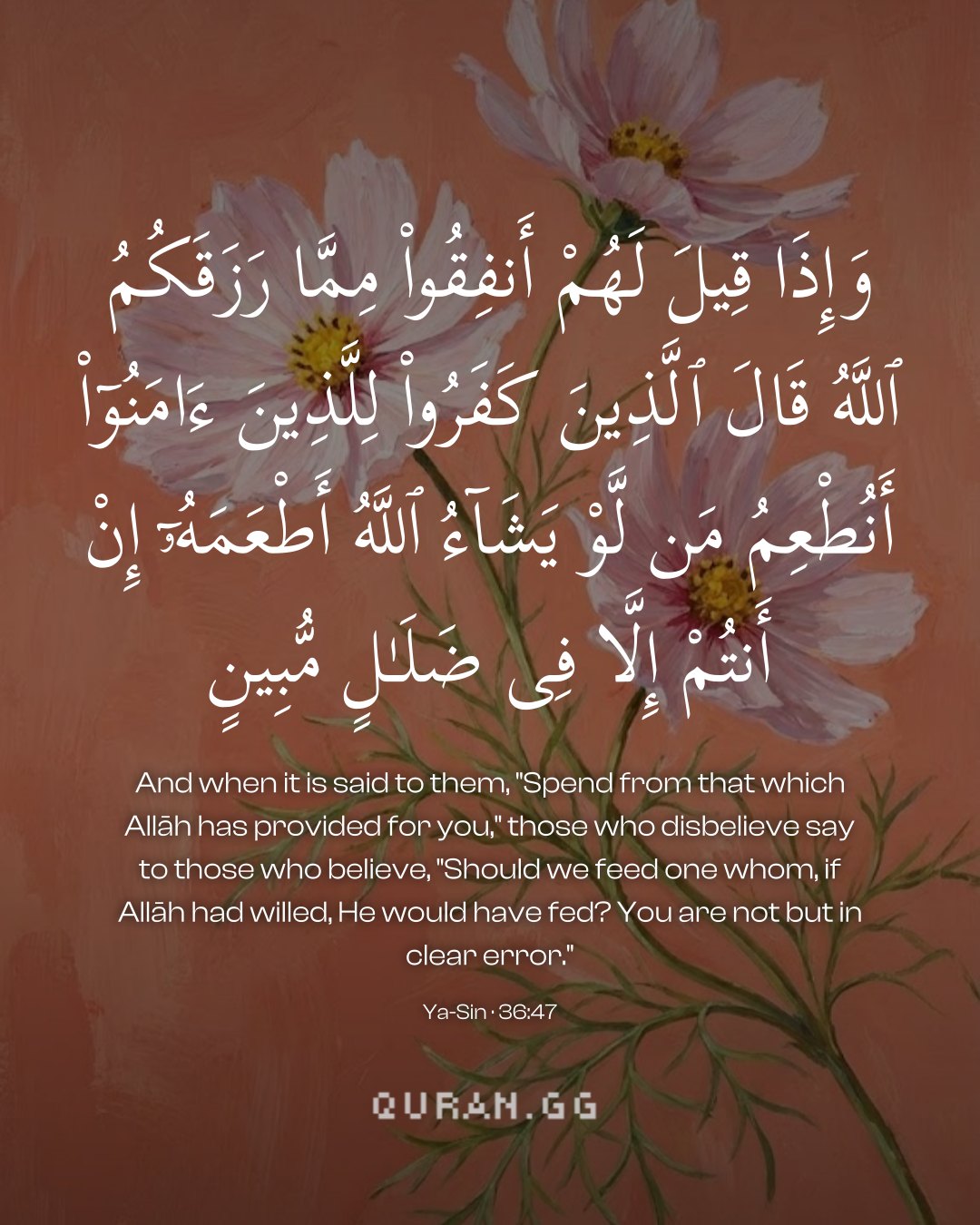
And when it is said to them, "Spend from that which Allāh has provided for you," those who disbelieve say to those who believe, "Should we feed one whom, if Allāh had willed, He would have fed? You are not but in clear error."
Allah tells us how the idolators persisted in their misguidance and in not paying attention to the sins that they had committed in the past or what was to happen to them in the future, on the Day of Resurrection.
(And when it is said to them: "Fear of that which is before you, and that which is behind you...") Mujahid said, "This refers to sins." Others said it is the opposite.
لَعَلَّكُمْ تُرْحَمُونَ
(in order that you may receive mercy.) means, `so that, if you fear such things Allah will have mercy on you and will save you from His punishment.' The wording implies that they would not respond. Rather that they would turn away and ignore that, as Allah says:
In the previous verses, through a description of Divine manifestations of power and wisdom in the creation of the heavens and the earth, people were invited to recognize their creator and believe that He alone is worthy of worship and, on the acceptance of this invitation, a promise of everlasting blessings was made along with a warning of severe punishment on its rejection. In the present verses and in the verses following these, there is a description of the disbelieving people of Makkah who were their direct addressees and who remained unmoved and unaffected either when persuaded to do something reward worthy, or when warned against some likely punishment.
Behind a man are his actions and before him lies the Day of Reckoning. Life, in other words, is a journey from the world of actions towards the world of results. This is a very crucial state of affairs. If a man actually realises his position, he will start trembling. But he does not consider this; nor does any sign open his eyes. He tries to justify his actions by false interpretations until the day he dies.
Uthmani text of the Madinah mushaf (King Fahd Complex). Translation: Saheeh International. Tafsir via Quran.com.