Allah tells us that the longer the son of Adam lives, the more he becomes weak after being strong, and incapable after being able and active
This is like the Ayah:
اللَّهُ الَّذِى خَلَقَكُمْ مِّن ضَعْفٍ ثُمَّ جَعَلَ مِن بَعْدِ ضَعْفٍ قُوَّةٍ ثُمَّ جَعَلَ مِن بَعْدِ قُوَّةٍ ضَعْفاً وَشَيْبَةً يَخْلُقُ مَا يَشَآءُ وَهُوَ الْعَلِيمُ الْقَدِيرُ
(Allah is He Who created you in (a state of) weakness, then gave you strength after weakness, then after strength gave weakness and gray hair. He creates what He wills. And it is He Who is the All-Knowing, the All-Powerful.) (30:54). And Allah says:
وَمِنكُمْ مَّن يُرَدُّ إِلَى أَرْذَلِ الْعُمُرِ لِكَيْلاَ يَعْلَمَ مِن بَعْدِ عِلْمٍ شَيْئاً
(And among you there is he who is brought back to the miserable old age, so that he knows nothing after having known) (22:5). The meaning here -- and Allah knows best -- is that Allah is telling us that this world is transient and will come to an end, it is not eternal and lasting. Allah says:
Continue reading the tafsir of ayahs 68–70 Commentary
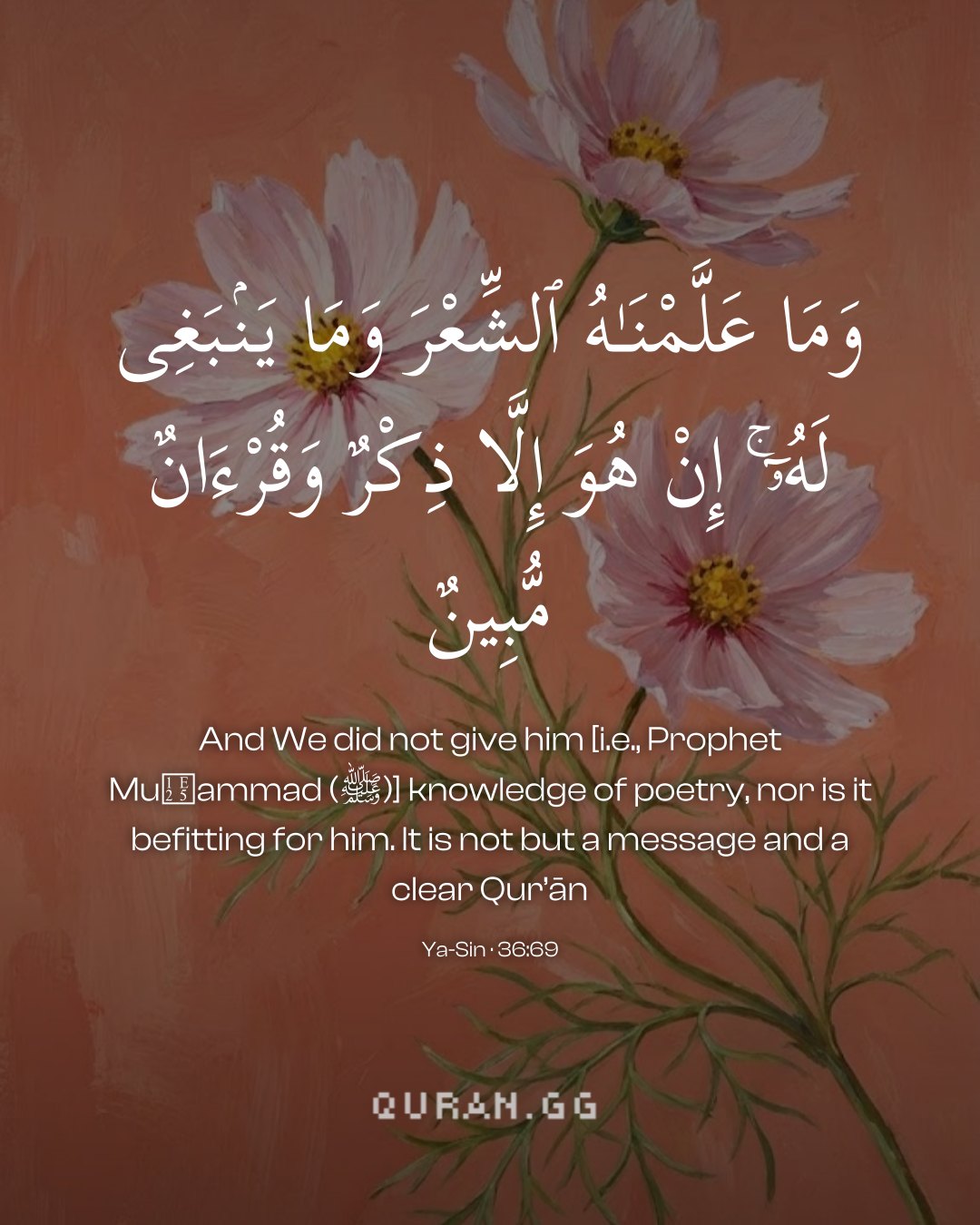
In the first verse cited here, it was said: وَمَا عَلَّمْنَاهُ الشِّعْرَ وَمَا يَنبَغِي لَهُ (And We did not teach him poetry and it is not proper for him.) Since the deniers of the appearance of a prophet and messenger with a mission could not deny the unique effectiveness of the Qur'an and its ability to move hearts that was a matter of common experience, therefore, they invented convenient excuses. At times, they would call this Divine Word, some magic and the Holy Prophet ﷺ ، a magician. Then, on other occasions, they would say that this Word was poetry and he was a poet. By saying that, they wanted to prove that this unique effectiveness did not come out of the Divine Word as such, instead, they were either words of magic or sorcery that made an impression on hearts, or it is poetic speech for that too affects hearts.
In this verse, Allah Ta’ ala said that He did not teach His prophet the art of poetry, nor was it appropriate to his station and saying that he was a poet, is false and wrong.
Here, we have a question. Is it not that Arabs are a people who have poetry in their blood? Even their women and children would compose impromptu lines of poetry. They knew poetry and its reality. How could they say that the Qur'an was poetry and the Holy Prophet ﷺ was a poet? On what basis could this be because neither is the Qur'an restricted by the compulsion of poetic meter, nor of radif (the unchanging word that appears at the end of the hemistich) and qafiyah (the changing rhymed word that appears before the radif) anywhere in the text? Not even someone who is pathetically ignorant of the mores of poetry would think of calling this poetry.
To answer this, it can be said that, essentially, poetry is composed of self-structured imaginary subjects, whether in poetry or prose. By calling the Qur'an, poetry and the Holy Prophet ﷺ ، a poet their purpose was to tell him that the Divine Word he claims to have brought, is no more than imaginary tales. Or, may be, they called him a poet in terms of the well recognized meaning of poetry with a certain congruity in mind, that is, the effect produced by the Qur'an is similar to the effect produced by poetic compositions.
Quoting his own chain of authority, Imam Abu Bakr al-Jassas (رح) has reported that someone asked Sayyidah ` A'ishah ؓ if the Holy Prophet ﷺ used to recite some verse of poetry once in a while. To that, she said, "No, however, he once did recite a verse of Ibn Tarfah:
----۔ و یأتیک بالاخبار من لّم تزوّدِ ستبدی لک الایام ما کنت جاھلاً-----
"The time will reveal to you that which you did not know, and the news will be brought to you by one whom you did not appoint to do so.
But the holy Prophet ﷺ recited this as: وزن شعری in a manner that broke the poetic measure. Sayyidna Abu Bakr ؓ submitted, 'Ya RasulAllah, this verse is not like that.' He said, 'I am not a poet, nor is poetry appropriate for me."
Ibn Kathir has reported this narration in his Tafsir, and at-Tirmidhi, an-Nasa'I and Imam Ahmad have also reported it. This tells us that he simply did not consider reciting verses of poetry composed by others as appropriate for him. That he would compose it himself was unthinkable. As for some sentences having the resonance of poetic measure reported from the Holy Prophet ﷺ himself, they did not issue forth from him with the intention of composing formal poetry. They were casual, and should some one or two lines issue forth from a person that fall into poetic measure, these do not make him a poet. But, from this natural condition of the Holy Prophet ﷺ that was based on great considerations of wisdom, it does not become necessary that poetry should be taken as blameworthy in any absolute sense - as explained under the details of injunctions relating to poetry in our commentary on verse 224 of Surah Ash-Shu` ara' (26) appearing at its end in Volume VI of Ma’ ariful-Qur'an, English. Those interested may see it there.
Man has been endowed with eyes, hands and legs and numerous such blessings, but instead of being thankful, he takes these blessings for granted. It is a fact that these features were not created by man himself, instead his Creator blessed him with them. He must therefore realize their importance, for what would man do, if the Creator decided to withdraw His blessings. Man gets a glimpse of this possibility at the onset of old age. When a man grows very old, all his powers are taken away from him, so much so that he becomes as weak and helpless as he was as a small child. But, man is so foolish that he does not learn a lesson from this.
Uthmani text of the Madinah mushaf (King Fahd Complex). Translation: Saheeh International. Tafsir via Quran.com.