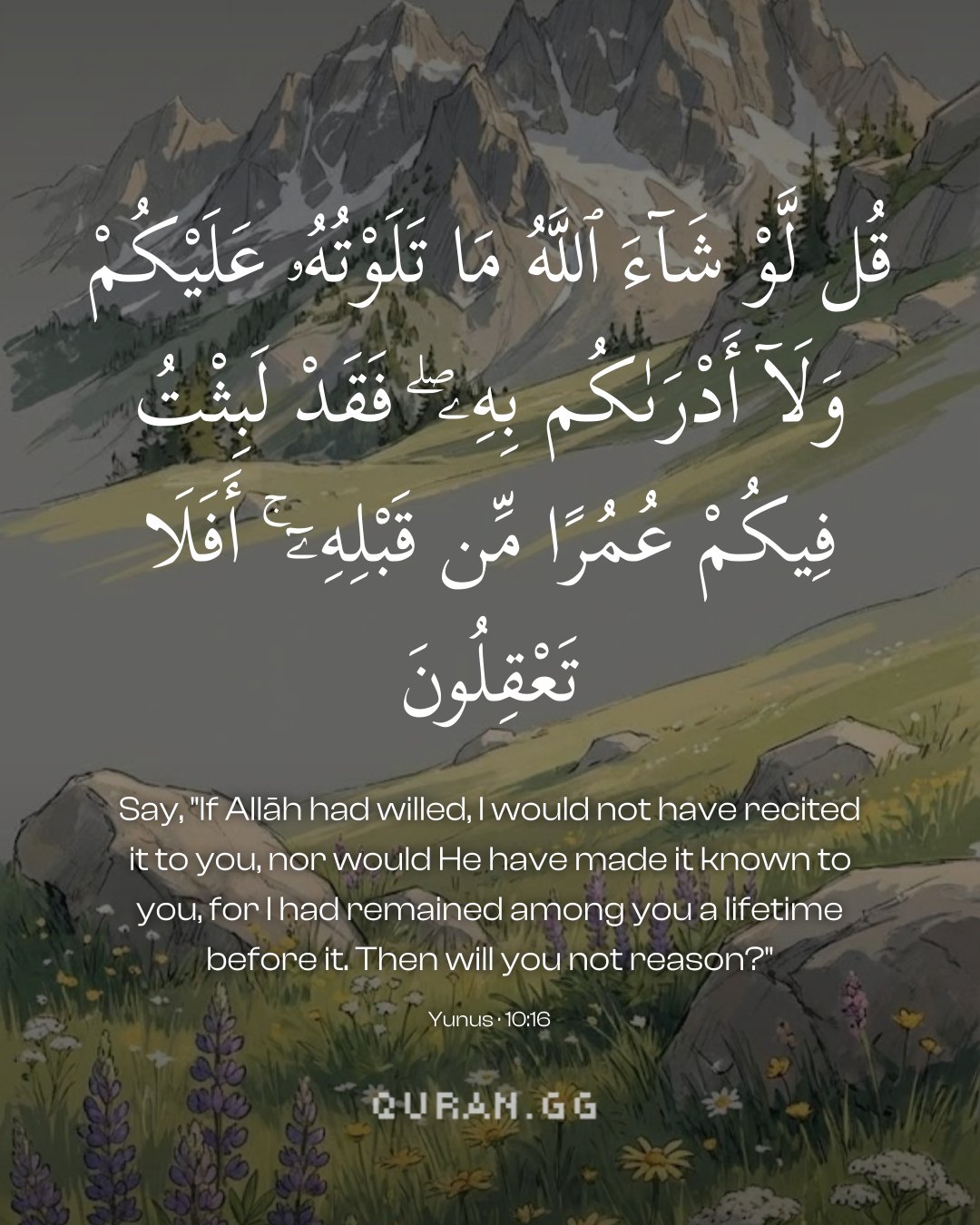
Say, "If Allāh had willed, I would not have recited it to you, nor would He have made it known to you, for I had remained among you a lifetime before it. Then will you not reason?"
Allah tells us about the obstinance of the disbelievers of the Quraysh, who were opposed to the message and denied Allah. When the Messenger ﷺ read to them from the Book of Allah and His clear evidence they said to him: "Bring a Qur'an other than this." They wanted the Prophet to take back this Book and bring them another book of a different style or change it to a different form. So Allah said to His Prophet :
(Say: "It is not for me to change it on my own accord;) This means that it is not up to me to do such a thing. I am but a servant who receives commands. I am a Messenger conveying from Allah.
After that, the fact that the Qur'an was from Allah and that it was His Word was driven home with an open argument by saying: فَقَدْ لَبِثْتُ فِيكُمْ عُمُرًا مِّن قَبْلِهِ (Then I have lived among you for years before it). In effect, he was saying, ` just think for a moment. Is it not that, much before the revelation of the Qur'an, I have spent a long period of forty years of my life among you? During this period, you have never heard me composing and reciting poetry or writing essays in prose. Had I been proficient in saying something like this Word of Allah, I would have naturally said at least some of it during this period of forty years. In addition to that, you have a direct experience of my character and conduct, particularly of my truth and honesty, during these long forty years of my life among you. You know that I have never lied then. How and why would I start lying now after all those forty years?' This clearly proves that the Holy Prophet ﷺ is true and trustworthy. Whatever there is in the Qur'an is the Word of Allah Ta` ala and has come from Him.
Important Note
No doubt, this argument of the Qur'an provides a perfect proof of its veracity as the Word of Allah. But, it has also given us a standing rule of conduct in matters of common interest where we must be able to separate the genuine from the counterfeit and the true from the false. When an office or rank of responsibility has to be given to a per-son, it becomes necessary to assess the qualification and capability of the incumbent. To do that, the best rule is to go through the record of his past life. If the person concerned is found to be true and trustworthy, the same can be expected from him in the future as well. And if, there is no evidence to prove his honesty and truth in that person's past life, trusting him for the future just because of what he says or claims is not a wise thing to do. In our time, finding the right person for an office of responsibility has become a nightmare. All sorts of errors (of intent, background research and decision making) are being committed and errors are compounded by widespread disorders (in social and governmental institutions). The real reason why all this is happening is the abandonment of this natural principle in favor of what is customary, formal (or straight dishonest).
Tazkirul Quran
Maulana Wahiduddin KhanOn ayahs 15–16
‘Then We made you their successors (khala’if, sing. khalifah) in the land.’ The real meaning of khalifah is ‘one who comes afterwards’. This word ‘successor’ is specially used for coming into power after another. This succession is in relation to human beings and not in relation to God. In the Quran, wherever the word khilafah has been used, it is in connection with succession to some creature and not in connection with succession to God. Making somebody a successor is solely for the purpose of putting him to the test and is not meant to confer any honour. Making somebody a successor means giving one an opportunity to work after another; it is placing one community in the arena of testing in place of another community. For example, in India, the native Rajas were replaced by Mughals. Then they were removed and the Britishers were made their successors. Later, they (the British) were made to leave the country, making way for the majority community. In all these cases, the ‘one coming afterwards’ was the successor (khalifah) of the earlier one.
Uthmani text of the Madinah mushaf (King Fahd Complex). Translation: Saheeh International. Tafsir via Quran.com.