(Say: "Is there of your partners one that originates the creation and then repeats it") meaning, who is the one who started the creation of these heavens and earth and created all the creatures in them Who can place the planets and the stars in their positions Who can then repeat the process of the creation
قُلِ اللَّهُ
(Say: "Allah") It is He Who does this. He does it by Himself, alone without partners.
فَأَنَّى تُؤْفَكُونَ
("Then how are you deluded away (from the truth)") How is it that you are so misled from the right path to falsehood
In the concluding verse (32), it was said: فَذَٰلِكُمُ اللَّـهُ رَبُّكُمُ الْحَقُّ ۖ فَمَاذَا بَعْدَ الْحَقِّ إِلَّا الضَّلَالُ (So, that is Allah, your Lord in truth. And what is there, after truth, but error?), that is, ` this is the Sacred Being whose attributes of perfection have just been mentioned. Once you have found the Truth, there remains nothing else to find except error and straying. In other words, once it stands proved that Allah Ta` ala is the only true and rightful object of worship, it is terribly senseless to abandon this truth and allow yourself to be diverted elsewhere.
important note
In relation to issues of religious beliefs embedded in this verse, it must be borne in mind that the statement: مَاذَا بَعْدَ الْحَقِّ إِلَّا الضَّلَالُ (What is there, after truth, but error?) proves that there is no intermediary link between truth and error. What is not the truth will be included in error and straying. There can be no such thing that is neither truth nor error. And it is also not possible that two opposite things could be the truth. This is an established rule in the sight of the majority of scholars in the Muslim Ummah. However, difference exists among ` Ulama' regarding minor and subsidiary juristic issues. In the view of some of them, both sides would be considered as on truth in Ijtihad-based issues and, according to the majority of them, there is consensus on the view that the taking of contra-position in Ijtihad-based problems cannot be termed as error and straying.
Tazkirul Quran
Maulana Wahiduddin KhanOn ayahs 36–38
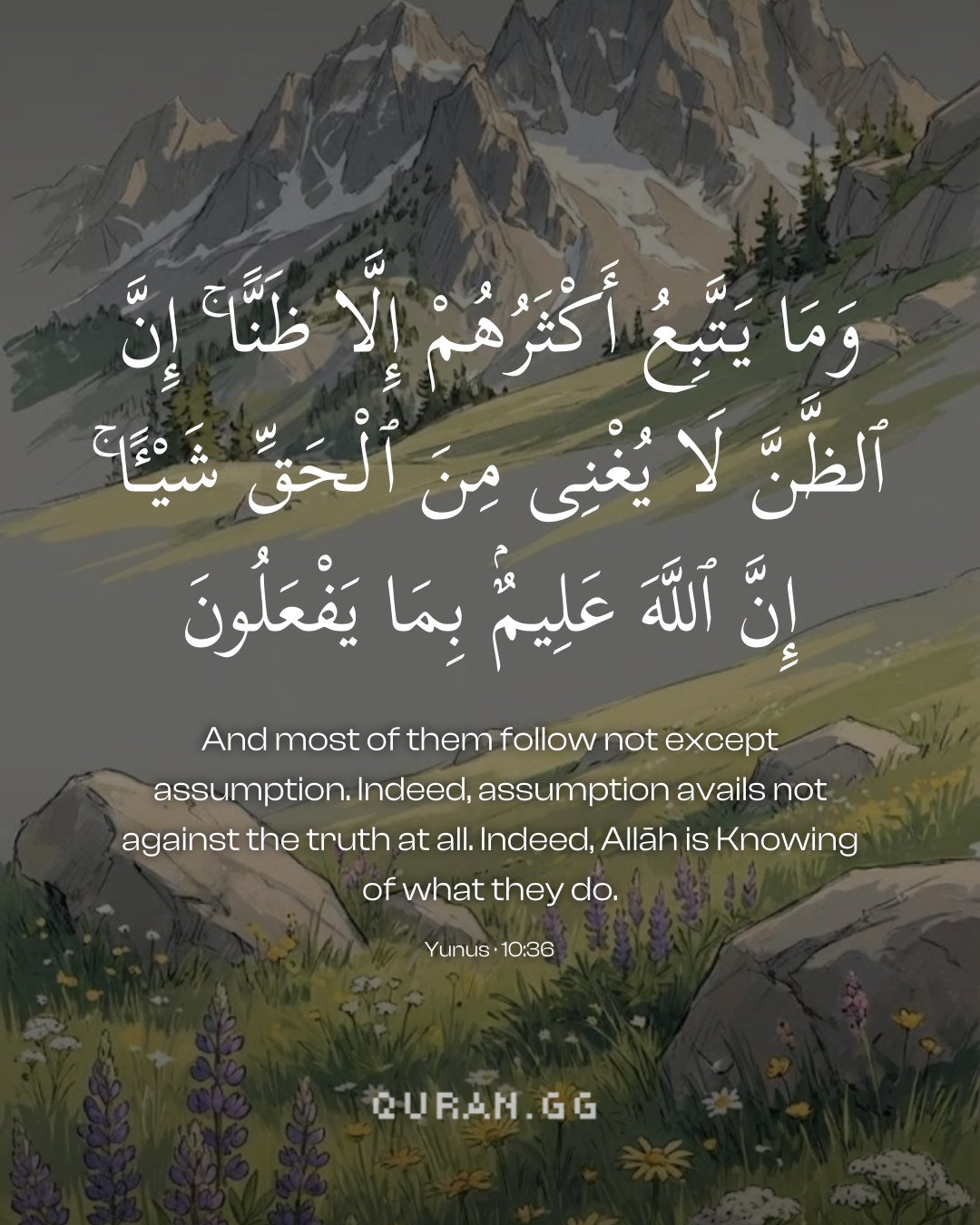
Except for God, no being who has been given the status of godhead, either from among human beings or non-human beings, has the power to bring anything into existence. It is only God whose creative power stands proved; and when God’s creativity has once been proved, it also stands to reason that He can and will repeat His acts of creation in the Hereafter. Then it is futile to pay attention to the so-called other partners. From them, man cannot obtain anything either in his first life or in his second. This is also the case with guidance. It is only God who sends guidance. The utterances of the prophets, presented by them as God’s guidance, were definitely such. As opposed to this, the condition of partners is that either they are entirely incapable of giving knowledge about right or wrong to human beings, or due to their own shortcomings and limitations, they are themselves in need of guidance, leave alone giving guidance to others. Given this state of affairs, man should revert to the one and only God and dismiss from his mind any imaginary partners. The tenets of polytheism are based not on any real knowledge but on suppositions or imagination. Without any basis, people have been wrongly persuaded that certain beings possess godly qualities, though such an important assessment of such beings can be formed only on the basis of real knowledge and not simply on conjecture or guesswork.
Uthmani text of the Madinah mushaf (King Fahd Complex). Translation: Saheeh International. Tafsir via Quran.com.