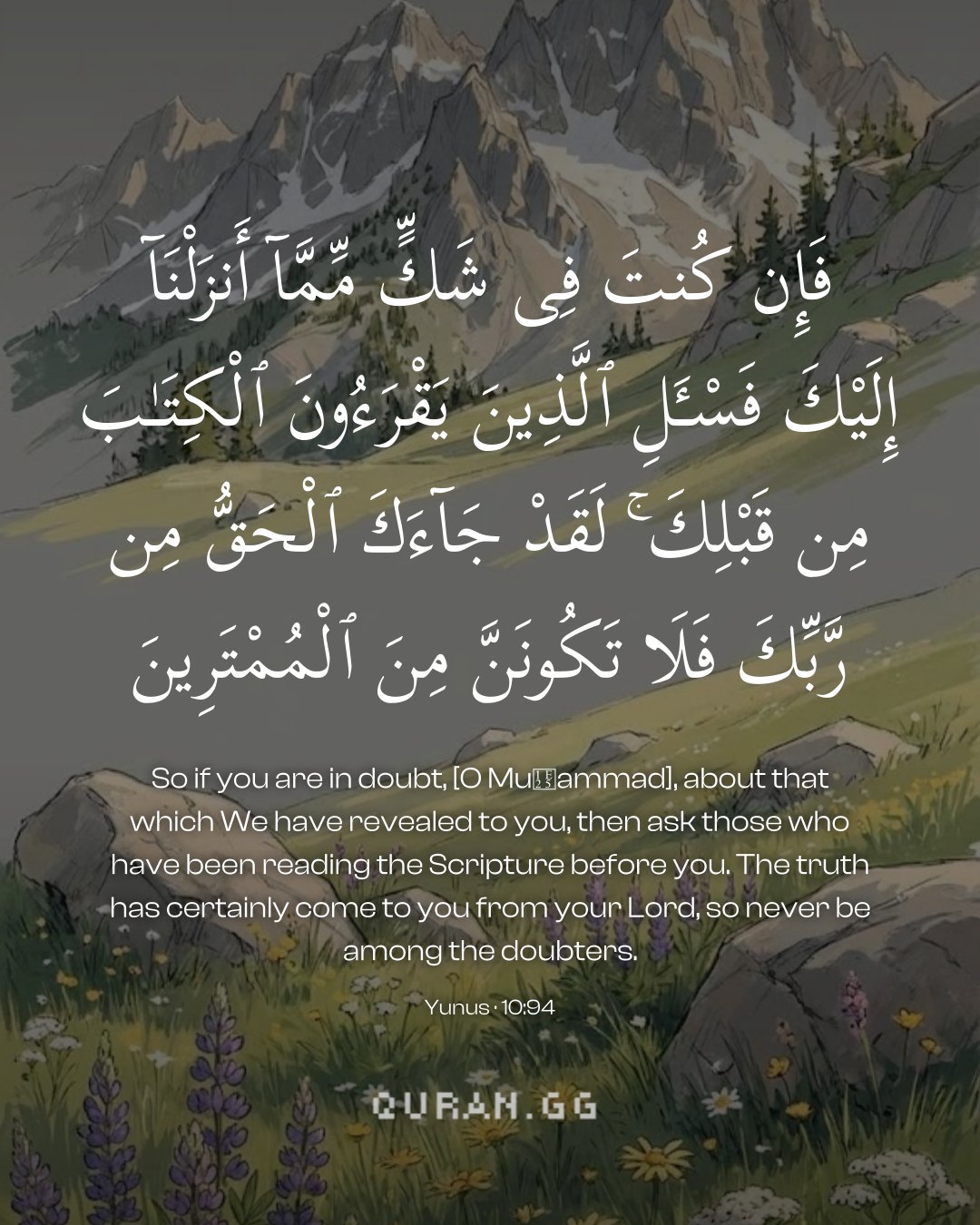
So if you are in doubt, [O Muḥammad], about that which We have revealed to you, then ask those who have been reading the Scripture before you. The truth has certainly come to you from your Lord, so never be among the doubters.
(Those who follow the Messenger, the Prophet who can neither read nor write whom they find written of with them in the Tawrah and the Injil.)(7:157) They are as certain of this as they are about who their children are, yet they hide it and distort it. They did not believe in it despite its clear evidence. Therefore Allah said:
(Truly, those, against whom the Word (wrath) of your Lord has been justified, will not believe. Even if every sign should come to them, until they see the painful torment.) meaning they would not believe in a way that they might benefit from that belief. This is when they believe at a time one may not be able to benefit from his belief. An example is when Musa prayed against Fir`awn and his chiefs, saying:
(And even if We had sent down unto them angels, and the dead had spoken unto them, and We had gathered together all things before their very eyes, they would not have believed, unless Allah willed, but most of them behave ignorantly.) (6:111) Allah then said:
Ma'arif al-Qur'an
Mufti Muhammad Shafi
In the third verse (94), the address is obviously to the Holy Prophet ﷺ . But, it goes without saying that there is no probability of his doubting the revelation. Therefore, the purpose is to beam the message to the Muslim community through this address where he is not the intended recipient. Then, it is also possible that this address may be to human beings at large asking them if they had any doubts about the Divine revelation sent to them through Sayyidna Muhammad al-Mustafa ﷺ . If they had, let them ask those who recited the Torah and Injil before them. They would tell them that all past prophets and their Books have been announcing the glad tidings of the Last among Prophets. This will remove their scruples and suspicions.
According to Tafsir Mazhari, this verse tells us that anyone in doubt about some religious matter is duty-bound to have his doubts removed by asking genuine ` Ulama' (religious scholars whose learning, honesty and adherence to Qur'an, and Sunnah is well recognized, popularly referred to as ` Ulama' al-Haqq). To continue nursing such doubts is not a good thing to do.
Tazkirul Quran
Maulana Wahiduddin KhanOn ayahs 93–94
The Israelites were the bearers of God’s religion in ancient times. God granted them the favour of saving them from their enemy, Pharaoh. Then He caused them to be led to the open atmosphere of Sinai. There, by His instrumentality, water and provisions were made available to them. Through this training in the desert, a new powerful generation came into being. This generation, after Moses, constituted a great nation, and in the fertile areas of Syria, Jordan and Palestine, established the Israelite empire, which remained in existence for several centuries. The result of this favour should have been that the Children of Israel should have remained obedient to God and grateful to Him and should have made the service of religion the purpose of their lives. But in spite of clear guidance, they had gone astray. What was it that is called here ‘going astray’? It was having differences among themselves. They possessed the knowledge revealed by God which was the only Truth. But they had differences in the correct construction to be put on this knowledge and became divided (at-Tafsir an-Nasafi). As long as a community is one, religion remains united. But, later on, differences develop among them in the explanation of the knowledge of God’s revelation (al-‘ilm). Some insist on one opinion and others on another. In order to establish the truth of its way of thinking, every faction resorts to unnecessary discussions, speeches and public debates, so much so that a stage is reached when the real knowledge of God’s revelation (al-‘ilm) remains bound in books and all its strength becomes dissipated in interpretations and explanations. In this way, in spite of being from the same mould, people become divisively opinionated by becoming involved in the subsidiary aspects of religious teachings. ‘Your Lord will judge between them on the Day of Resurrection’ is apparently in the transitive form, but actually it is in the intransitive form. The idea is that on Judgement Day, when God makes His appearance, all men and women will forget their differences and accept the one and only Truth. Had they been God-fearing, they would have converged on one opinion. Fearlessness leads to a multiplicity of opinions, while fear results in a convergence of opinion.