There are Lessons to draw from the Story of Yusuf
Allah says that there are Ayat, lessons and wisdom to learn from the story of Yusuf and his brothers, for those who ask about their story and seek its knowledge. Surely, their story is unique and is worthy of being narrated.
إِذْ قَالُواْ لَيُوسُفُ وَأَخُوهُ أَحَبُّ إِلَى أَبِينَا مِنَّا
(When they said: "Truly, Yusuf and his brother are dearer to our father than we...") They swore, according to their false thoughts, that Yusuf and his brother Binyamin (Benjamin), Yusuf's full brother,
أَحَبُّ إِلَى أَبِينَا مِنَّا وَنَحْنُ عُصْبَةٌ
(dearer to our father than we, while we are `Usbah.) meaning, a group. Therefore, they thought, how can he love these two more than the group,
Continue reading the tafsir of ayahs 7–10Ma'arif al-Qur'an
Mufti Muhammad Shafi
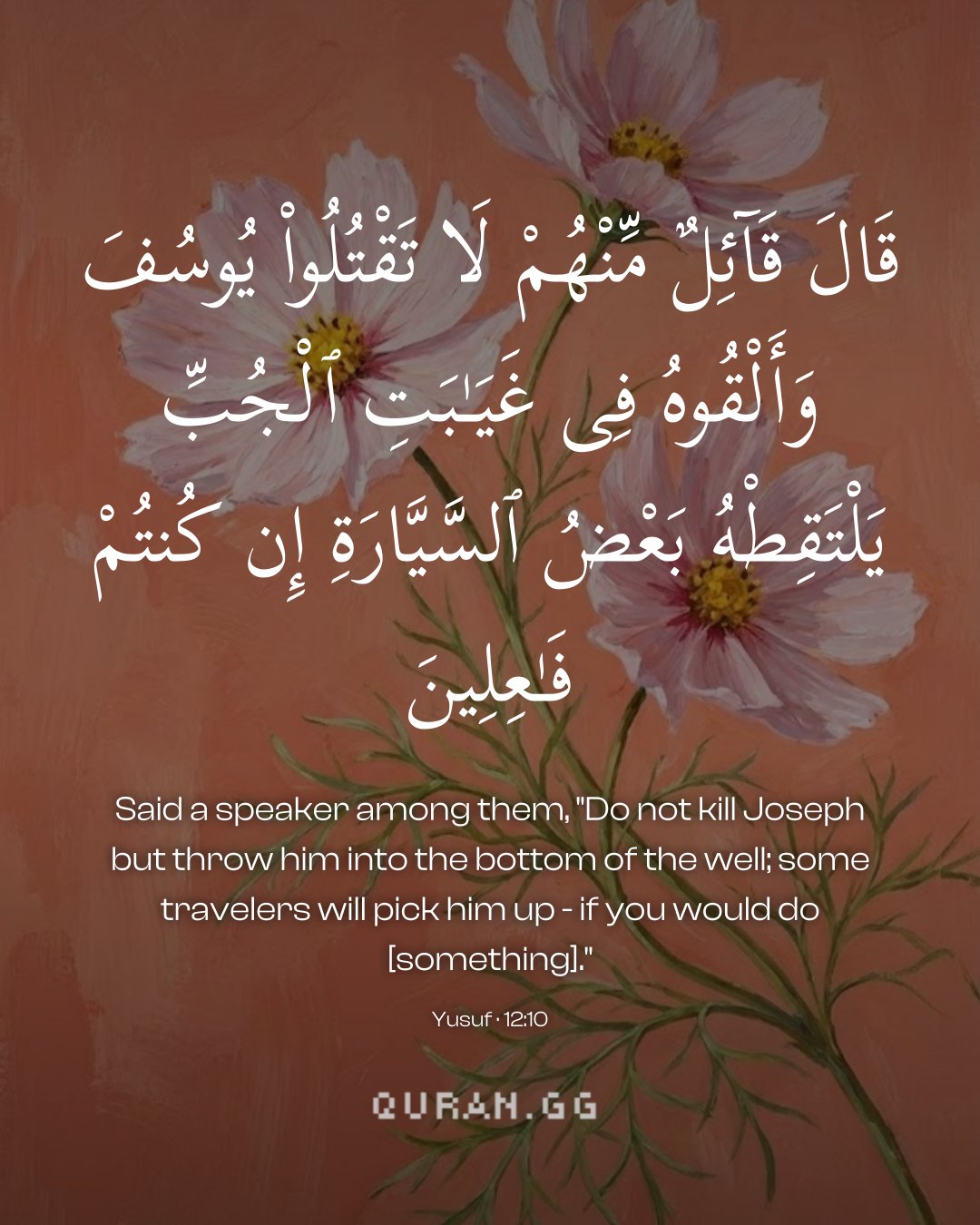
Mentioned in the fourth verse (10) is that, hearing this whole conversation, one of these brothers advised that Yusuf should not be killed. If something has to be done, let him be thrown into some pit of a well where he could remain alive so that when wayfarers stop at this well, they would take him out and away. Thus, it would serve their purpose while they would not have to take the trouble of traveling with him to some far out place. Some caravan passing this way would itself do this for them by taking him away to some distant destination.
The giver of this advice was their eldest brother, Yahuda (Judah). Some narrations report that Ruebel (Rueben) was the eldest and it was he who gave this advice. And this is the same person mentioned later, that is, he was the one who, when Benyamin, the younger brother of Sayyidna Yusuf (علیہ السلام) was detained in Egypt, came forward and said: How am I going to face my father when I go to him without him with me, therefore, I am not going back to Canaan.
The expression used in this verse is: غَيَابَتِ الْجُبِّ (ghayabatil jubb: bottom of a pit). Literally, ghayabah means everything which hides something in or makes it disappear. Therefore, a grave is also called ghayabah. And jubb refers to a well without raised sidings.
Another word: يَلْتَقِطْهُ (yaltaqithu) appearing in the next sentence: يَلْتَقِطْهُ بَعْضُ السَّيَّارَةِ (so that some wayfarer picks him up) needs explanation. This word: اِلتِقَاط (iltiqat) is a derivation from: لُقطَہ (luqtah). The word: لُقطَہ (luqtah) refers to something left or dropped which is found by someone with-out having the desire to have it. If it is inert, it is called لُقطَہ luqtah, and if it is live, it is identified as laqit (لَقیط) in the terminology of Muslim jurists. A human being will be called لَقیط laqit when he or she is a child, not rational and pubert. It is from this word that Al-Qurtubi proves that, when Sayyidna Yusuf (علیہ السلام) was thrown in the pit of a well, he was a non-pubert child. In addition to that, the saying of Sayyidna Ya` qub (علیہ السلام) fear lest a wolf should devour him (13) ' also indicates his being a child - because, the likelihood of being eaten up by a wolf can only be imagined in the case of a child. As reported by Ibn Jarir, Ibn al-Mundhir and Ibn Abi Shaiybah, the age of Sayyidna Yusuf (علیہ السلام) was seven years at that time.
Some rules about the disposal of something owned by an unknown person (lugtah)
At this place, Imam Al-Qurtubi has given details of Islamic legal injunctions relating to 'luqtah' and ` laqit' for which this is not the appropriate occasion. However, it is necessary to understand a matter of principle operative in this connection. Islam has a system of its own in which the protection of the life and property of common people, the upkeep and cleanliness of walkways and streets, and similar other civic duties, have not been left in the sole charge of the departments of the government. In-stead of that, it has made everyone obligated to the duty of keeping them safe and clean. The Hadith has sternly warned those who make things difficult for passersby by crowding or lingering or depositing or throwing their belongings on public walkways and streets. It says: ` The Jihad of a person who blocks or clogs the passageway of Muslims is not acceptable.' Similarly, there is the instance of thorns or nails or broken glass or rocks and things like that which may be lying on walkways and which pose a danger of hurting others. Islam has not made their removal from public thoroughfare the sole responsibility of a city council or municipal board. Instead of that, it has made every believing Muslim responsible for it. Of course, it does that in a mode of persuasion and great reward and thawab has been promised for those who do so.
If, on this principle, the property lost by a person is found by some-one, his Islamic legal responsibility does not remain simply limited to not stealing it - it goes much beyond that. In fact, it also becomes his responsibility that he must pick it up as an article of trust, keep it safe, make an announcement, look for the owner and, when he finds him and his description of the lost property before him makes him sure that the lost property does belong to him, then, he should give it to him. And when, despite his announcement and search, the owner remains untraced and, given the general valuation and status of the lost property, one becomes convinced that its owner is not going to look for it anymore, then, one has two choices. If he himself is poor, he may use it personally; if not, he should give it in charity to those poor and needy. However, in both these situations, the lost property thus used shall be taken as sadaqah (charity) from the owner. The thawab for it shall reach the owner - as if, it was deposited in his name in the Treasury of the Heavens.
These are golden principles of public service and social self-help. The responsibility of putting them in regular practice has been placed on every individual of an Islamic society. Only if Muslims would under-stand their religion and start acting in accordance with it, they will be noticed by the whole world with surprise as to how do they accomplish things so easily and so effectively, things which big departments of governments fail to accomplish at the cost of millions and billions.
In the course of the last days of the Prophet Muhammad in Makkah, when Abu Talib and Khadijah had passed away, the people of Makkah intensified their opposition to him. In that period, some Makkans asked him about Joseph, whose name they had heard from some Jews during their travels. They asked him this question just to ridicule him, but God Almighty turned the thrust of this question against the interrogators themselves. By means of this story they were indirectly informed that they were treading in the footsteps of Joseph’s stepbrothers, while by the Grace of God, the prophet’s future would be like that of Joseph in Egypt. Jacob could see that among his children Joseph was the ablest and most pious. In him he could see the personality of a future prophet. For this reason, he was very much attached to Joseph. But his other ten sons looked at the matter from the worldly point of view. They thought that the most important in the eyes of their father should have been their collective group, because only that was capable of helping and supporting the family. In ancient tribal times the number (particularly male) of family members was of the utmost importance in defending and supporting the family. This one-sided view of theirs assumed such proportions that they thought that if they removed Joseph from the scene, they would have their father’s undivided attention. When they sat together to devise plans against Joseph, one of his brothers proposed that instead of killing Joseph, he should be pushed into some dry well. This was a special plan of God Almighty. It is the way of God, when a group is bent upon oppressing someone unjustly, that He makes them adopt such a moderate course as may open up new possibilities for their victim.
Uthmani text of the Madinah mushaf (King Fahd Complex). Translation: Saheeh International. Tafsir via Quran.com.