Allah narrated to Muhammad ﷺ, the story of Yusuf and his brothers and how Allah raised him over them, giving him the better end, triumph, the sovereignty and wisdom (i.e., prophethood), even though they tried to harm and kill him. Allah said, `This and similar stories are part of the unseen incidents of the past, O Muhammad,
نُوحِيهِ إِلَيْكَ
(which We reveal to you.) and inform you of, O Muhammad, because it carries a lesson, for you to draw from and a reminder to those who defy you.' Allah said next,
وَمَا كُنتَ لَدَيْهِمْ
`(You were not (present) with them), you did not witness their conference nor saw them,
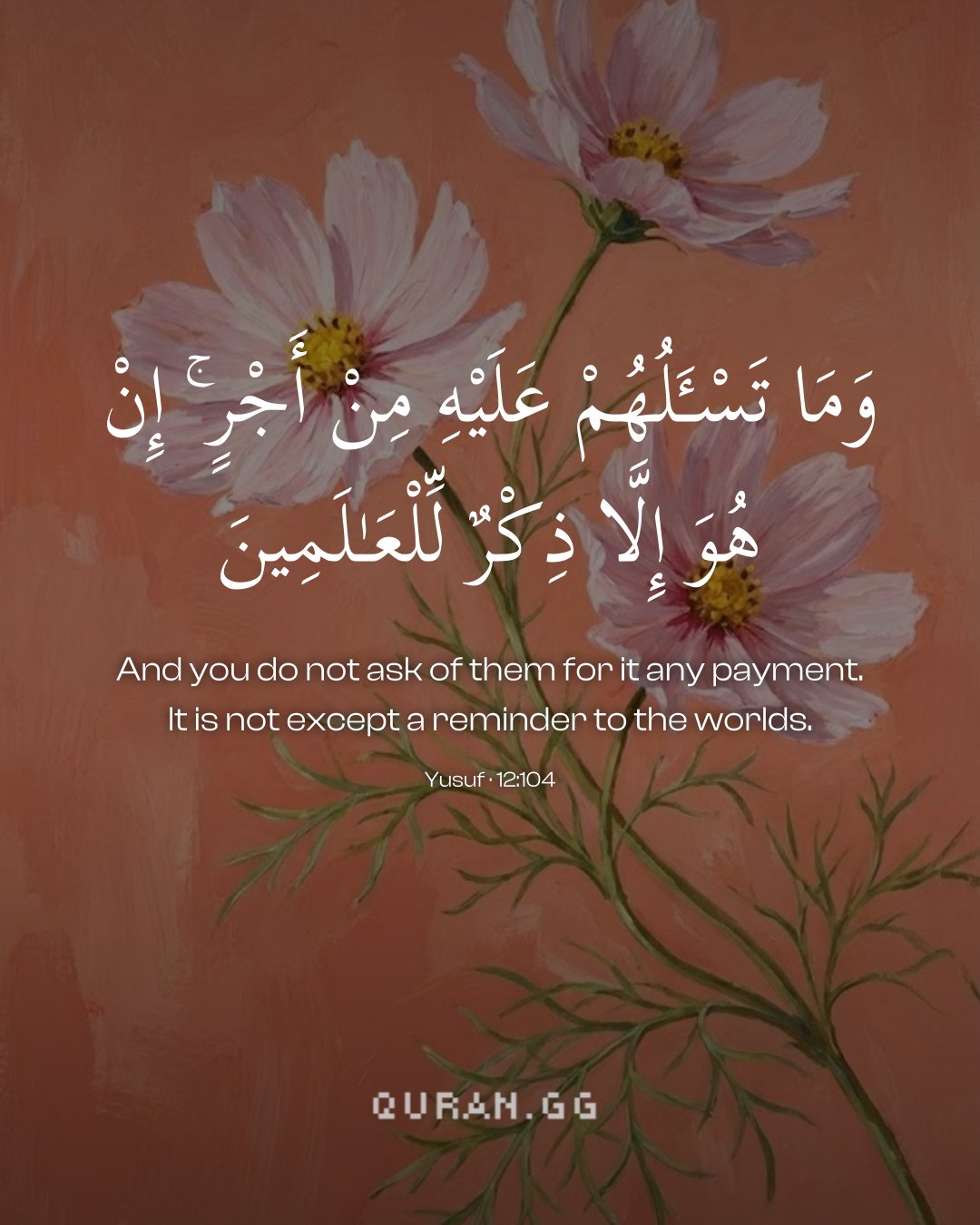
After that it was said: وَمَا تَسْأَلُهُمْ عَلَيْهِ مِنْ أَجْرٍ ۚ إِنْ هُوَ إِلَّا ذِكْرٌ لِّلْعَالَمِين ، that is, ` your mission is to tell them the truth and call 'them to the straight path. For this you do not ask them to give you something in return - which could have caused them to find it difficult to listen to him or follow him. In fact, what you are telling them is for their own good. It is only an advice to heed to and a lesson to learn from. And it is for everyone. The text here also carries a hint to the effect: When the purpose behind your effort is no worldly gain, in fact it is nothing but the reward of the Hereafter and the betterment of your people, then, that purpose of yours already stands achieved. Why would you then grieve over it?
Tazkirul Quran
Maulana Wahiduddin KhanOn ayahs 104–107
The story of Joseph is in itself a proof of the Quran being the revelation of God and not the discourse of a human being. This incident occurred about two and half thousand years prior to the advent of the Prophet Muhammad. He had neither witnessed this train of events himself, nor was it recorded in history books so that he could have read about it, nor could he have heard it from others. It was found only on the pages of the Torah, and before the age of the printing press, the Torah was a book which was known only to a few Jewish scholars at Jewish centres and not to anybody else. Moreover, the events pertaining to Joseph’s life have been described in the Quran in such a way that, in spite of their tallying basically with the descriptions in the Torah, they differ in respect of details. This difference is in itself a proof of the Quran being the revelation of God, because throughout the Quran its description appears to be very rational and natural. The descriptions given in the Quran are clearly consistent with Jacob’s and Joseph’s prophetic character, while the descriptions given in the Torah are not. Similarly, many very important aspects, for instance, Joseph’s speech in the prison ( 5: 37-40 ), which is mentioned in the Quran, find no place in the Bible or in the Talmud: even certain historical errors that are found in the Bible are not repeated in the Quran. For example, the Bible says that the king of Egypt in Joseph’s period was Pharaoh. In actual fact, the dynasty which assumed the title of Pharaoh became the rulers of Egypt only five hundred years after Joseph. During the period of Joseph, Egypt was ruled by an Arab dynasty, the Hyksos, known as the shepherd kings. (See Bible, chapter ‘Genesis’). The refusal to accept the Truth here is due to an apparent lack of reason. But as soon as a convincing argument is presented to an individual, he should immediately accept it. Most often the real reason for denial of the Truth is stubbornness. People do not accept the Truth because they do not want to do so. Acceptance of the Truth generally involves humbling oneself and this is a very difficult task for a human being. This is one reason why arrogant people never change their ways, in spite of valid arguments or reasoning being used to convince them. They will tolerate the downgrading of the truth, but they are not ready to humble themselves; they forget that those who keep a low profile in this world will be glorified in the Hereafter, whereas one who does not do so will be forever reduced to insignificance in the next world.
Uthmani text of the Madinah mushaf (King Fahd Complex). Translation: Saheeh International. Tafsir via Quran.com.