Yusuf is Rescued from the Well and sold as a Slave
Allah narrates what happened to Yusuf, peace be upon him, after his brothers threw him down the well and left him in it, alone, where he remained for three days, according to Abu Bakr bin `Ayyash. Muhammad bin Ishaq said, "After Yusuf's brothers threw him down the well, they remained around the well for the rest of the day to see what he might do and what would happen to him. Allah sent a caravan of travelers that camped near that well, and they sent to it the man responsible for drawing water for them. When he approached the well, he lowered his bucket down into it, Yusuf held on to it and the man rescued him and felt happy,
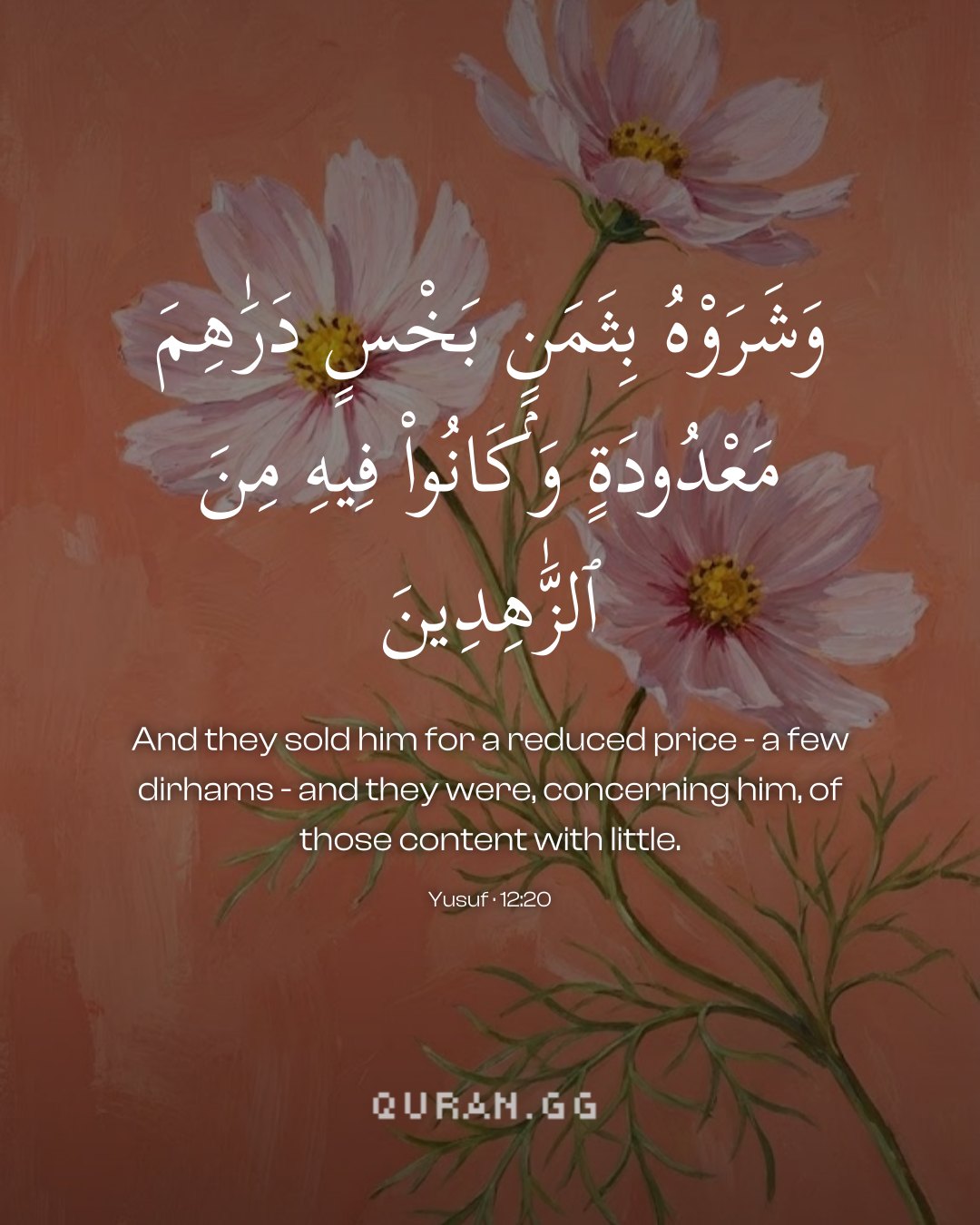
Verse 20 begins with the words: وَشَرَوْهُ بِثَمَنٍ بَخْسٍ دَرَاهِمَ مَعْدُودَةٍ (And they sold him for a paltry price, for a few silver-coins, and they were disinterested in him). In Arabic, the word: شِرَا (shira' ) is used for buying and selling both. The probability of both meanings exists here. If the pronoun is reverted back to the brothers of Sayyidna Yusuf (علیہ السلام) ، it will mean selling - and if applied to the people of the caravan, it would mean buying. Thus, the sense would be: ` the brothers of Yusuf sold him - or, the people of the caravan bought him - for a paltry price, that is, for a counted few dirhams in return.'
Al-Qurtubi says: The Arab traders used to transact deals involving big amounts by weight while, for amounts not more than forty, they would go by count. Therefore, the word: مَعْدُودَةٍ (ma` dudah: few) used with: دِرَاھُم (darahim: plural of dirham: silver-coins) tells us that the count of dirhams was less than forty. Ibn Kathir, citing the authority of Sayyidna ` Abdullah ibn Masud ؓ ، has written that the deal was closed at twenty dirhams which the ten brothers had divided among themselves at the rate of two dirhams per person. As for the exact amount of dirhams, reported there are other narrations as well which put them as twenty two and forty. (Ibn Kathir)
In the last sentence of the verse: وَكَانُوا فِيهِ مِنَ الزَّاهِدِينَ (and they were disinterested in him), the word: الزَّاهِدِينَ (az-zahidin) is the plural of zahid which is a derivation from zuhd. Literally, zuhd means indifference, disinterestedness. In usage, the lack of interest in and the avoidance of wealth and property in worldly life is referred to as zuhd. The meaning of the verse is that the brothers of Yusuf (علیہ السلام) were really not interested in any financial gain for themselves in this matter. Their real purpose was to separate Sayyidna Yusuf (علیہ السلام) from their father. Therefore, they struck a deal for a very few dirhams.
Tazkirul Quran
Maulana Wahiduddin KhanOn ayahs 20–21
After pushing Joseph into the dry well, the brothers returned home. Three days later, a caravan of traders, which was going from Midian to Egypt, happened to pass by that place. A member of the caravan set out in search of water and let his bucket down into the dry well. Joseph (who was about 16 years old at the time) caught hold of it and was pulled up. This was the age of the slave trade. So the people of the caravan were very happy because they could carry this lad to Egypt and sell him very profitably. Accordingly, when they reached Egypt, they put Joseph on sale along with other saleable commodities. There, a man, finding Joseph attractive in appearance and demeanour, bought him for twenty dirhams. Joseph’s brothers exiled him and pushed him into a well. The people of the caravan sold him as a slave. Thereafter the wife of a highly-placed officer of Egypt (Zulaykha) had him imprisoned. But God Almighty made all these stages stepping stones of honour and glory for him. What a tremendous difference there is between human knowledge and the divine knowledge of God!
Uthmani text of the Madinah mushaf (King Fahd Complex). Translation: Saheeh International. Tafsir via Quran.com.