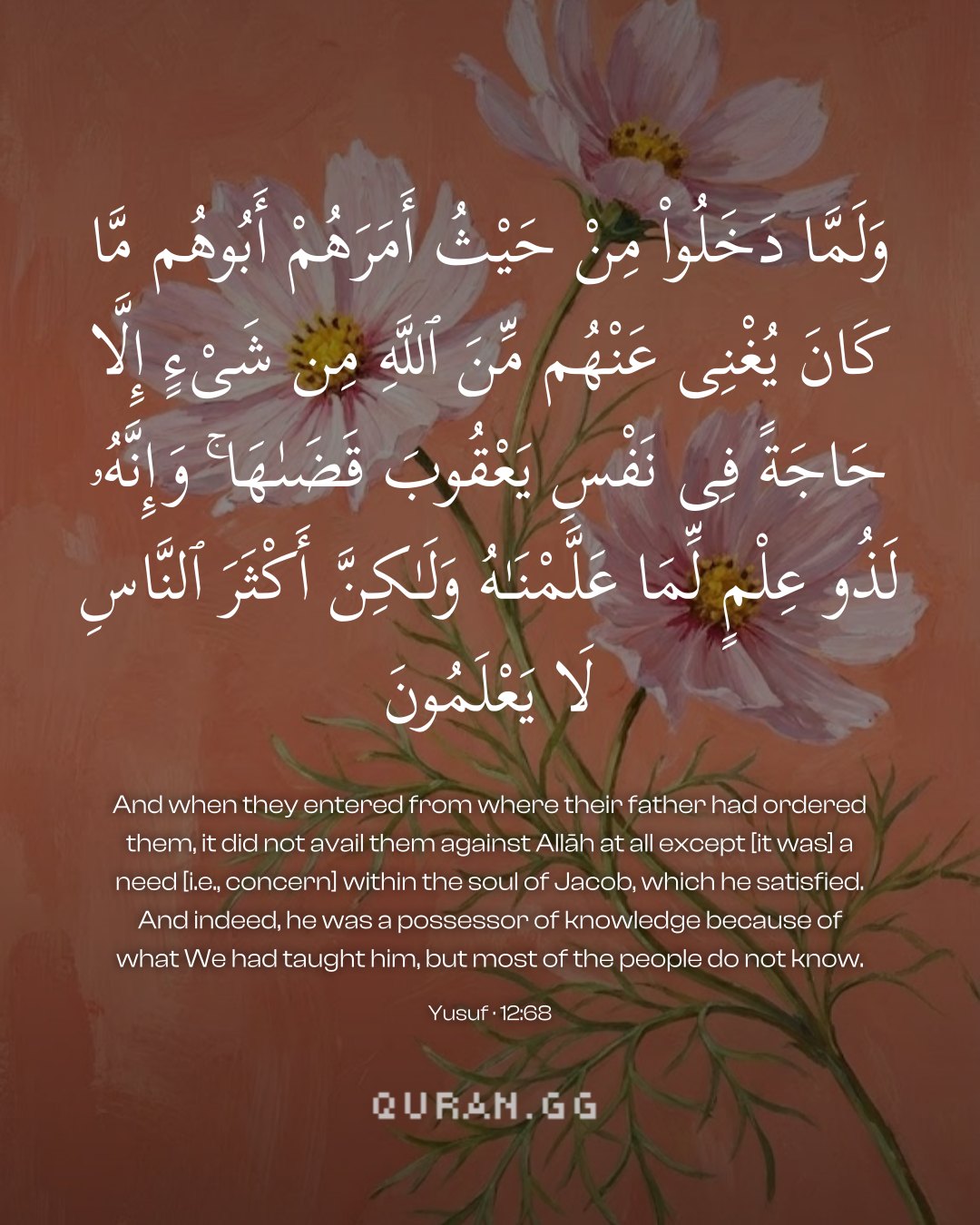
And when they entered from where their father had ordered them, it did not avail them against Allāh at all except [it was] a need [i.e., concern] within the soul of Jacob, which he satisfied. And indeed, he was a possessor of knowledge because of what We had taught him, but most of the people do not know.
Ya`qub orders His Children to enter Egypt from Different Gates
Allah says that Ya`qub, peace be upon him, ordered his children, when he sent Binyamin with them to Egypt, to enter from different gates rather than all of them entering from one gate. Ibn `Abbas, Muhammad bin Ka`b, Mujahid, Ad-Dahhak Qatadah, As-Suddi and several others said that he feared the evil eye for them, because they were handsome and looked beautiful and graceful. He feared that people might direct the evil eye at them, because the evil eye truly harms, by Allah's decree, and brings down the mighty warrior-rider from his horse. He next said, l
This subject has been taken up in the succeeding verse where it is said that the sons carried out the instructions of their father and entered the city from different gates. When they did so, the desire of their father stood fulfilled - though, this measure taken by him could not avert anything already destined by Allah. But, as for the paternal love and concern of Sayyidna Ya` qub (علیہ السلام) for his sons, this he did demonstrate to his heart's content.
Towards the end of the verse, Sayyidna Ya` qub (علیہ السلام) has been praised in the following words: وَإِنَّهُ لَذُو عِلْمٍ لِّمَا عَلَّمْنَاهُ وَلَـٰكِنَّ أَكْثَرَ النَّاسِ لَا يَعْلَمُونَ (He was a man of knowledge, because We had taught him, but most of the people do not know - 68). It means that his knowledge was not acquired. It did not come from books. Instead, it was directly a Divine gift. Therefore, he did employ physical means, something legally required, and commendable. But, he did not place his total trust in it. However, the truth is that most of the people do not know the reality behind it. Thus unaware, they would fall in doubts about Sayyidna Ya` qub (علیہ السلام) thinking that the employment of these means did not match the station of a prophet.
Some commentators have said that the first word: عِلم : knowledge) means acting in accordance with the dictate of ` ilm (knowledge). The translation in this case will be: "He was a man of action according to the knowledge We gave him". Therefore, he did not place his trust in material means, in fact, it was Allah alone he relied on and trusted in.'
Tazkirul Quran
Maulana Wahiduddin KhanOn ayahs 68–74
The ancient capital of Egypt was a city around which there was a rampart with many gates in it. Jacob’s advice to his sons that they should not enter the city through the same gate, but through different gates was based on the fear that some enemy of theirs might try to kill them (Tafsir an-Nasafi). Verse 73 of this chapter clarifies the matter of this fear. In this Joseph’s brothers profess that they are innocent by saying that they had not come there to fight or steal. Joseph’s brothers had come to Egypt from foreign lands; their way of dressing was different from that of the local people; because of their appearance they would appear to be outsiders to the people of Egypt; the entry of eleven such persons together would have created suspicion in the eyes of the people. So in order to save them from any unnecessary clash with the local people, Jacob advised them not to band together in one group while entering the city. A believer’s eyes are ever on the supreme power of God; he observes that in this universe nobody has any power except God. At the same time he knows that this world is a testing ground. Owing to the exigencies of this test God has hidden all matters behind the veil of cause and effect. For this reason, Jacob advised his sons to take worldly precautions. But he also said that whatever happened, would happen at the instance of God, because nobody except God had any real power.
Uthmani text of the Madinah mushaf (King Fahd Complex). Translation: Saheeh International. Tafsir via Quran.com.