Yusuf had His Golden Bowl placed in Binyamin's Bag; a Plot to keep Him in Egypt
After Yusuf supplied them with their provisions, he ordered some of his servants to place his silver bowl (in Binyamin's bag), according to the majority of scholars. Some scholars said that the king's bowl was made from gold. Ibn Zayd added that the king used it to drink from, and later, measured food grains with it since food became scarce in that time, according to Ibn `Abbas, Mujahid, Qatadah, Ad-Dahhak and `Abdur-Rahman bin Zayd. Shu`bah said that Abu Bishr narrated that Sa`id bin Jubayr said that Ibn `Abbas said that the king's bowl was made from silver and he used it to drink with. Yusuf had the bowl placed in Binyamin's bag while they were unaware, and then had someone herald,
أَيَّتُهَا الْعِيرُ إِنَّكُمْ لَسَارِقُونَ
(O you (in) the caravan! Surely, you are thieves!) They looked at the man who was heralding this statement and asked him,
مَّاذَا تَفْقِدُونَقَالُواْ نَفْقِدُ صُوَاعَ الْمَلِكِ
("What is it that you have lost" They said: "We have lost the bowl of the king..."), which he used to measure food grains,
وَلِمَن جَآءَ بِهِ حِمْلُ بَعِيرٍ
(and for him who produces it is a camel load), as a reward,
وَأَنَاْ بِهِ زَعِيمٌ
(and I will be bound by it.), as assurance of delivery of the reward.
Ma'arif al-Qur'an
Mufti Muhammad Shafi
The answer given by the announcers was:
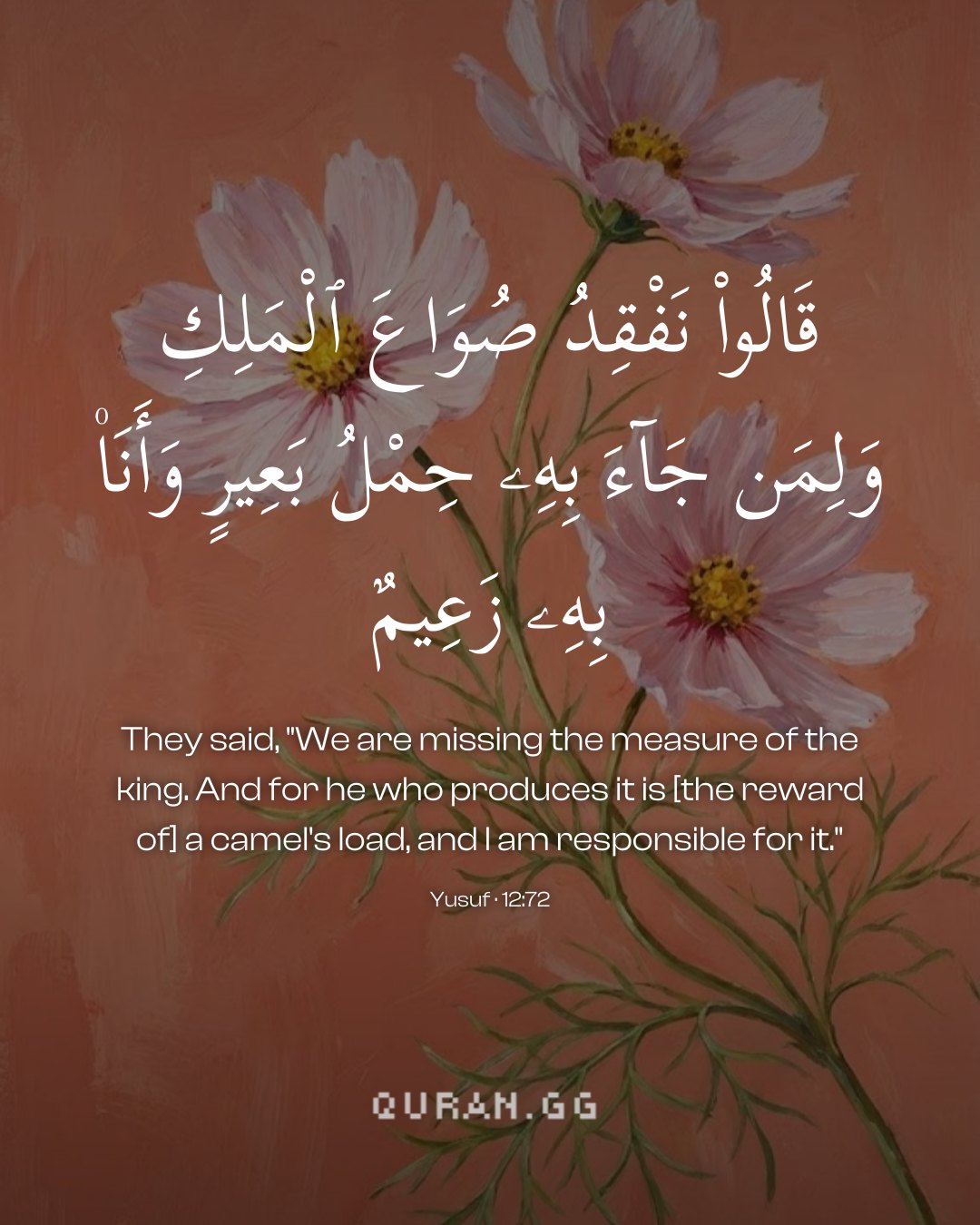
قَالُوا نَفْقِدُ صُوَاعَ الْمَلِكِ وَلِمَن جَاءَ بِهِ حِمْلُ بَعِيرٍ وَأَنَا بِهِ زَعِيمٌ
We are missing the measuring- bowl of the king, and whoever brings it back shall deserve a camel-load, and I stand a surety for it.
The question which emerges here is: Why did Sayyidna (علیہ السلام) opt for this excuse to detain Benyamin with him, especially when he knew that his separation was already shocking for his father. Now, how could he bear by giving him another shock by detaining his other brother?
The other question which arises here is far more important because it involves things like accusing innocent brothers of theft and concealing something in their baggage secretly to cause them disgrace later. These are impermissible acts. Sayyidna Yusuf (علیہ السلام) was a prophet of Allah. It is difficult to visualize how would he have gone along with them.
Some commentators, such as al-Qurtubi and others, have stated: When Benyamin recognized Sayyidna Yusuf (علیہ السلام) and was at peace, he requested his brother not to send him back along with his brothers. In-stead, he pleaded, he should let him stay with him. First, Sayyidna Yusuf (علیہ السلام) made the excuse that his staying behind will shock their father. Then, he had no way of making him stay with him other than that blame him of theft, arrest him for it and thus keep him with him. Benyamin was so disgusted with the ways of his brothers that he was ready to go through all this.
But, even if this event were taken as correct, the heart-break caused for his father, the disgrace inflicted on all his brothers and dubbing them as thieves cannot become permissible simply because of the pleasure of Benyamin. That some commentators have interpreted the charge of theft levelled on them by the announcer as being without the knowledge and permission of Sayyidna Yusuf (علیہ السلام) is not valid. This is a claim without any proof and, given the anatomy of the event, incoherent too. Similar is the case of another interpretation where it has been stated that these brothers stole Sayyidna Yusuf (علیہ السلام) from his father, and sold him, therefore, they were called ` thieves.' This too is a long-drawn explanation.
Therefore, the correct answer to these questions is what has been given by al-Qurtubi and Mazhari. They have said: Whatever has been done and said in this connection was neither the outcome of Benyamin's wish, nor that of the initiative of Sayyidna Yusuf (علیہ السلام) himself. Instead of all that, all these happenings were the manifestation of the infinite wisdom of Allah alone under whose command they came to be what they were and being completed through them was the process of the trial and test of Sayyidna Ya` qub (علیہ السلام) hint towards this answer appears in this verse (76) of the Qur'an itself which says: ذَٰلِكَ كِدْنَا لِيُوسُفَ : ` This is how We planned for Yusuf (to detain his brother).'
In this verse, Allah Ta’ ala has very clearly attributed this excuse and plan to Himself. So, when all these things took shape as Divinely commanded, calling them impermissible becomes meaningless. They would be like the incident of the dismantling of the boat and the killing of the boy in the event relating to Sayyidna Musa and Al-Khadir (علیہما السلام) . Obviously, these were sins, therefore, Sayyidna Musa (علیہ السلام) registered his disapproval of them. But, al-Khadir was doing all this with Divine assent and permission under particularly expedient considerations, therefore, he was not committing any sin.
The ancient capital of Egypt was a city around which there was a rampart with many gates in it. Jacob’s advice to his sons that they should not enter the city through the same gate, but through different gates was based on the fear that some enemy of theirs might try to kill them (Tafsir an-Nasafi). Verse 73 of this chapter clarifies the matter of this fear. In this Joseph’s brothers profess that they are innocent by saying that they had not come there to fight or steal. Joseph’s brothers had come to Egypt from foreign lands; their way of dressing was different from that of the local people; because of their appearance they would appear to be outsiders to the people of Egypt; the entry of eleven such persons together would have created suspicion in the eyes of the people. So in order to save them from any unnecessary clash with the local people, Jacob advised them not to band together in one group while entering the city. A believer’s eyes are ever on the supreme power of God; he observes that in this universe nobody has any power except God. At the same time he knows that this world is a testing ground. Owing to the exigencies of this test God has hidden all matters behind the veil of cause and effect. For this reason, Jacob advised his sons to take worldly precautions. But he also said that whatever happened, would happen at the instance of God, because nobody except God had any real power.
Uthmani text of the Madinah mushaf (King Fahd Complex). Translation: Saheeh International. Tafsir via Quran.com.