Allah says that there are Ayat, lessons and wisdom to learn from the story of Yusuf and his brothers, for those who ask about their story and seek its knowledge. Surely, their story is unique and is worthy of being narrated.
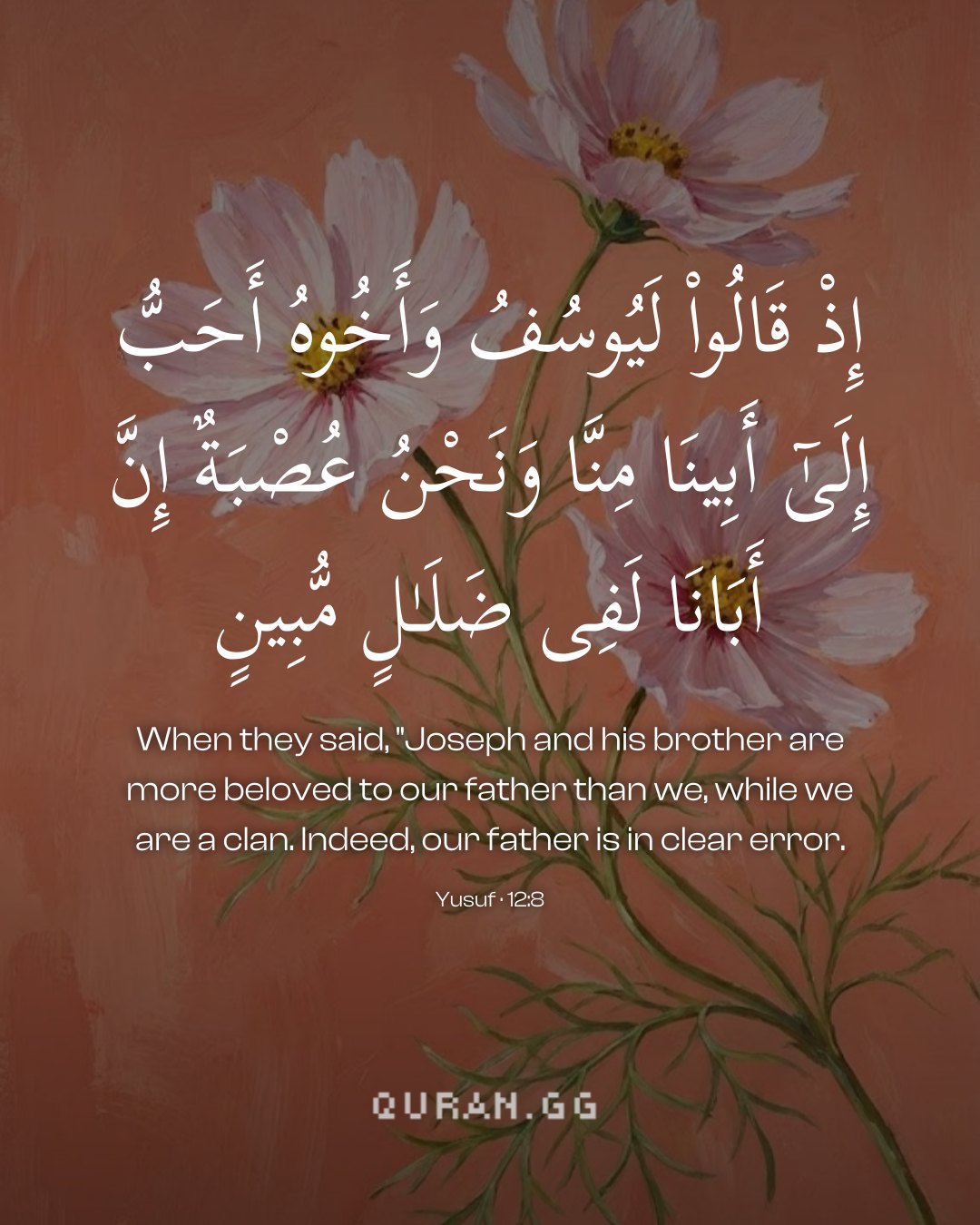
(When they said: "Truly, Yusuf and his brother are dearer to our father than we...") They swore, according to their false thoughts, that Yusuf and his brother Binyamin (Benjamin), Yusuf's full brother,
أَحَبُّ إِلَى أَبِينَا مِنَّا وَنَحْنُ عُصْبَةٌ
(dearer to our father than we, while we are `Usbah.) meaning, a group. Therefore, they thought, how can he love these two more than the group,
From the second verse (8), begins the story of Sayyidna Yusuf (علیہ السلام) which tells that the brothers of Sayyidna Yusuf (علیہ السلام) saw that their father, Sayyidna Ya` qub (علیہ السلام) loved Sayyidna Yusuf (علیہ السلام) unusually more than them who were older than him. Therefore, this made them envy him. And it is also possible that they had somehow found out about the dream of Sayyidna Yusuf (علیہ السلام) which may have led them to become uncomfortable at the prospect of his coming rise in status, and which may have made them envious of him. They talked about it among themselves: We see that our father loves Yusuf and his brother Benyamin much more than us, although we are ten of us and older than them. We have the ability and group strength to manage the affairs of the family while they both are small children who cannot do much. Our father should have noticed this and we are the ones he should have been loving more. But, what he is doing is open injustice. Therefore, you should either kill Yusuf, or throw him away into some far out spot of land from where he could not come back.
In this verse, these brothers have referred to themselves as: عُصبَۃً (` usbah). This word is used in the Arabic for a group from five to ten. As for their remark about their father: إِنَّ أَبَانَا لَفِي ضَلَالٍ مُّبِينٍ (Surely, our father is in clear error), the word: ضَلَال (dalal) appearing here lexically means the error of straying. But, at this place, dalal ضَلَال or error does not mean religious error. If so, such a connotation would have made all of them Kafirs (disbelievers) - because, Sayyidna Ya` qub (علیہ السلام) is an exalted prophet of Allah Ta` ala and such a thought in his case is an absolute Kufr.
And about the brothers of Sayyidna Yusuf (علیہ السلام) ، it has been mentioned in the Qur'an itself that they, later on, admitted their crime and requested their father to pray for their forgiveness which he accepted to do. This makes it obvious that their mistake was forgiven. Now, this can become possible only when all of them are believers - otherwise, the prayer for the forgiveness of a disbeliever is not permissible. This is the reason why there is no difference of opinion about their being believers, although ` Ulama' do differ about these brothers being prophets. This tells us that the word: ضَلَال (dalal: error) has been uttered at this place in the sense that he does not treat brothers equally in the matter of their rights.
Tazkirul Quran
Maulana Wahiduddin KhanOn ayahs 6–9
Here the expression ‘He will bestow the full measure of His blessings upon you’ applies to Joseph as it had previously applied to Abraham. The difference between the two was that Joseph was invested with political power, while Abraham was not. There was, however, an all-important factor common to both, namely, the prophethood conferred upon each of them by God. That was the sense in which God’s ‘blessings’ had been bestowed in ‘full measure’. It was the prophethood, that is, the conferring of special divine guidance, which would lead them to a high status in the Hereafter. God’s guidance to man is, in effect, the perfection of His favour to him. This favour is available directly to His prophets and indirectly to their true followers.
Uthmani text of the Madinah mushaf (King Fahd Complex). Translation: Saheeh International. Tafsir via Quran.com.