Allah's Prophet Ya`qub receives the Grievous News
Allah's Prophet Ya`qub repeated to his children the same words he said to them when they brought false blood on Yusuf' shirt,
بَلْ سَوَّلَتْ لَكُمْ أَنفُسُكُمْ أَمْرًا فَصَبْرٌ جَمِيلٌ
(Nay, but your own selves have beguiled you into something. So patience is most fitting (for me).) Muhammad bin Ishaq said, "When they went back to Ya`qub and told him what happened, he did not believe them and thought that this was a repetition of what they did to Yusuf. So he said,
بَلْ سَوَّلَتْ لَكُمْ أَنفُسُكُمْ أَمْرًا فَصَبْرٌ جَمِيلٌ
(Nay, but your own selves have beguiled you into something. So patience is most fitting (for me).) Some said that since this new development came after what they did before to Yusuf, they were given the same judgement to this later incident that was given to them when they did what they did to Yusuf. Therefore, Ya`qub's statement here is befitting,
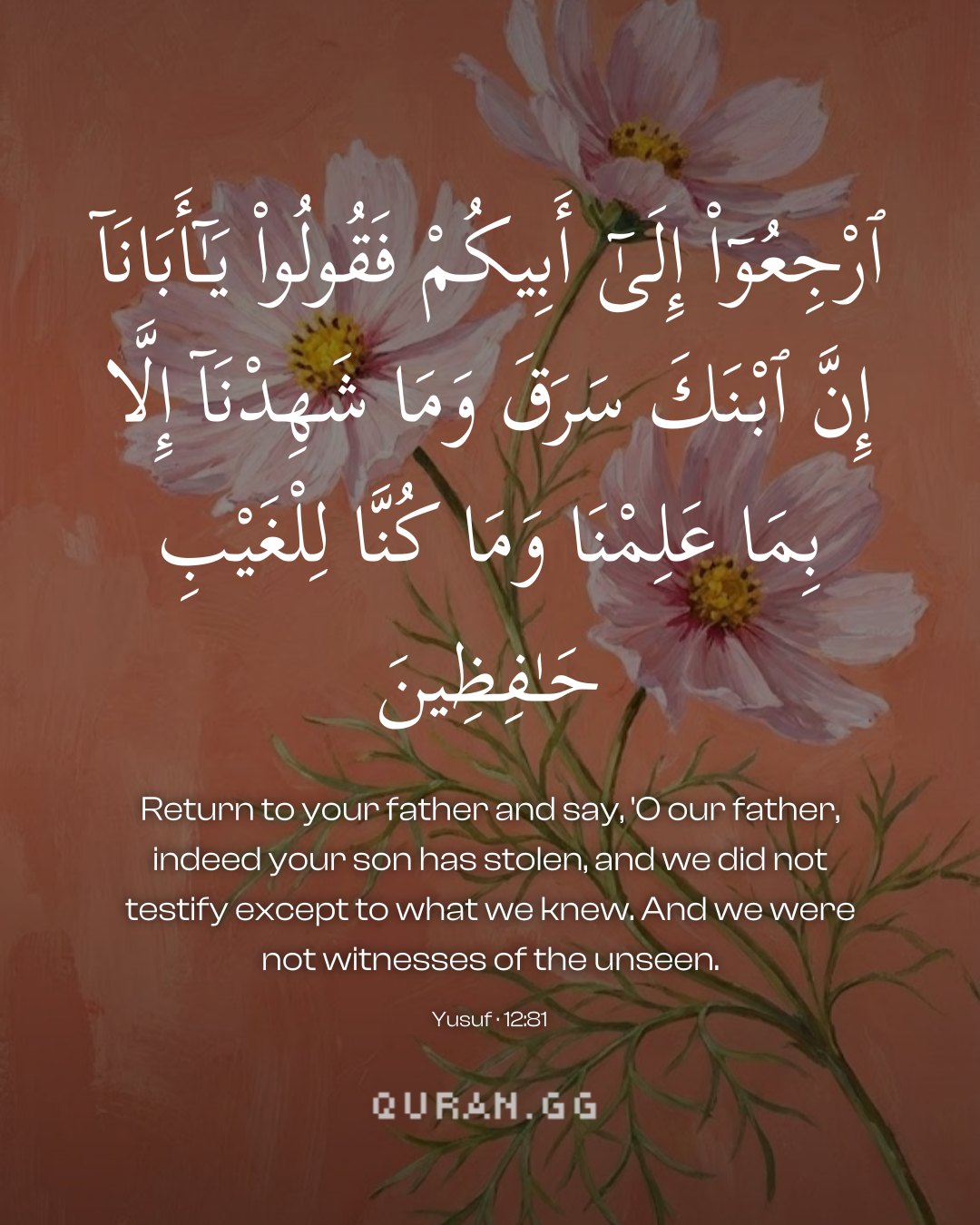
Continue reading the tafsir of ayahs 80–86 Then, in verse 81, it was said: ارْجِعُوا إِلَىٰ أَبِيكُمْ , that is, the oldest brother said: I am going to stay here. You all go back to your father and tell him that his son has committed a theft, and that whatever we are saying is what we have seen with our own eyes, and that the stolen property was recovered from his baggage before us.
As for the last sentence of verse 81: وَمَا كُنَّا لِلْغَيْبِ حَافِظِينَ (and we could not guard against the unseen), it means that ` the pledge we had given to you to bring back Benyamin definitely was given in terms of outwardly visible circumstances. We did not know what we did not see and control - thus how could we know that he would steal and be arrested for it leaving us helpless in this matter.' The sentence could also mean that ` we did our best to keep Benyamin protected seeing that he does nothing which would put him in trouble. But, this effort of ours could be within the limits of our outwardly visible circumstances. That this thing would happen to him, in absence of our vigilance and knowledge, was something we did not know about.'
Since the brothers of Yusuf (علیہ السلام) had deceived their father earlier, and knew that their father would never be satisfied with their statement mentioned above, and he would never believe in what they would tell him, therefore, for additional emphasis, they said: `(and if you do not believe us), you can check with the people of the town in which we have been (that is, the city in Egypt). And you can also check with the caravan which has come from Egypt to Canaan with us. And we are true in what we are saying.'
At this point, the question - why would Sayyidna Yusuf (علیہ السلام) bear by such a heartless treatment with his father - reappears in Tafsir Mazhari. This question has also been taken up earlier in our comments on this Surah where it has been said that it was surprising that Sayyidna Yusuf (علیہ السلام) did not tell his father about himself, then detained his brother too, then his brothers made repeated visits to Egypt and he never told them about himself nor sent some message to his father. Tafsir Mazhari answers all these doubts by saying:
اِنَّہُ عَمِلَ ذٰلِکَ بِامرِ اللہِ تَعَالٰی لِیَزِیدَ فِی بِلآءِ یَعقُوبَ
That is, Sayyidna Yusuf (علیہ السلام) did that with the command of Allah Ta` ala so that (the cycle of) the test and trial of Sayyidna Ya` qub (علیہ السلام) reaches its completion.
Rules and Principles
1. The statement: وَمَا شَهِدْنَا إِلَّا بِمَا عَلِمْنَا (and we do not testify except what we know) appearing in verse 82 proves that human transactions and contracts are based on apparently known circumstances. They do not cover things which no one knows. The pledge to protect Benyamin which the brothers of Sayyidna Yusuf (علیہ السلام) had given to their father was relat-ed to things which were in their control. As for the incident that he was accused of theft and arrested for it, it was a different matter which does not affect the pledge as such.
2. Deduced from the same verse, there is another ruling which appears in Tafsir al-Qurtubi. It says: This sentence proves that testimony depends on knowledge. No matter how this knowledge is acquired, testimony can be given in accordance with it. Therefore, the way an event can be testified by having seen it with one's own eyes, similarly, it can be testified by having heard it from someone reliable and worthy of trust - subject to the condition that he does not conceal the truth of the matter, instead, states plainly that he has not seen it personally but has heard it from such and such reliable person. It is on the basis of this principle that Maliki jurists have ruled the testimony of a blind person as permissible.
3. The present verses also prove that should a person be true, right and proper, but the situation is such that others may suspect him to be otherwise, then, he must remove that shadow of doubt so that those who see him do not fall into the sin of (unwarranted) suspicion - as in this event relating to Benyamin, there came up an occasion of accusation and doubt because of a past event in the life of Sayyidna Yusuf (علیہ السلام) . Therefore, in order to make things clear, the testimony of the people of the city, and the caravan, was presented in support.
The Holy Prophets ﷺ has, by his personal conduct, affirmed it positively. On his way back from his Masjid, when he was going through an alley with Ummul-Mu'minin, Sayyidah Safiyyah ؓ he noticed two persons appearing at the head of the alley. They were still at some distance, but the Holy Prophet told them that he was with Safiyyah hint Huyayy. They said: Ya Rasul Allah, can anyone have any suspicion about you? Then, he said: Yes, the shaitan keeps seeping through the human body, may be it drops a doubt in somebody's heart. (Al-Bukhari and Muslim) [ Qurtubi ]
According to commentators of the Quran, in his childhood Joseph quietly removed an idol from his grandmother’s house and broke it. This showed his antipathy for polytheism. But because it was a parallel to Benjamin’s act, his brothers gave it the colour of theft, and making this an excuse to blacken Benjamin’s name, they said, ‘A brother of his had [also] committed theft before him.’ Joseph’s brothers showed great humility to Joseph, who occupied a very high position in Egypt, addressing him as ‘O exalted one’, etc. But the Joseph of Canaan, who was in their eyes only a village boy, was being wrongly alleged to be a thief. Joseph knew very well that due to the drinking cup placed by him in Benjamin’s pack, his brother was unnecessarily being accused of being a thief. But for timely reasons, he kept quiet and allowed matters (i.e. what was going on between his brothers and the royal officers) to take their own course. When he was obliged to say something, he did not refer to Benjamin as ‘one who has stolen something belonging to us,’ but ‘the person on whom we found our property.’
Uthmani text of the Madinah mushaf (King Fahd Complex). Translation: Saheeh International. Tafsir via Quran.com.