
The simplest way to start reading the Quran daily is to choose a small minimum—one ayah, a few ayahs, or five minutes—and attach it to a time that already happens every day. Keep the goal easy enough to repeat, read slowly, and return the next day without waiting for a perfect schedule.
Key takeaways
- Start with a minimum you can complete even on a busy day, such as one ayah or five minutes.
- Attach Quran reading to an existing daily cue, such as after a prayer or before opening social media.
- Choose one clear starting point and continue from where you stopped instead of choosing a new passage every day.
- Combine Arabic reading or listening with translation and reliable tafsir when you want to understand more deeply.
- If you miss a day, restart at the next opportunity; do not turn one missed session into a week away.
You do not need a long daily Quran reading schedule to begin. You need a repeatable first action: open the Quran at a known time and read a small amount with attention. A daily practice can begin with one ayah. Once opening and reading becomes normal, you can gradually add more.
The goal is not to prove how much you can read on your most motivated day. It is to create a path back to the Quran on ordinary days—when you are busy, tired, travelling, or tempted to spend the next few minutes scrolling.
How do you start reading the Quran daily?
Start with this simple formula:
- Choose one daily cue, such as finishing Fajr or sitting down before bed.
- Set a minimum of one ayah, one page, or five minutes.
- Choose where you will begin.
- Read slowly enough to stay present.
- Mark your place and return to it the next day.
This approach reflects a wider Islamic principle of consistency: a small deed maintained regularly is better than an unsustainable burst. Sahih al-Bukhari records that the most beloved deeds are the most regular, even when they are few. 1
How to build a daily Quran reading habit in 7 steps
1. Set a minimum that works on your busiest day
Make your first target deliberately small. A beginner Quran reading plan might start with:
- One ayah
- Three to five ayahs
- One page
- Five focused minutes
- One short surah you are learning
Your minimum is the amount that keeps the habit alive. It is not a limit. On a spacious day, continue reading. On a difficult day, complete the minimum and let that be enough.
Avoid beginning with a target based only on enthusiasm, such as a full juz every day, unless that amount already fits your ability and schedule. A smaller baseline gives you room to build without making the Quran feel tied to failure or guilt.
2. Attach reading to something you already do
“I will read later” leaves the decision open all day. Give the routine a clear cue instead:
- After Fajr, I will read five ayahs.
- After another daily prayer, I will read for five minutes.
- When I sit at my desk in the morning, I will read one ayah before checking messages.
- Before sleep, I will continue from my saved place.
Choose one cue first. The best time to read the Quran is a time you can protect consistently, not necessarily the time that sounds most ambitious.
3. Choose one clear place to start
Beginners often lose time asking where to start reading the Quran. There is no need to make the decision complicated. Choose one of these paths:
- Start with Al-Fatihah and familiar short surahs if you are developing fluency or connecting reading with salah.
- Start at Al-Fatihah and continue in order if you want a straightforward journey through the Quran.
- Resume where you previously stopped if you already began a reading.
- Choose a surah you want to understand and stay with it until you finish.
Whichever path you choose, keep it for at least a week. Consistency becomes easier when you already know what you will open tomorrow.
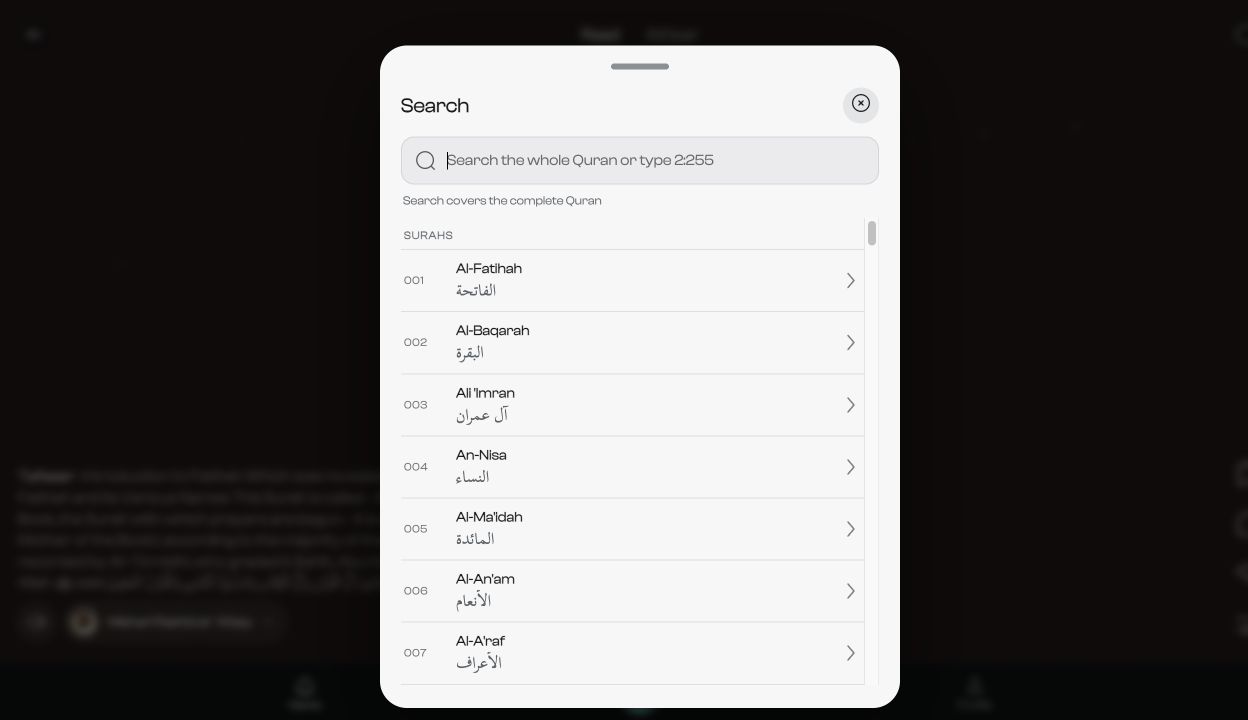
Quran.GG lets you search the complete Quran by surah, word or phrase, or a direct reference such as 2:255.
4. Read one ayah at a time
Daily Quran reading does not have to become a race through pages. Read the Arabic at a pace appropriate to your current ability. Pause at the end of an ayah. If you are still learning to read Arabic, follow a reciter and seek qualified help with pronunciation and tajweed rather than guessing.
The Quran itself describes reflection on its ayahs as a purpose of revelation. This makes room for a routine that includes both recitation and thoughtful attention, not page count alone. 2
5. Add meaning without making the routine too heavy
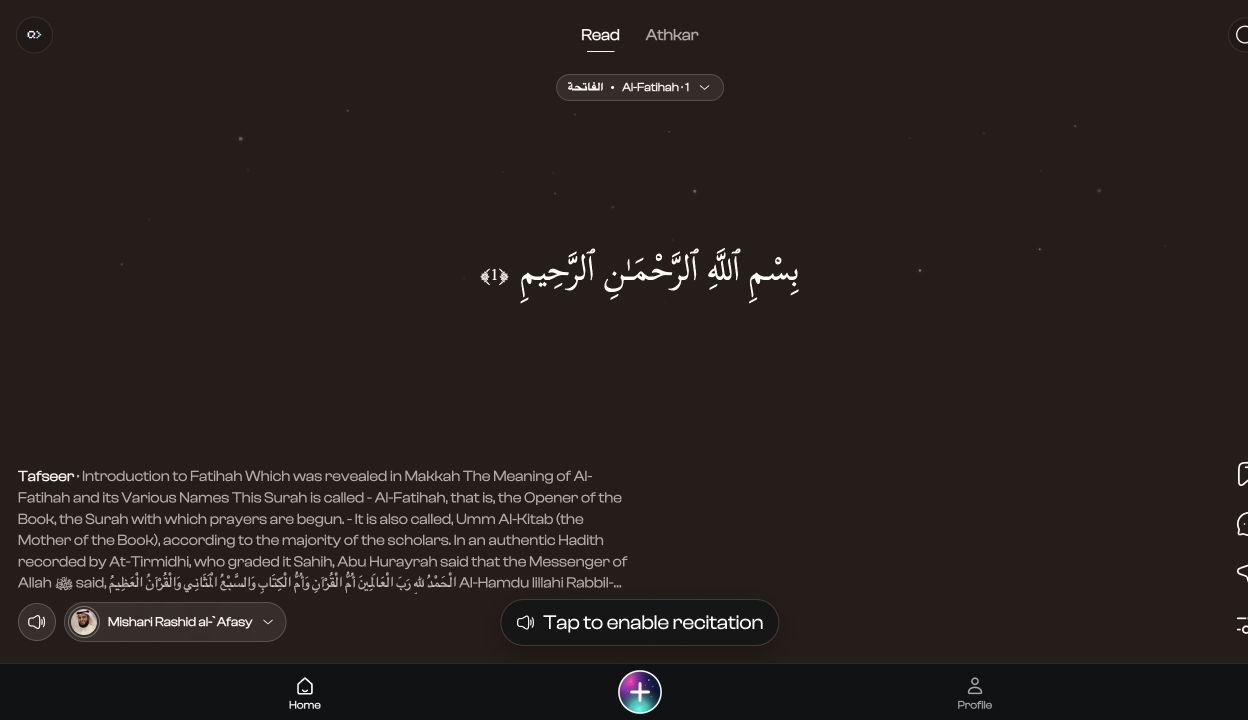
Reading, listening, translation, and tafsir answer different needs. You do not have to do all four in every session.
A simple daily Quran reading routine
| Part | What to do | Suggested time |
|---|---|---|
| Read | Recite one to five ayahs slowly | 2–5 minutes |
| Listen | Replay the same ayahs with a reciter | 2–5 minutes |
| Understand | Read a translation of their meaning | 2–5 minutes |
| Reflect | Write or remember one lesson or question | 1–2 minutes |
If five minutes is all you have, choose one or two parts. If you have longer, combine them. A translation communicates meaning in another language; it is not a replacement for the Arabic Quran. Tafsir can add context when a translation alone leaves questions.
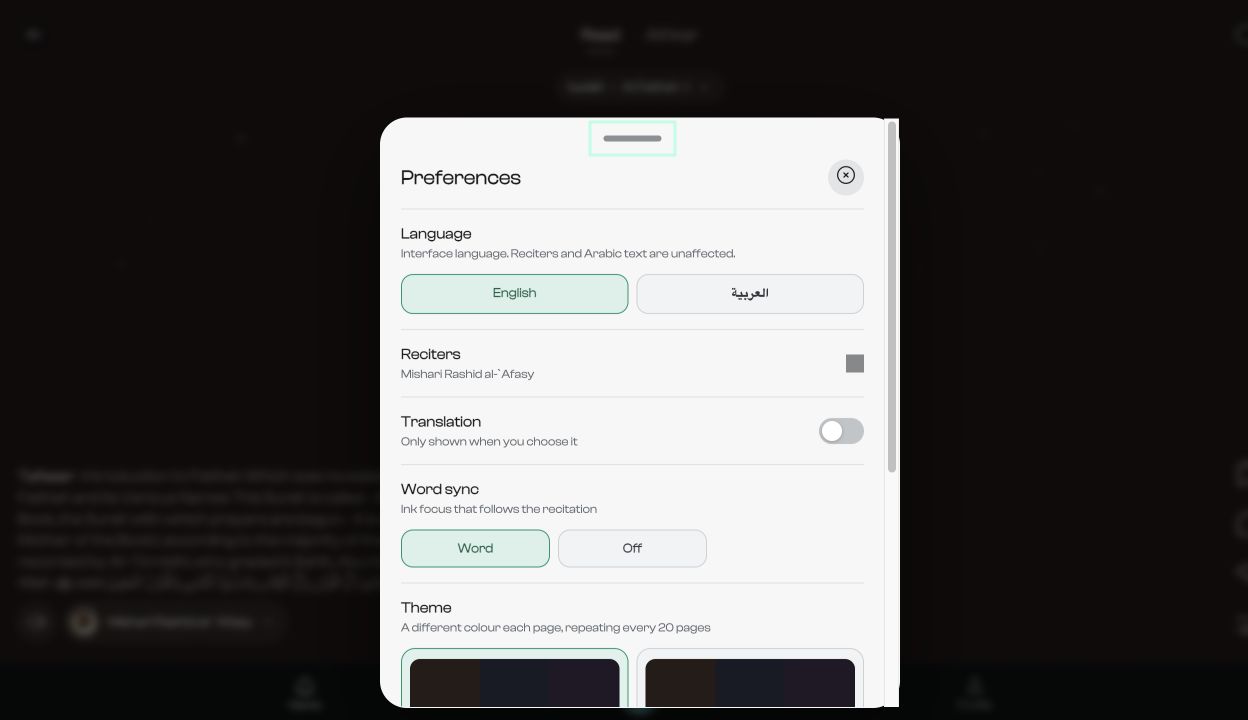
In Quran.GG preferences, you can choose a reciter, turn an English translation on or off, adjust word-synced recitation, and select a comfortable theme.
6. Turn one social media check into a Quran break
You do not have to abandon your phone to create a quieter habit. Replace one automatic social-media check with one intentional Quran reading break.
Try a simple rule: before I open a social feed, I will read one ayah. Put Quran.GG on your home screen, silence non-essential notifications, and keep the verse reader easier to reach than the app you open without thinking.
This is not a contest between screen time and worship. It is an environment change: the same device that invites distraction can also provide a direct, focused place to read the Quran online.
7. Use a minimum goal and an optional goal
A two-level target prevents an all-or-nothing routine:
- Minimum: one ayah every day
- Optional: one page or ten minutes when time allows
Complete the minimum first. Treat anything beyond it as extra, not as the new standard you must maintain forever. After two steady weeks, review the routine. If it feels easy, add a few ayahs or a few minutes. If it regularly feels heavy, reduce the amount but keep the cue.
How much Quran should you read daily?
There is no universal number of ayahs or pages that every person must use for a personal daily reading plan. Choose an amount based on your reading ability, attention, and available time.
Daily Quran reading targets by goal
| Your goal | A practical starting target | Focus |
|---|---|---|
| Restart after a long gap | 1 ayah or 3 minutes | Show up daily |
| Build a steady habit | 3–5 ayahs or 1 page | Read and continue |
| Understand more deeply | 1–5 ayahs for 10–20 minutes | Translation, tafsir, reflection |
| Improve recitation | A short repeated passage | Listen, repeat, seek correction |
| Work toward completion | A planned daily portion | Steady progress over a chosen period |
If your goal is to complete the Quran, choose a realistic finish date and divide the reading into portions that fit your copy or reader. Keep a smaller fallback amount for unusually busy days so the daily connection does not depend on completing the full portion.
A 7-day Quran reading plan for beginners
Use this first week to establish the routine, not to test endurance.
- Day 1: Choose your time, starting place, and one-ayah minimum.
- Day 2: Read at the same cue and continue to the next ayah.
- Day 3: Read, then listen to the same passage once.
- Day 4: Add a translation for one ayah.
- Day 5: Save your place and keep the session under ten minutes.
- Day 6: Use the session as a break before social media or messages.
- Day 7: Review what worked and set next week's sustainable minimum.
At the end of the week, success means you built a clear path to return. It does not mean every session was long or perfectly focused.
What if you cannot read Arabic yet?
Start at your current level without pretending that reading a translation and reciting the Arabic are the same activity.
- Learn Arabic letters and sounds with a qualified teacher or a structured beginner course.
- Listen to a clear reciter while following the Arabic text.
- Repeat a short passage rather than rushing into new material.
- Read a trusted translation to begin engaging with meaning.
- Ask for pronunciation correction instead of relying only on self-assessment.
Your daily routine can be two minutes of letter practice, one line followed with audio, or one familiar surah repeated carefully. The structure remains the same: small amount, stable cue, patient repetition.
Common mistakes that make daily reading harder
Starting with a target you cannot repeat
A large target may feel exciting for three days and discouraging on the fourth. Begin below your maximum and grow gradually.
Waiting for perfect focus
Prepare a quiet place when you can, but do not wait for a day with no work, noise, travel, or tiredness. Protect a small window inside real life.
Changing the plan every day
Moving between random surahs, apps, schedules, and targets creates new decisions. Keep one starting place and one minimum long enough to learn whether they work.
Measuring only pages
Page count can track progress, but it does not show whether you read carefully, listened, understood, or reflected. Use a measure that matches your current goal.
Giving up after a missed day
Do not wait for Monday, a new month, or Ramadan to restart. Open the Quran at the next cue and continue from your saved place. A durable habit includes a simple way back.
Your daily Quran routine can begin now
Choose one cue, one ayah, and one starting place. Read it today. Save your position, then return tomorrow before increasing the target.
Quran.GG provides a focused ayah-by-ayah reader with recitation, translation, tafsir, search, saved ayahs, and a reading position that continues where you left off.
Start with one ayah: Read the Quran online with Quran.GG →
If you later want to turn an ayah you encounter into something shareable, see the guide to creating a Quran video online.
Frequently asked questions
What is the best way to start reading the Quran daily?
Choose one fixed cue, one starting place, and one very small daily minimum. For example, read one ayah after Fajr, continue from the same place each day, and only increase the amount when the routine feels easy.
How much Quran should I read every day?
There is no single daily amount that fits everyone. A sustainable starting target can be one to five ayahs, one page, or five minutes. The best amount is one you can read attentively and repeat consistently.
What is the best time to read the Quran?
Choose the time when you are most likely to be present and consistent. Many people anchor reading after Fajr or another prayer, while others use a lunch break or the period before sleep. A reliable time is better than an ideal time you regularly miss.
Where should a beginner start reading the Quran?
You can begin with Al-Fatihah and short surahs you already hear in prayer, start from the beginning and continue in order, or resume a place you previously reached. Pick one approach for now so deciding does not become a daily obstacle.
Can I read a Quran translation as a beginner?
Yes. A translation can help you follow the meaning, while the Arabic text is the Quran itself. Reading the translation alongside the Arabic, listening to recitation, and consulting reliable tafsir can support understanding at different levels.
Can I read the Quran on my phone every day?
Yes. A phone-based Quran reader can make a daily routine easier because it is available wherever you are. Reduce distractions first by silencing notifications or opening the Quran before any social media app.
How can I stay consistent with daily Quran reading?
Make the minimum small, keep the time and place stable, prepare the reader in advance, and track only whether you showed up. Increase the amount gradually after consistency is established.
What should I do if I miss a day of Quran reading?
Continue at the next planned time without doubling the target or waiting for a new week. One missed day is an interruption, not the end of the habit.
Sources
- Sahih al-Bukhari 6464— Sunnah.com
- Surah Sad 38:29— Quran.com