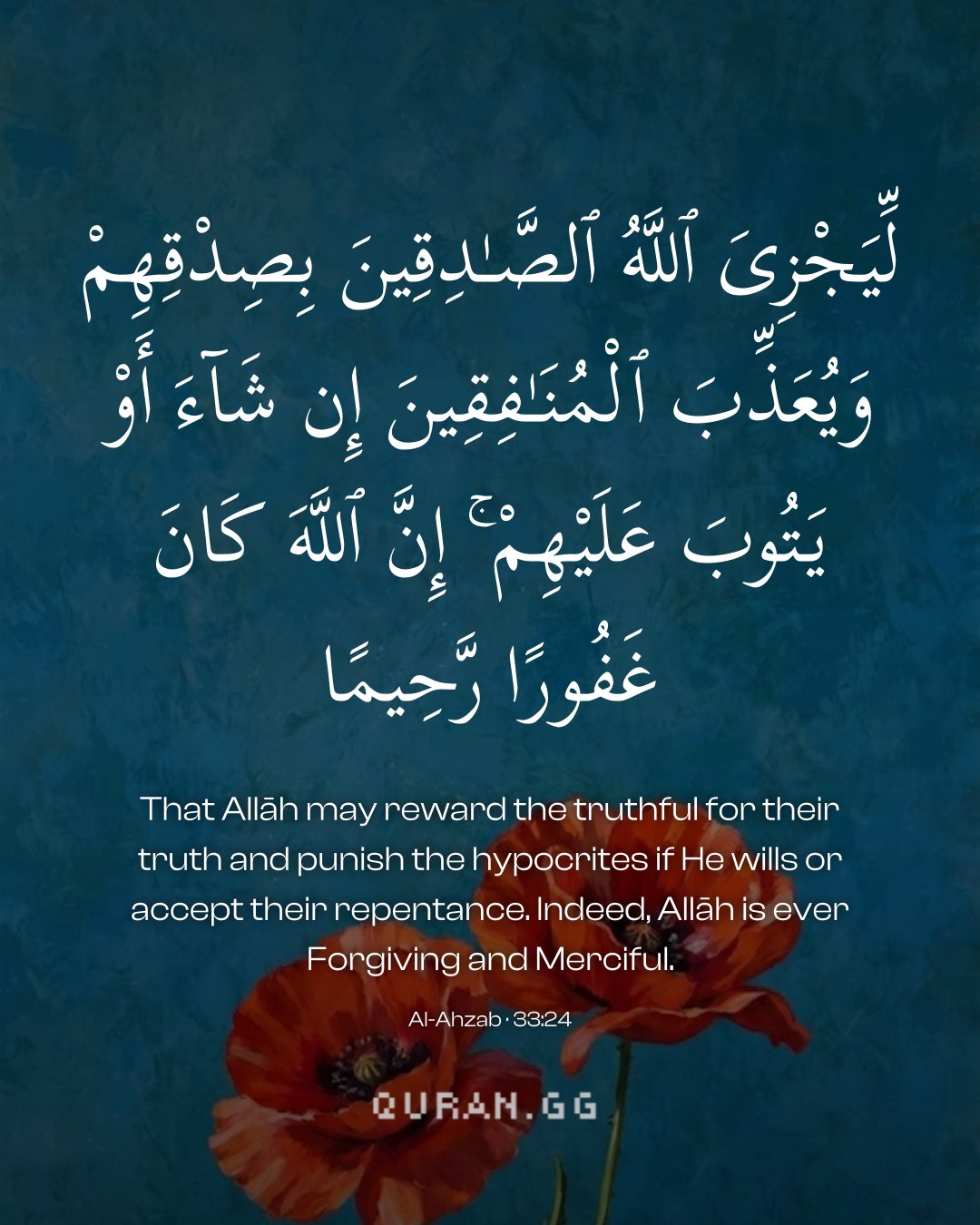
That Allāh may reward the truthful for their truth and punish the hypocrites if He wills or accept their repentance. Indeed, Allāh is ever Forgiving and Merciful.
Praise for the Believers' Attitude, and leaving the ultimate Fate of the Hypocrites to Allah
When Allah mentions how the hypocrites broke their promise to Him that they would not turn their backs, He describes the believers as firmly adhering to their covenant and their promise:
(they have been true to their covenant with Allah; of them some have fulfilled their Nahbah;) Some of them said: "Met their appointed time (i.e., death)." Al-Bukhari said, "Their covenant, and refers back to the beginning of the Ayah."
(and some of them are still waiting, but they have never changed in the least.) means, they have never changed or broken their covenant with Allah. Al-Bukhari recorded that Zayd bin Thabit said: "When we wrote down the Mushaf, an Ayah from Surat Al-Ahzab was missing, which I used to hear the Messenger of Allah ﷺ reciting. I did not find it with anyone except Khuzaymah bin Thabit Al-Ansari, may Allah be pleased with him, whose testimony the Messenger of Allah ﷺ counted as equal to that of two other men. (The Ayah in question was:)
The second state mentioned here is that of the hypocrites for they had started saying that the promises of Allah and His Rasul ﷺ were a web of deception: إِذْ يَقُولُ الْمُنَافِقُونَ وَالَّذِينَ فِي قُلُوبِهِم مَّرَضٌ مَّا وَعَدَنَا اللَّـهُ وَرَسُولُهُ إِلَّا غُرُورًا (And (remember) when the hypocrites and those having malady in their hearts were saying, "Allah and His messenger did not promise us but deceitfully; -12). This was an externalized demonstration of their inner disbelief. Onward from here, mention has been made of two groups of hypocrites who were practically a part of the Jihad effort along with Muslims, though outwardly only. One of the two groups started running without any permission saying: وَإِذْ قَالَت طَّائِفَةٌ مِّنْهُمْ يَا أَهْلَ يَثْرِبَ لَا مُقَامَ لَكُمْ فَارْجِعُوا (and when a group of them said, "0 people of Yathrib (Madinah), there is no place for you to stay; so go back. - 13" And the other group requested the permission of the Holy Prophet ﷺ to go back on the basis of false excuses. Their conduct has been mentioned as: وَيَسْتَأْذِنُ فَرِيقٌ مِّنْهُمُ النَّبِيَّ يَقُولُونَ إِنَّ بُيُوتَنَا عَوْرَةٌ (And a group of them was seeking permission (to leave) from the prophet, saying, "In fact our homes are vulnerable," while they were not vulnerable - 13). Thus, the Qur'an exposed the hollowness of their excuses as a pack of lies. The truth of the matter was no more than that they intended to run from the battlefront:إِن يُرِيدُونَ إِلَّا فِرَارًا (They wanted nothing but to escape - 13). Taken up in the next several verses is their mischief-making and enmity with Muslims following which their sad end has been pointed out.
The lives of the Prophet and his companions were of an exemplary, godly character and were meant to be followed by all the faithful till the Day of Judgement. They set an example to show what it means to seek God’s pleasure and merit success in the Hereafter; what is meant by remembering God; how to be steady and persevering in difficult times; how reliance is placed on the promises of God; what ever-increasing faith is and how it is achieved; and how to fulfill the vows taken before God. The Prophet and his companions set the final example in all these matters. Under the most difficult circumstances, they did not falter. They were the embodiment of Islamic thought and Islamic character in all matters. Before the arrival of the moment of trial, they were firm in their acceptance of Truth and even after the arrival of that moment they remained unwavering. Then, it was the life of the Prophet and his companions which set an example and showed that no decision was taken by God, unless one was put to the test. It is the way of God that He creates severe conditions so as to separate the truly faithful from the false claimants. In this Divine precept and practice, there was no exception earlier and neither will there be any exception in future.
Uthmani text of the Madinah mushaf (King Fahd Complex). Translation: Saheeh International. Tafsir via Quran.com.