Surah Al-Ahzab Ayah 25 (33:25) — Meaning & Tafsir | Quran.GG

Surah Al-Ahzab, Ayah 25

33:25 · Meaning and tafsir

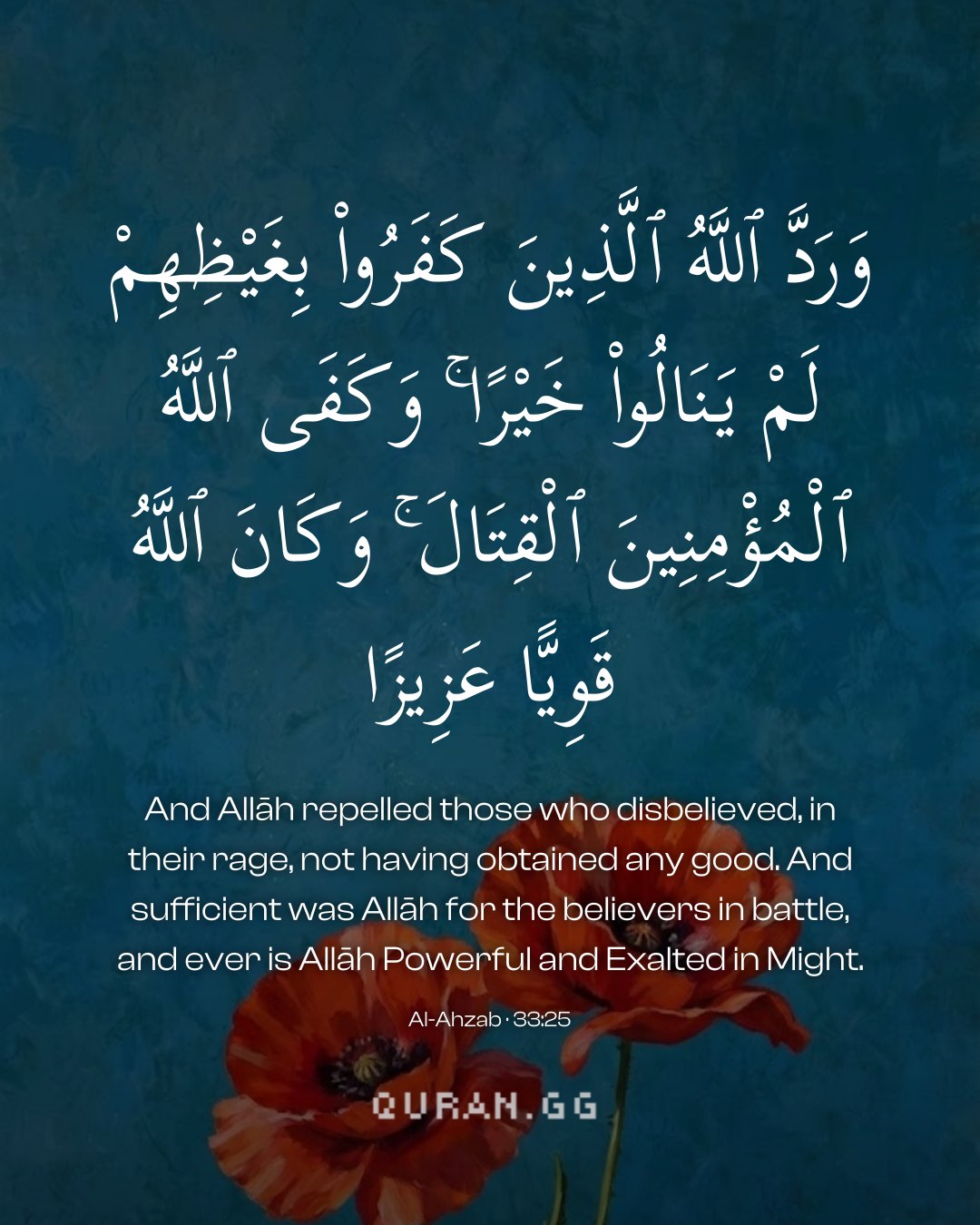
وَرَدَّ ٱللَّهُ ٱلَّذِينَ كَفَرُوا۟ بِغَيْظِهِمْ لَمْ يَنَالُوا۟ خَيْرًا ۚ وَكَفَى ٱللَّهُ ٱلْمُؤْمِنِينَ ٱلْقِتَالَ ۚ وَكَانَ ٱللَّهُ قَوِيًّا عَزِيزًا ٢٥

And Allāh repelled those who disbelieved, in their rage, not having obtained any good. And sufficient was Allāh for the believers in battle, and ever is Allāh Powerful and Exalted in Might.

Surah Al-Ahzab 33:25 in Arabic with its translation: “And Allāh repelled those who disbelieved, in their rage, not having obtained any good. And sufficient was…”

Make something with this ayah

Turn it into a video for Stories, Reels or TikTok, recited by the reciter you pick, or an image on a background you choose. Free, in your browser.

Download this image

Tafsir Ibn Kathir (abridged)

Allah drove back the Confederates disappointed and lost

Allah tells us how he drove the Confederates away from Al-Madinah by sending against them a wind and troops of angels. If Allah had not made his Messenger a Mercy to the Worlds, this wind would have been more severe than the barren wind which He sent against `Ad, but Allah says:

وَمَا كَانَ اللَّهُ لِيُعَذِّبَهُمْ وَأَنتَ فِيهِمْ

(And Allah would not punish them while you are amongst them) (8:33). So, Allah sent them a wind which dispersed them after they had gathered on the basis of their whims. They were a mixture of tribes and parties with a variety of opinions, so it was befitting that a wind should be sent against them that would scatter them and break up their gathering, driving them back disappointed and lost in their hatred and enmity. They did not achieve any worldly good such as the victory and booty that they had hoped for, nor did they achieve any good in the Hereafter, because of their sin of declaring enmity against the Messenger and seeking to kill him and destroy his army. Whoever wants and seriously intends to do a thing is the same as one who actually does it.

وَكَفَى اللَّهُ الْمُؤْمِنِينَ الْقِتَالَ

(Allah sufficed for the believers in the fighting.) means, they did not have to fight them in order to expel them from their land, but Allah Alone sufficed them and helped His servant and granted victory to His troops. Hence the Messenger of Allah ﷺ used to say,

«لَا إِلَهَ إِلَّا اللهُ وَحْدَهُ، صَدَقَ وَعْدَهُ، وَنَصَرَ عَبْدَهُ وَأَعَزَّ جُنْدَهُ، وَهَزَمَ الْأَحْزَابَ وَحْدَهُ، فَلَا شَيْءَ بَعْدَه»

(None has the right to be worshipped but Allah, Alone, He was true to His promise, and He helped His servant, and He gave might to His soldiers and defeated the Confederates alone and there is nothing after Him.) This was reported from a Hadith of Abu Hurayrah, may Allah be pleased with him. In the Two Sahihs it was recorded that `Abdullah bin Abi `Awfa, may Allah be pleased with him, said: "The Messenger of Allah ﷺ invoked Allah against the Confederates and said:

«اللَّهُمَّ مُنْزِلَ الْكِتَابِ سَرِيعَ الْحِسَابِ، اهْزِمِ الْأَحْزَابَ، اللَّهُمَّ اهْزِمْهُمْ وَزَلْزِلْهُم»

(O Allah, Who revealed the Book and is swift in bringing to account, defeat the Confederates, O Allah defeat them and shake them.)

وَكَفَى اللَّهُ الْمُؤْمِنِينَ الْقِتَالَ

(Allah sufficed for the believers in the fighting.) This Ayah indicates that there would be a cessation of war between them and Quraysh; after this, the idolators did not attack the Muslims, on the contrary, the Muslims attacked them in their own land. Imam Ahmad recorded that Sulayman bin Surad, may Allah be pleased with him, said: "On the day of Al-Ahzab, the Messenger of Allah ﷺ said:

«الْآنَ نَغْزُوهُمْ وَلَا يَغْزُونَا»

(Now we will attack them and they will not attack us.) This was also recorded by Al-Bukhari in his Sahih.

وَكَانَ اللَّهُ قَوِيّاً عَزِيزاً

(And Allah is Ever All-Strong, All-Mighty.) means, by His power and might He drove them back disappointed and lost, and they did not achieve anything, and Allah granted victory to Islam and its followers, and fulfilled His promise and helped His servant and Messenger; to Him be blessings and praise.

Ma'arif al-Qur'an

The second state mentioned here is that of the hypocrites for they had started saying that the promises of Allah and His Rasul ﷺ were a web of deception: إِذْ يَقُولُ الْمُنَافِقُونَ وَالَّذِينَ فِي قُلُوبِهِم مَّرَ‌ضٌ مَّا وَعَدَنَا اللَّـهُ وَرَ‌سُولُهُ إِلَّا غُرُ‌ورً‌ا (And (remember) when the hypocrites and those having malady in their hearts were saying, "Allah and His messenger did not promise us but deceitfully; -12). This was an externalized demonstration of their inner disbelief. Onward from here, mention has been made of two groups of hypocrites who were practically a part of the Jihad effort along with Muslims, though outwardly only. One of the two groups started running without any permission saying: وَإِذْ قَالَت طَّائِفَةٌ مِّنْهُمْ يَا أَهْلَ يَثْرِ‌بَ لَا مُقَامَ لَكُمْ فَارْ‌جِعُوا (and when a group of them said, "0 people of Yathrib (Madinah), there is no place for you to stay; so go back. - 13" And the other group requested the permission of the Holy Prophet ﷺ to go back on the basis of false excuses. Their conduct has been mentioned as: وَيَسْتَأْذِنُ فَرِ‌يقٌ مِّنْهُمُ النَّبِيَّ يَقُولُونَ إِنَّ بُيُوتَنَا عَوْرَ‌ةٌ (And a group of them was seeking permission (to leave) from the prophet, saying, "In fact our homes are vulnerable," while they were not vulnerable - 13). Thus, the Qur'an exposed the hollowness of their excuses as a pack of lies. The truth of the matter was no more than that they intended to run from the battlefront:إِن يُرِ‌يدُونَ إِلَّا فِرَ‌ارً‌ا (They wanted nothing but to escape - 13). Taken up in the next several verses is their mischief-making and enmity with Muslims following which their sad end has been pointed out.

Continue reading the tafsir of ayahs 13–27

Tazkirul Quran

The lives of the Prophet and his companions were of an exemplary, godly character and were meant to be followed by all the faithful till the Day of Judgement. They set an example to show what it means to seek God’s pleasure and merit success in the Hereafter; what is meant by remembering God; how to be steady and persevering in difficult times; how reliance is placed on the promises of God; what ever-increasing faith is and how it is achieved; and how to fulfill the vows taken before God. The Prophet and his companions set the final example in all these matters. Under the most difficult circumstances, they did not falter. They were the embodiment of Islamic thought and Islamic character in all matters. Before the arrival of the moment of trial, they were firm in their acceptance of Truth and even after the arrival of that moment they remained unwavering. Then, it was the life of the Prophet and his companions which set an example and showed that no decision was taken by God, unless one was put to the test. It is the way of God that He creates severe conditions so as to separate the truly faithful from the false claimants. In this Divine precept and practice, there was no exception earlier and neither will there be any exception in future.

Uthmani text of the Madinah mushaf (King Fahd Complex). Translation: Saheeh International. Tafsir via Quran.com.